Ditapis dengan

The new Asian hemisphere: The irresistible shift of global power to The East
For centuries, the Asians (Chinese, Indians, Muslims, and others) have been bystanders in world history. Now they are ready to become co-drivers. Asians have finally understood, absorbed, and implemented Western best practices in many areas: from free-market economics to modern science and technology, from meritocracy to rule of law. They have also become innovative in their own way, creating …
- Edisi
- -
- ISBN/ISSN
- 978-1-58648-466-8
- Deskripsi Fisik
- x, 314 pages : illustrations : index ; 21 cm
- Judul Seri
- -
- No. Panggil
- 327.5 Mah n

Indonesia-Portugal: Five hundred years of political relationship
This book gathers the proceedings of the International conference "Indonesia-Portugal: 500 years", gathering Portuguese and European historians to Indonesian historians from Java to Kalimantan. The book studies in-depth political, trade and cultural encounters from the first arrival of Portuguese to Indonesia, in 1512, up to the split between the two countries due to the East-Timor problem from…
- Edisi
- -
- ISBN/ISSN
- 9729879702
- Deskripsi Fisik
- 259 pages : illustrations ; 22 cm
- Judul Seri
- -
- No. Panggil
- 327.4690598 Sou i

The quest for identity: International relations of Southeast Asia
The book provides a wide-ranging discussion of the key themes in the international relations of Southeast Asia. These themes include the impact of super-power rivalry on the region; the relationship between insurgency, separatism and regional stability; the strengths and limitations of ASEAN's approach to regional order; conflict and conflict-management in Cambodia; the emergence and evolution …
- Edisi
- First Edition
- ISBN/ISSN
- 0-19-588709-3
- Deskripsi Fisik
- xxii, 204 pages ; 23 cm
- Judul Seri
- -
- No. Panggil
- 327.9598944 Mon d
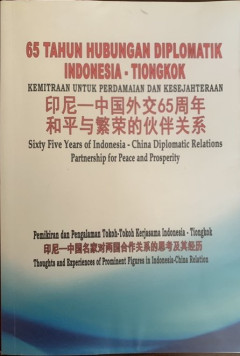
65 tahun hubungan diplomatik Indonesia-Tiongkok
Buku ini dibuat dalam rangka merajut hubungan diplomatik Indonesia dan China ke-26 tahun dengan maksud menyadap pemikiran dan pegalaman para pelaku sejarah dan tokoh - tokoh kebijakan luar negeri di Indonesia dan China terkait arah kerjasama Indonesia-China yang saat ini dihadapkan menjadi mitra strategis komprehensif.
- Edisi
- -
- ISBN/ISSN
- -
- Deskripsi Fisik
- 25 cm
- Judul Seri
- -
- No. Panggil
- 327.598031 Wah t
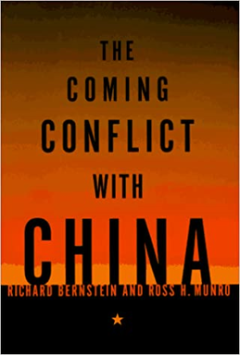
The coming conflict with China
Richard Bernstein and Ross Munro, former Beijing bureau chiefs with long experience in Asian affairs, present a clear-eyed and uncompromising look at the potentially disastrous collision course now taking shape in US-China relations
- Edisi
- First Edition
- ISBN/ISSN
- 0-679-45463-2
- Deskripsi Fisik
- xix, 245 pages : map : index ; 21 cm
- Judul Seri
- -
- No. Panggil
- 327.51073 Ber c
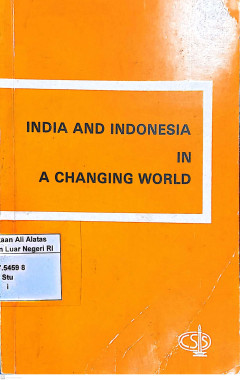
India and Indonesia in a changing world
Neither India nor Indonesia may yet be categorized as a super- power, rather, they are both developing countries within the total spectrum of nations in this single world. This reality can not be denied. However, even though neither of us are superpowers, both In- dia and Indonesia have definite roles to play in international relations. There can be no doubt that the roles of India and Indonesi…
- Edisi
- First Edition
- ISBN/ISSN
- -
- Deskripsi Fisik
- x, 131 pages ; 22 cm
- Judul Seri
- -
- No. Panggil
- 327.54598 Stu i
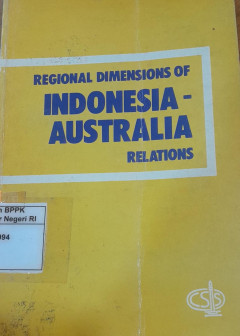
Regional dimensions of Indonesia-Australia relations
contains papers presented at a bilateral con- ference between Indonesians and Australians at the end of 1982. The Conference was sponsored by CSIS and the Department of Foreign Affairs of Australia
- Edisi
- -
- ISBN/ISSN
- -
- Deskripsi Fisik
- viii, 124 p. : ill. ; 22 cm
- Judul Seri
- -
- No. Panggil
- 327.598094 Ind r

Soft Power: The means to sucess in world politics
Joseph Nye coined the term "soft power" in the late 1980s. It is now used frequently - and often incorrectly - by political leaders, editorial writers, and academics around the world. So what is soft power? Soft power lies in the ability to attract and persuade. Whereas hard power - the ability to coerce - grows out of a country's military or economic might, soft power arises from the attractiv…
- Edisi
- -
- ISBN/ISSN
- 1586483064
- Deskripsi Fisik
- xvi, 191 pages : illustrations ; 22 cm
- Judul Seri
- -
- No. Panggil
- 327.73 Nye s
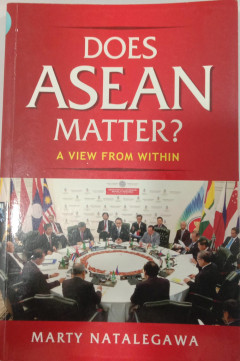
Does ASEAN Matter? A view From Within
Written by the highly regarded diplomat Marty Natalegawa, former ambassador and foreign minister of Indonesia , this book offers a unique insider-perspective on the present and future relevance of ASEAN.
- Edisi
- -
- ISBN/ISSN
- 9789814786744
- Deskripsi Fisik
- 258 pages;23 cm
- Judul Seri
- -
- No. Panggil
- 341.2473 Nat d
Asia-Pacific: a strategic assesment
Dr. David Lai provides a timely assessment of the geostrategic significance of Asia-Pacific. His monograph is also a thought-provoking analysis of the U.S. strategic shift toward the region and its implications. Dr. Lai judiciously offers the following key points. First, Asia-Pacific, which covers China, Northeast Asia, and Southeast Asia, is a region with complex currents. On the one hand, the…
- Edisi
- -
- ISBN/ISSN
- 1584875739
- Deskripsi Fisik
- 23 cm
- Judul Seri
- -
- No. Panggil
- 355. 07 Lai a
 Karya Umum
  Filsafat
  Agama
Agama  Ilmu-ilmu Sosial
  Bahasa
  Ilmu-ilmu Murni
  Ilmu-ilmu Terapan
  Kesenian, Hiburan, dan Olahraga
  Kesusastraan
  Geografi dan Sejarah