Ditapis dengan
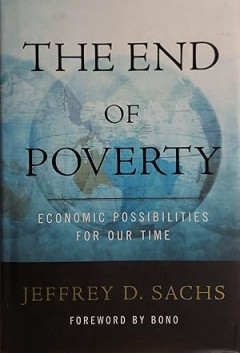
The end of poverty: Economic possibilities for our time
A respected international economic advisor and the director of The Earth Institute shares a wide-spectrum theory about how to enable economic success throughout the world, identifying the different categories into which various nations fall in today's economy while posing solutions to top political, environmental, and social problems that contribute to poverty.
- Edisi
- Cet. 1
- ISBN/ISSN
- 1-59420-045-9
- Deskripsi Fisik
- xviii, 396 pages : illustrations (black and white) ; 24 cm
- Judul Seri
- -
- No. Panggil
- 339.46 Sac e
The challenge to the south: The report of the south commission
This report provides a general introduction to the problems of development as seen by the developing country. It has been produced by the South Commission, which was established in 1987, with Julius Nyerere, President of Tanzania as its Chairman and Manmohan Sing as Secretary General. This report is a follow-up to the 1983 Brandt Commission Common North-South Co-operation for World Recovery. …
- Edisi
- -
- ISBN/ISSN
- 0-19-877311-0
- Deskripsi Fisik
- xv, 325 pages : illustrations ; 21 cm.
- Judul Seri
- -
- No. Panggil
- 338.9 Nye c

The impact of support for imports on food security in Indonesia
This study on the impact of import support on food security was conducted in eight developing countries – including Indonesia – that were facing food insecurity and were recipients of subsidized exports and food aid. In Indonesia, the analysis of import flows in comparison with overall production and consumption data led to the selection of the three import substitute commodities, soybean, …
- Edisi
- -
- ISBN/ISSN
- 978-979-9317-69-8
- Deskripsi Fisik
- xii, 58 pages ; 24 cm
- Judul Seri
- -
- No. Panggil
- 353.997 Rus i

The pentagon's new map: War and peace in the twenty-first century
Contents: 1. New rule sets 2. The rise of the "lesser includeds" 3. Disconnectedness defines danger 4. The core and the gap 5. The new ordering principle etc.
- Edisi
- -
- ISBN/ISSN
- 0-399-15175-3
- Deskripsi Fisik
- 435 pages ; 23 cm
- Judul Seri
- -
- No. Panggil
- 355.033 Bar p
International monetary cooperation since Bretton Woods
This comprehensive history, published jointly by the IMF and Oxford University Press, was written to mark the fiftieth anniversary of international monetary cooperation. From the establishment of the postwar international monetary system in 1944 to how the framework functions in a vastly expanded world economy, historian Harol James describes the tensions, negotiations, challenges, and progress…
- Edisi
- -
- ISBN/ISSN
- 0-19-510448-X
- Deskripsi Fisik
- xvi, 742 pages : illustrations (black and white) ; 24 cm
- Judul Seri
- -
- No. Panggil
- 332.042 Jam i
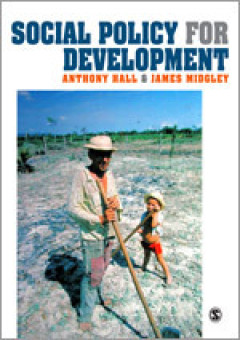
Social policy for development
Strong social policy is essential for sustainable growth. This book is an extremely useful overview of social policy issue for policy makers and anyone who wants to understand the true roots of successful sustainable development. Contents: 1. Social policy for development : Local, national and global dimensions 2. Poverty, inequality and development: The challenge for social policy 3. Soci…
- Edisi
- -
- ISBN/ISSN
- 0-7619-6715-X
- Deskripsi Fisik
- XV, 288 pages ; 24 cm
- Judul Seri
- -
- No. Panggil
- 361.1 Hal s
Remaking economic policy: New Zealand and Australian
During the 1980s and early 1990s, Australia and New Zealand extensively deregulated their economies to create two of the most open markets in the industrialized world. Drawing on interviews with more than 180 leading policymakers in Australia and New Zealand—including former prime ministers, ministers of finance, treasurers, and public servants—Shaun Goldfinch analyzes the factors that made…
- Edisi
- Cet. 1
- ISBN/ISSN
- 0-86473-393-3
- Deskripsi Fisik
- 295 pages : illustrations (black and white) ; 23 cm
- Judul Seri
- -
- No. Panggil
- 343.07 Gol r

Natural capitalism: Creating the next industrial revolution
Contents: 1. The next industrial revolution 2. Reinventing the wheels: Hypercars and neighborhoods 3. Waste not 4. Making the world 5. Building blocks 6. Tunneling through the cost barrier etc.
- Edisi
- Ed. 1
- ISBN/ISSN
- 0-316-35316-7
- Deskripsi Fisik
- xix, 396 pages : illustrations (black and white) ; 24 cm
- Judul Seri
- -
- No. Panggil
- 338.973 Haw n
The end of oil: On the edge of a perilous new world
Contents: Part 1: The free ride 1. Lighting the fire 2. The last of the easy oil 3. The future's so bright 4. Energy is power 5. Too hot Part II: On the road to nowhere Part III: Into the blue etc.
- Edisi
- -
- ISBN/ISSN
- 0-618-56211-7
- Deskripsi Fisik
- 399 pages ; 21 cm
- Judul Seri
- -
- No. Panggil
- 333.79 Rob e

Price, principle, and the environment
Demonstrating the contribution of economics to environmental policy, Mark Sagoff argues that economics is helpful in designing institutions and processes through which people can settle environmental disputes. However, Sagoff also reveals that economic analysis fails completely when it attempts to attach value to environmental goods. He concludes that environmental policy responds to principles…
- Edisi
- -
- ISBN/ISSN
- 0-521-54596-X
- Deskripsi Fisik
- x, 284 pages ; 23 cm
- Judul Seri
- -
- No. Panggil
- 333.7 Sag p
 Karya Umum
 Filsafat
 Agama
 Ilmu-ilmu Sosial
 Bahasa
 Ilmu-ilmu Murni
 Ilmu-ilmu Terapan
 Kesenian, Hiburan, dan Olahraga
 Kesusastraan
 Geografi dan Sejarah