Ditapis dengan

Foreign relations of the United States, 1951: Volume V, the near East and Africa
This volume of the “Foreign Relations of the United States” series documents U.S. diplomatic activities and foreign policy decisions concerning the Near East and Africa during the year 1951. Compiled by the Office of the Historian, it presents declassified correspondence, policy papers, and internal communications that illustrate America’s strategic interests in the region during the earl…
- Edisi
- -
- ISBN/ISSN
- -
- Deskripsi Fisik
- xxxv pages ; 23,5 cm
- Judul Seri
- -
- No. Panggil
- 327.73 SLA f
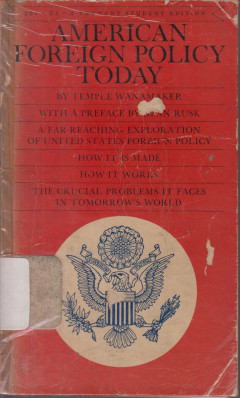
American foreign policy today
This book provides an overview of the principles, goals, and challenges of United States foreign policy during the mid-twentieth century. Written by Temple Wanamaker with a preface by then–Secretary of State Dean Rusk, it analyzes America’s international role in the context of Cold War tensions, global diplomacy, and emerging political shifts in Asia, Africa, and Latin America. The text dis…
- Edisi
- -
- ISBN/ISSN
- -
- Deskripsi Fisik
- 250 pages ; 18 cm
- Judul Seri
- -
- No. Panggil
- 327.73 WAN a
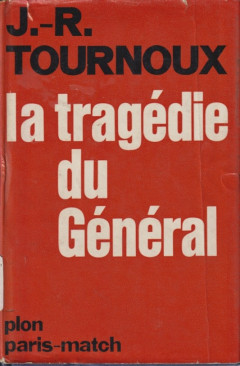
La tragédie du général
This book is an investigative work by J.-R. Tournoux, examining the life, political role, and conflicts surrounding a key general in modern French history. Using a documentary approach, Tournoux explores the political events, intrigues, and personal tragedies that shaped his journey. This book presents an in-depth look at the dynamics of power in 20th-century France, written by one of France's …
- Edisi
- -
- ISBN/ISSN
- -
- Deskripsi Fisik
- 697 pages ; 21 cm
- Judul Seri
- -
- No. Panggil
- 944.081 TOU l

America right or wrong: An Anatomy of American nationalism
America Right or Wrong offers a critical examination of American nationalism and its influence on U.S. domestic and foreign policy. Anatol Lieven analyzes the cultural, political, and historical roots of American national identity, highlighting how different strands of nationalism—both civic and ideological—shape America’s worldview and global actions. The book explores the impact of nati…
- Edisi
- -
- ISBN/ISSN
- 978-0-19-984162-2
- Deskripsi Fisik
- x, 297 pages ; 23,5 cm
- Judul Seri
- -
- No. Panggil
- 320.54 LIE a

A Bird’s-eye view of French history
This book presents a concise yet comprehensive overview of French history, written by historian René Sédillot and translated into English by Gerard Hopkins. Using an easy-to-follow narrative approach, the book traces the political, social, and cultural development of France from early times to the modern era. Its concise and systematic presentation provides a comprehensive understanding for r…
- Edisi
- -
- ISBN/ISSN
- -
- Deskripsi Fisik
- 336 pages : illustration ; 20 cm
- Judul Seri
- -
- No. Panggil
- 944 SED b
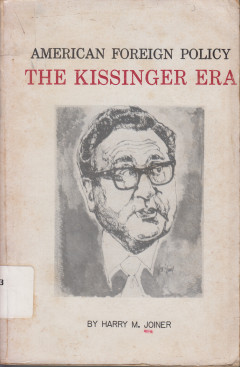
American foreign policy: The Kissinger era
American Foreign Policy: The Kissinger Era provides an analytical overview of the United States’ foreign policy during the period in which Henry Kissinger played a dominant role as National Security Advisor and Secretary of State. The book explores Kissinger’s strategic doctrines, diplomatic negotiations, and the geopolitical challenges of the Cold War. It examines the principles guiding U.…
- Edisi
- -
- ISBN/ISSN
- 87397-126-4
- Deskripsi Fisik
- 308 pages ; 23 cm
- Judul Seri
- -
- No. Panggil
- 327.73 JOI a

Let us live in peace and friendship: The Visit of N. S. Khrushchov to the U.S…
This publication documents the historic visit of Soviet Premier Nikita S. Khrushchev to the United States from September 15 to 27, 1959, during a critical phase of the Cold War. The booklet presents speeches, statements, meetings, and public appearances made throughout his tour, emphasizing the Soviet Union’s call for peaceful coexistence and improved international relations. It highlights di…
- Edisi
- -
- ISBN/ISSN
- -
- Deskripsi Fisik
- 404 pages : illustrations ; 21 cm
- Judul Seri
- -
- No. Panggil
- 327.172 KHR l

Mixed messages: American politics and international organization 1919–1999
Mixed Messages explores the complex relationship between the United States and major international organizations from the end of World War I through the end of the twentieth century. Edward C. Luck analyzes how American domestic politics, shifting national interests, and public opinion have shaped U.S. engagement with institutions such as the League of Nations and the United Nations. The book h…
- Edisi
- -
- ISBN/ISSN
- 0-8157-5308-X
- Deskripsi Fisik
- xvi, 374 pages ; 23 cm
- Judul Seri
- -
- No. Panggil
- 341.23 LUC m

An End to al-qaeda: Destroying bin Laden’s Jihad and restoring America’s …
An End to al-Qaeda presents intelligence expert Malcolm Nance’s strategic analysis of the global jihadist movement led by Osama bin Laden and the methods required to defeat it. Drawing from decades of counterterrorism experience, Nance explains the origins, ideology, and operational structure of al-Qaeda, revealing how the group exploits global conflicts and political narratives. He argues th…
- Edisi
- -
- ISBN/ISSN
- 978-0-312-59249-3
- Deskripsi Fisik
- viii, 296 pages ; 25 cm
- Judul Seri
- -
- No. Panggil
- 363.325 NAN e

Tell me how this ends: General David Petraeus and the search for a way out of…
Tell Me How This Ends provides an in-depth examination of General David Petraeus and his central role in reshaping U.S. military strategy during the Iraq War. Linda Robinson offers a detailed narrative of the development and implementation of the 2007 “surge,” exploring the challenges, political dynamics, and military operations that aimed to stabilize Iraq during one of its most turbulent …
- Edisi
- -
- ISBN/ISSN
- 978-1-58648-528-3
- Deskripsi Fisik
- xviii, 410 pages : illustrations ; 24,5 cm
- Judul Seri
- -
- No. Panggil
- 956.70443 ROB t
 Karya Umum
 Filsafat
 Agama
 Ilmu-ilmu Sosial
 Bahasa
 Ilmu-ilmu Murni
 Ilmu-ilmu Terapan
 Kesenian, Hiburan, dan Olahraga
 Kesusastraan
 Geografi dan Sejarah