Ditapis dengan

The Road to Tahrir square: Egypt and the United States from the rise of Nasse…
The Road to Tahrir Square chronicles the complex and often turbulent relationship between Egypt and the United States from the 1950s to the early 2010s. Lloyd C. Gardner traces how successive American administrations engaged with Egyptian leaders—from Gamal Abdel Nasser through Anwar Sadat to Hosni Mubarak—shaping the political trajectory of the Middle East’s most influential nation. The …
- Edisi
- -
- ISBN/ISSN
- 978-1-59558-721-3
- Deskripsi Fisik
- x, 230 pages ; 21 cm
- Judul Seri
- -
- No. Panggil
- 327.73062 GAR r

The War on our freedoms: Civil liberties in an age of terrorism
The War on Our Freedoms is a collection of essays examining the impact of U.S. government policies on civil liberties following the attacks of September 11, 2001. Edited by Richard C. Leone and Greg Anrig, Jr., the book presents analyses by legal experts, journalists, and academics on major changes in law enforcement, national security, and privacy protections. The authors critique the expansio…
- Edisi
- -
- ISBN/ISSN
- 1-58648-210-6
- Deskripsi Fisik
- xi, 317 pages ; 21 cm
- Judul Seri
- -
- No. Panggil
- 323.0973 LEO w
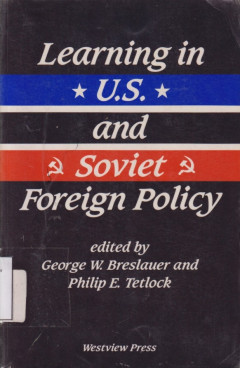
Learning in U.S. and Soviet foreign policy
This volume examines how political leaders and institutions in the United States and the Soviet Union learn from past experiences in shaping their foreign policy decisions. Through comparative case studies, the contributors analyze the cognitive, organizational, and political factors that influence learning in both superpowers during the Cold War era. The book explores how successes and failure…
- Edisi
- -
- ISBN/ISSN
- 0-8133-8264-5
- Deskripsi Fisik
- xiv, 881 pages ; 23 cm
- Judul Seri
- -
- No. Panggil
- 327.730 BRE l

The Great crash ahead: Strategies for a world turned upside down
This book presents Harry S. Dent Jr.’s predictions of a looming major economic downturn based on demographic, financial, and market-cycle analysis. Dent argues that structural shifts in consumer spending, aging populations, and excessive debt will trigger a global economic crash and reshape financial markets. The book provides strategic guidance for investors and individuals seeking to naviga…
- Edisi
- -
- ISBN/ISSN
- -
- Deskripsi Fisik
- xvi, 341 pages : illustration ; 23,5 cm
- Judul Seri
- -
- No. Panggil
- 330.973 DEN g

Failed states: The Abuse of power and the assault on democracy
In this book, Noam Chomsky argues that the United States increasingly exhibits the characteristics of a “failed state”—one that disregards international law, undermines democratic principles, and relies on military force to pursue global dominance. Chomsky examines U.S. foreign policy after 2001, focusing on unilateral actions, the Iraq War, counterterrorism strategies, and the erosion of…
- Edisi
- -
- ISBN/ISSN
- 978-0-8050-7912-8
- Deskripsi Fisik
- 311 pages ; 24 cm
- Judul Seri
- -
- No. Panggil
- 327.73 CHO f
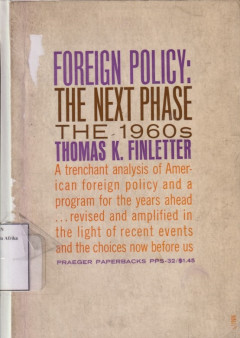
Foreign policy: The Next phase — the 1960s
This book examines the challenges and strategic choices facing United States foreign policy as the nation entered the 1960s. Finletter discusses the political, military, and economic factors shaping America’s role in the postwar world, emphasizing the need for new approaches to emerging Cold War realities. The work analyzes key issues including nuclear strategy, international alliances, and t…
- Edisi
- -
- ISBN/ISSN
- -
- Deskripsi Fisik
- 235 pages ; 20 cm
- Judul Seri
- -
- No. Panggil
- 327.73 FIN f
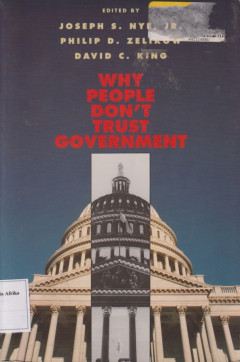
Why people don’t trust government
This volume explores the declining public trust in government within the United States, analyzing its causes, consequences, and implications for democratic governance. Edited by Joseph S. Nye Jr., Philip D. Zelikow, and David C. King, the book brings together leading scholars who examine political participation, public opinion, political culture, and the growing sense of alienation among citize…
- Edisi
- -
- ISBN/ISSN
- 0-674-94057-1
- Deskripsi Fisik
- xi, 339 pages ; 23,5 cm
- Judul Seri
- -
- No. Panggil
- 306.209 NYE w
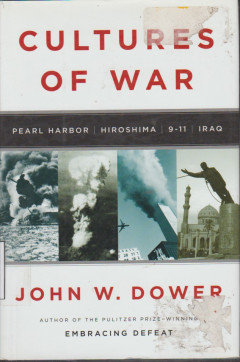
Cultures of war: Pearl Harbor / Hiroshima / 9-11 / Iraq
Cultures of War explores how nations justify, experience, and remember war through four pivotal events: the attack on Pearl Harbor, the bombing of Hiroshima, the September 11 attacks, and the 2003 invasion of Iraq. John W. Dower examines recurring patterns in U.S. strategic thinking, political rhetoric, and cultural responses to conflict. Through comparative historical analysis, Dower reveals h…
- Edisi
- -
- ISBN/ISSN
- 978-0-393-06150-5
- Deskripsi Fisik
- xxxvii, 396 pages : illustration ; 24,5 cm
- Judul Seri
- -
- No. Panggil
- 355.00973 DOW c
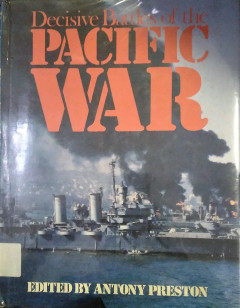
Decisive battles of the pacific war
"Decisive Battles of the Pacific War" is a comprehensive illustrated work edited by military historian Antony Preston, presenting key battles that shaped the outcome of the Second World War in the Pacific theater. The book examines major engagements between Allied and Japanese forces, analyzing strategies, naval clashes, amphibious assaults, and turning points from Pearl Harbor to the final sta…
- Edisi
- -
- ISBN/ISSN
- 0-89009-293-1
- Deskripsi Fisik
- 192 pages : illustration ; 30 cm
- Judul Seri
- -
- No. Panggil
- 940.5426 PRE d

The United states and world war II
This book provides a comprehensive analysis of the United States' involvement in World War II, exploring political, military, economic, and social dimensions of the conflict. Robert James Maddox examines America's path to war, the strategic decisions that shaped military operations, domestic mobilization, wartime diplomacy, and the broader international consequences of U.S. participation. Desig…
- Edisi
- -
- ISBN/ISSN
- 0-8133-0437-7
- Deskripsi Fisik
- ix, pages : illustration ; 23 cm
- Judul Seri
- -
- No. Panggil
- 940.53 MAD u
 Karya Umum
  Filsafat
  Agama
Agama  Ilmu-ilmu Sosial
  Bahasa
  Ilmu-ilmu Murni
  Ilmu-ilmu Terapan
  Kesenian, Hiburan, dan Olahraga
  Kesusastraan
  Geografi dan Sejarah