Ditapis dengan

Southeast Asia: Problems of United States policy
This book examines the major issues faced by the United States in formulating its policy toward Southeast Asia during the early Cold War period. Edited by William Henderson, it analyzes political, economic, and security considerations that shaped American involvement in the region. Through contributions by subject-matter experts, the volume explores regional dynamics, nationalist movements, the…
- Edisi
- -
- ISBN/ISSN
- -
- Deskripsi Fisik
- xiv, 273 pages ; 21 cm
- Judul Seri
- -
- No. Panggil
- 327.59 HEN s

The Arab world
The Arab World by William R. Polk provides a comprehensive overview of the history, politics, and cultural foundations of the Arab region. This fourth edition expands earlier work published under the title The United States and the Arab World. Polk examines the political evolution of Arab countries, their relations with major world powers—especially the United States—and the internal and ex…
- Edisi
- -
- ISBN/ISSN
- 0-674-04317-0
- Deskripsi Fisik
- xxix, 456 pages : illustration ; 23,5 cm
- Judul Seri
- -
- No. Panggil
- 327.73017 POL a

The League of Arab States and regional disputes
This book examines the role of the League of Arab States in managing and responding to regional disputes within the Arab world. Hussein A. Hassouna analyzes the League’s legal foundations, institutional structure, and political functions, highlighting its efforts to address inter-Arab conflicts and promote regional stability. The study evaluates the effectiveness of the League’s dispute-set…
- Edisi
- -
- ISBN/ISSN
- 0-379-00290-4
- Deskripsi Fisik
- xxi, 512 pages ; 24 cm
- Judul Seri
- -
- No. Panggil
- 341.2477 HAS l

The Anglo-American threat to Albania : Memoirs of the national liberation war
The Anglo-American Threat to Albania by Enver Hoxha, First Secretary of the Central Committee of the Party of Labour of Albania, reflects events he lived through, his personal impressions, and gives conclusions, which provide lessons for all periods, drawn from the hostile activity carried out openly or behind the scenes by the Anglo Bourgeois attempts to put Albania under its imperialistic swa…
- Edisi
- -
- ISBN/ISSN
- -
- Deskripsi Fisik
- 446 pages, 20 x 14 cm
- Judul Seri
- -
- No. Panggil
- 973 HOX t

The Age of turbulence: Adventures in a new world
This memoir by Alan Greenspan, former Chairman of the Federal Reserve, offers an in-depth reflection on his personal journey, professional career, and the evolution of the global economy. Through historical insights and analytical commentary, Greenspan discusses major economic events, policy challenges, and the forces that shaped the modern financial world. The book provides both an autobiograp…
- Edisi
- -
- ISBN/ISSN
- 978-1-59420-131-8
- Deskripsi Fisik
- 531 pages : illustration ; 24 cm
- Judul Seri
- -
- No. Panggil
- 920 GRE a
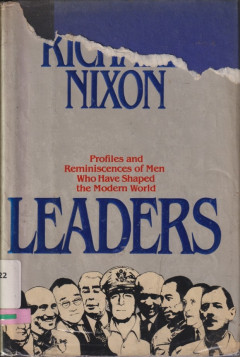
Leaders
In this reflective work, former U.S. President Richard Nixon offers his insights on global leadership through a series of biographical portraits and personal evaluations of major world figures. Drawing from his extensive experience in international politics and diplomacy, Nixon analyzes the qualities, decisions, and historical moments that shaped the leaders who influenced the 20th century. The…
- Edisi
- -
- ISBN/ISSN
- 0-446-51249-4
- Deskripsi Fisik
- 371 pages : illustration ; 23,5 cm
- Judul Seri
- -
- No. Panggil
- 909.82 NIX l

Cold war captives: Imprisonment, escape, and brainwashing
This book examines the ways imprisonment, escape, and the notion of “brainwashing” shaped American cultural and political perceptions during the Cold War. Susan L. Carruthers explores how captivity narratives, political prisoners, defections, and repatriation stories were represented in media, motion pictures, literature, and popular culture. Through historical documentation and cultural an…
- Edisi
- -
- ISBN/ISSN
- 978-0-520-25730-6
- Deskripsi Fisik
- xiii, 335 pages : illustration ; 23 cm
- Judul Seri
- -
- No. Panggil
- 909.825 CAR c

Anti-Americanisms in world politics
This volume examines the diverse forms, sources, and political consequences of anti-Americanism across different regions of the world. Bringing together leading scholars, it analyzes how perceptions of the United States are shaped by historical experiences, foreign policy actions, ideological differences, and global power dynamics. The book explores variations of anti-American attitudes, rangin…
- Edisi
- -
- ISBN/ISSN
- 978-0-8014-4517-0
- Deskripsi Fisik
- xii, 351 pages ; 23,5 cm
- Judul Seri
- -
- No. Panggil
- 303.48 KAT a

The New egalitarianism : Questions and challenges
The New Egalitarianism explores the rise of modern egalitarian theories and their impact on political and social life in the United States. Edited by David Lewis Schaefer, the book compiles essays that critically examine issues such as civil rights, affirmative action, equality, social justice, and the evolving nature of political thought. Through a series of scholarly analyses, the contributor…
- Edisi
- -
- ISBN/ISSN
- 0-8046-9220-3
- Deskripsi Fisik
- 248 pages ; 22,5 cm
- Judul Seri
- -
- No. Panggil
- 323.4 SCH n

Political culture and political change in communist states
This edited volume explores the dynamics of political culture and the processes of political change within communist states during the mid-20th century. Featuring contributions from leading scholars, the book examines ideology, state structures, leadership patterns, social mobilization, and internal transformations across various communist regimes. Through comparative analysis, it highlights bo…
- Edisi
- -
- ISBN/ISSN
- 0-8419-0289-5
- Deskripsi Fisik
- xiii, 286 pages ; 22 cm
- Judul Seri
- -
- No. Panggil
- 320.532 BRO p
 Karya Umum
  Filsafat
  Agama
Agama  Ilmu-ilmu Sosial
  Bahasa
  Ilmu-ilmu Murni
  Ilmu-ilmu Terapan
  Kesenian, Hiburan, dan Olahraga
  Kesusastraan
  Geografi dan Sejarah