Ditapis dengan

American insurgents American patriots
American Insurgents, American Patriots examines the grassroots movements that shaped the early stages of the American Revolution. T. H. Breen argues that the Revolution was driven not only by founding elites but also by ordinary colonists who organized local committees, enforced boycotts, and challenged British authority. Through detailed analysis of political mobilization, community networks, …
- Edisi
- -
- ISBN/ISSN
- 978-0-8090-7588-1
- Deskripsi Fisik
- 337 pages, 24 x 16 cm
- Judul Seri
- -
- No. Panggil
- 973 BRE a
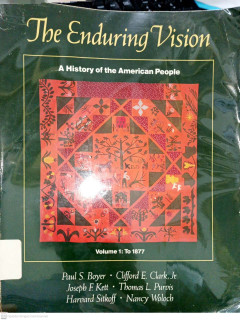
The Enduring vision: A History of the American people volume 1: to 1877
The Enduring Vision: A History of the American People, Volume 1, provides a comprehensive narrative of the development of the United States from pre-Columbian societies through the end of Reconstruction in 1877. Emphasizing social, cultural, political, and economic forces, the authors explore the diverse experiences that shaped the early American nation. This volume highlights Native American s…
- Edisi
- -
- ISBN/ISSN
- 0-669-09799-3
- Deskripsi Fisik
- il, 563 pages : illustrations ; 25,5 cm
- Judul Seri
- -
- No. Panggil
- 973 BOY e

The Free and the unfree: A New history of the United States
Although European expansion was the driving force that first opened up the frontier land called America, the growth of the new nation would be forged over the centuries by the diverse peoples who struggled to make it their home. But not everyone who made a home in the country was accepted as an American. When the democratic, humanitarian principles were retested by the native Americans, blacks,…
- Edisi
- -
- ISBN/ISSN
- 0-1402-2088-0
- Deskripsi Fisik
- 448 pages, 20 x 13 cm
- Judul Seri
- -
- No. Panggil
- 973 CAR f

Conflict and consensus in early American history
This book presents a comprehensive collection of essays exploring the major themes, debates, and interpretations in early American history. Edited by Allen F. Davis and Harold D. Woodman, the volume examines the political, social, cultural, and ideological developments that shaped the United States from its colonial foundations to the early republic. Through diverse scholarly perspectives, the …
- Edisi
- Sixth Edition
- ISBN/ISSN
- 0-669-06751-2
- Deskripsi Fisik
- xxviii, 496 pages ; 23,5 cm
- Judul Seri
- -
- No. Panggil
- 973 DAV c

The Americans: A history
The Americans: A History provides a comprehensive survey of the historical development of the United States, written by Winthrop D. Jordan, Miriam Greenblatt, and John S. Bowes. The book covers key political, social, cultural, and economic events from the nation’s early beginnings through its modern evolution. Designed as an educational text, it places strong emphasis on social history, every…
- Edisi
- -
- ISBN/ISSN
- 0-8123-7641-2
- Deskripsi Fisik
- xxv, 1062 pages ; 26 cm
- Judul Seri
- -
- No. Panggil
- 973 JOR a

United States history
This book provides an introductory survey of United States history up to the year 1877, designed for undergraduate coursework at the University of Houston. It covers major political, social, economic, and cultural developments from the colonial era through the Civil War and Reconstruction. The volume compiles selected materials prepared specifically for instructional use, offering students a fo…
- Edisi
- -
- ISBN/ISSN
- 978-0-536-55640-0
- Deskripsi Fisik
- viii, 355 pages ; 21,5 cm
- Judul Seri
- -
- No. Panggil
- 973 HOP u

48 liberal lies about American history: (that you probably learned in school)
This book presents a critical examination of widely accepted narratives in American history that the author argues have been shaped by liberal ideology. Larry Schweikart challenges forty-eight commonly taught historical interpretations, offering counterarguments based on alternative evidence and perspectives. Covering political, social, and cultural themes, the book aims to correct misconceptio…
- Edisi
- -
- ISBN/ISSN
- 978-1-59523-056-0
- Deskripsi Fisik
- xv, 316 pages ; 24 cm
- Judul Seri
- -
- No. Panggil
- 973 SCH f
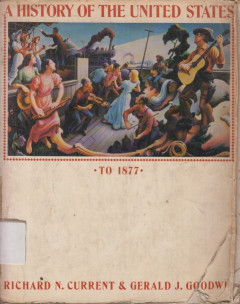
A History of the United States: To 1877
This volume provides a comprehensive historical overview of the United States from its earliest colonial foundations to the year 1877. It examines major political, social, and economic developments that shaped the nation, including colonial settlement, independence, the formation of the federal government, territorial expansion, and the Civil War era. Written by leading historians Richard N. Cu…
- Edisi
- -
- ISBN/ISSN
- 0-394-32301-7
- Deskripsi Fisik
- xvi, 428 pages : illustrations ; 23,5 cm
- Judul Seri
- -
- No. Panggil
- 973 CUR h
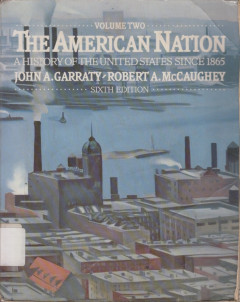
The American nation: A History of the United States since 1865
The American Nation: A History of the United States Since 1865, Volume Two provides a comprehensive examination of the political, social, and economic developments in the United States after the Civil War. This volume focuses on the Reconstruction era, the rise of industrialization, westward expansion, immigration, urbanization, and the transformation of American society into a modern nation-st…
- Edisi
- Second Edition
- ISBN/ISSN
- 0-06-042297-1
- Deskripsi Fisik
- xix, 972 pages : illustrations ; 25,5 cm
- Judul Seri
- -
- No. Panggil
- 973 GAR a
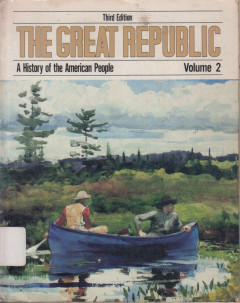
The Great republic: A History of the American people, volume 2
This volume of The Great Republic provides a comprehensive survey of American history from the Reconstruction era through the rise of modern America. Written by leading historians Frank Freidel, Richard N. Current, T. Harry Williams, and Alan Brinkley, the book explores political developments, social transformations, economic expansion, and cultural change in the United States. As part of a wid…
- Edisi
- -
- ISBN/ISSN
- 0-669-91390-4
- Deskripsi Fisik
- xlviii, 869 pages : illustrations ; 25,5 cm
- Judul Seri
- -
- No. Panggil
- 973 FRE g
 Karya Umum
  Filsafat
  Agama
Agama  Ilmu-ilmu Sosial
  Bahasa
  Ilmu-ilmu Murni
  Ilmu-ilmu Terapan
  Kesenian, Hiburan, dan Olahraga
  Kesusastraan
  Geografi dan Sejarah