Ditapis dengan
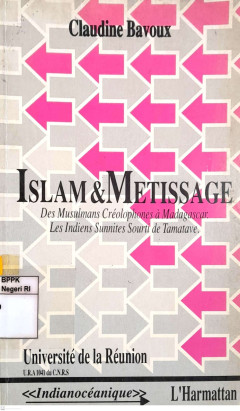
Islam & métissage: Des musulmans créolophones à Madagascar: Les Indiens su…
The work sets the general, historical and social framework in which the Malagasy adventure of a “foreign minority” took place. This book will in fact be about a Sunni Muslim community in Madagascar (a minority compared to the Khodja Shiites), a Creole-speaking community of some six hundred people established for more than a hundred years in Tamatave, the country's first port, capital of the…
- Edisi
- -
- ISBN/ISSN
- 2-7384-0748-X
- Deskripsi Fisik
- 137 pages : illustrations : map : bibl: hlm 127-133 : index ; 24 cm
- Judul Seri
- -
- No. Panggil
- 305.89147 Bav i
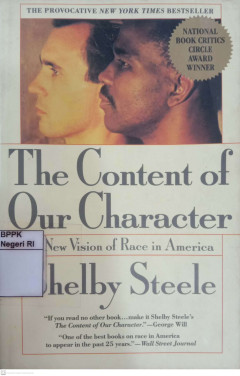
The content of our character: A new vision of race in America
Steele illuminates the origins of the conflict in race relations today--the increase in anger, mistrust, and even violence between blacks and whites. With candid and persuasive arguments, he shows us how both black and white Americans have become trapped into seeing color before character, and how social policies designed to lessen racial differences have instead made them greater. The Content …
- Edisi
- -
- ISBN/ISSN
- 006097415X
- Deskripsi Fisik
- xii, 175 pages ; 22 cm
- Judul Seri
- -
- No. Panggil
- 305.8 Ste c

Computing myths, class realities: An ethnography of technology and working pe…
Computing Myths, Class Realities is about the extensive change-on the job, where people live, in social relations-taking place in contemporary societies. The book examines whether this social change is caused by the introduction of computer-based new technology or "computerization." To answer this question, computerization is examined culturally, through the holistic approach of anthropology.
- Edisi
- -
- ISBN/ISSN
- 0-8133-8135-5
- Deskripsi Fisik
- xiii, 251 pages : bibl: 241-250 ; 21 cm
- Judul Seri
- -
- No. Panggil
- 305.5620942821 Hak c

The great divide: Unequal societies and what we can about them
This book is mostly about the economics of inequality. In various essays in this volume, Stiglitz describing the nexus between politics and economics: the vicious circle by which more economic inequality gets translated into political inequality, especially in America's political system, which gives such unbridled power to money.
- Edisi
- First Edition
- ISBN/ISSN
- 978-0-393-24857-9
- Deskripsi Fisik
- xxvi, 428 pages ; 24 cm
- Judul Seri
- -
- No. Panggil
- 305.50973 Sti g

Islam and the cultural accommodation of social change
The author's thesis "Crisis of Modern Islam" is taken in new directions in this book. He provides a critique of Islam as a cultural system, arguing that cultural patterns within Islam - especially in the areas of law, language and education - retard its capacity to accommodate rapid social change. Exploring the links between culture and religion, Tibi perceives the resurgence of Islamic fundame…
- Edisi
- Cetakan Kedua
- ISBN/ISSN
- 0-8133-8437-0
- Deskripsi Fisik
- xiv, 272 pages : bibl: hlm 243-262 : index ; 23 cm
- Judul Seri
- -
- No. Panggil
- 306.697 Tib i

Surveillance after September 11
The aftermath of terrorist attacks on September 11 2001 includes widespread tightening of surveillance. The responses are a prism that puts several things in perspective. One, it is premature to see decentralised and commercial surveillance simply supplanting nation-state power. Rather, the nation-state now draws upon an augmented surveillant assemblage for its own purposes. Two, reliance on hi…
- Edisi
- First Published
- ISBN/ISSN
- 0-7456-3181-9
- Deskripsi Fisik
- viii, 197 pages : index ; 19 cm
- Judul Seri
- -
- No. Panggil
- 303.33 Lyo s
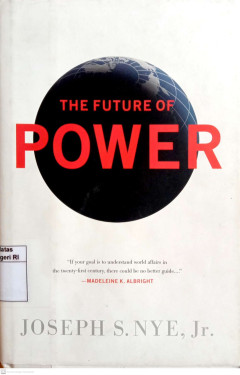
The future of power
In The Future of Power, Joseph S. Nye, Jr., a longtime analyst of power and a hands-on practitioner in government, delivers a new power narrative that considers the shifts, innovations, bold technologies, and new relationships that will define the twenty-first century. He shows how power resources are adapting to the digital age and how smart power strategies must include more than a country's …
- Edisi
- Ed.1
- ISBN/ISSN
- 978-1-58648-891-8
- Deskripsi Fisik
- xviii, 300 pages : Index ; 24 cm
- Judul Seri
- -
- No. Panggil
- 303.3 Nye f

Global outrage: The impact of world opinion on contemporary history
Longer pieces then started appearing, and more recently books. What almost all of this analysis and imagining revealed was a sense not only that one historical era had ended, but that some- thing of truly epic significance had occurred which would affect the human international political consciousness with the same impact as the dropping of the atomic bombs, the First World War or the Thirty Ye…
- Edisi
- -
- ISBN/ISSN
- 1-85168-364-X
- Deskripsi Fisik
- viii, 245 pages : index ; 22 cm
- Judul Seri
- -
- No. Panggil
- 303 Ste g

Future search: An action guide to finding common ground in organizations and …
Future Search explores a highly successful new many for enabling diverse people with a stake in an organization or community to plan their own future. This event brings a "whole system" into the room to explore participants past, present, and desired future as a back-drop to action planning.
- Edisi
- First Edition
- ISBN/ISSN
- 1881052125
- Deskripsi Fisik
- xvi, 219 pages : Ilustration : bibl: hlm 203-205 : index ; 23 cm
- Judul Seri
- -
- No. Panggil
- 302.35 Wei f

The role of social capital in development: An empirical assessment
It is based on a large volume of collected data, relying equally on quantitative and qualitative research methodologies to establish approaches for measuring social capital and its impact. The book documents the pervasive role of social capital in accelerating poverty alleviation and rural development, facilitating the provision of goods and services, and easing political transition and recover…
- Edisi
- First Published
- ISBN/ISSN
- 0-521-81291-7
- Deskripsi Fisik
- xxii, 360 pages : index ; 24 cm
- Judul Seri
- -
- No. Panggil
- 302 Gro r
 Karya Umum
  Filsafat
  Agama
Agama  Ilmu-ilmu Sosial
  Bahasa
  Ilmu-ilmu Murni
  Ilmu-ilmu Terapan
  Kesenian, Hiburan, dan Olahraga
  Kesusastraan
  Geografi dan Sejarah