Ditapis dengan

The Soviet empire: Expansion & détente
The book The Soviet Empire: Expansion & Détente is one volume in the Critical Choices for Americans series, which discusses the development of Soviet foreign policy from the beginning of the Cold War to the mid-1970s. This work describes the dynamics of Soviet geopolitical expansion, whether through military influence, ideology, or intervention in various regions of the world. In addition, th…
- Edisi
- -
- ISBN/ISSN
- 0-669-00421-9
- Deskripsi Fisik
- xix, 417 pages ; 23,5 cm
- Judul Seri
- -
- No. Panggil
- 327.47 GRI s
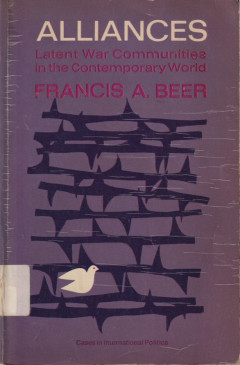
Alliances: Latent war communities in the contemporary world
This book examines the theory and dynamics of international alliances as a form of latent war community in the global political system. Edited by Francis A. Beer, this collection of writings explores how states form coalitions for security purposes, political strategy, and the balance of power. The analysis is presented using a multidisciplinary approach, encompassing international relations th…
- Edisi
- -
- ISBN/ISSN
- 03-076760-1
- Deskripsi Fisik
- viii, 384 pages ; 23 cm
- Judul Seri
- -
- No. Panggil
- 327.17 BEE a
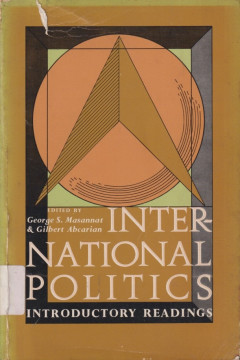
International politics: Introductory readings
This anthology provides a comprehensive introduction to the field of international politics through selected foundational readings edited by George S. Masannat and Gilbert Abcarian. It presents essential theoretical perspectives, historical analyses, and contemporary discussions that help readers understand the dynamics of international relations. The book is designed for students and scholars …
- Edisi
- -
- ISBN/ISSN
- -
- Deskripsi Fisik
- xiii, 498 pages ; 23,5 cm
- Judul Seri
- -
- No. Panggil
- 327 MAS i

Non-Aligned Movement under India’s chairmanship
Published by the Indian Institute for Non-Aligned Studies, the book Non-Aligned Movement Under India’s Chairmanship examines India’s role during its leadership of the Non-Aligned Movement (NAM). First published in November 1986, the book provides an overview of India’s diplomatic activities, work programs, and political positions in guiding the movement’s direction in the mid-1980s. It …
- Edisi
- -
- ISBN/ISSN
- -
- Deskripsi Fisik
- 47 pages; 22 cm
- Judul Seri
- -
- No. Panggil
- 327.172 IND n

Inaugural address and responses: Fifth conference of heads of state or govern…
This official conference volume contains the inaugural address and formal responses delivered at the Fifth Conference of Heads of State or Government of Non-Aligned Countries held in Colombo, Sri Lanka, on 16–19 August 1976. The document presents key political statements, declarations, and diplomatic positions of member states regarding international cooperation, peace, decolonization, global…
- Edisi
- -
- ISBN/ISSN
- -
- Deskripsi Fisik
- 509 page ; 24 cm
- Judul Seri
- -
- No. Panggil
- 327.17 FIF i
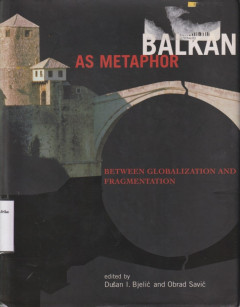
Balkan as metaphor
Balkan as Metaphor is an edited volume led by Dušan I. Bjelić that examines how the Balkans have been represented, imagined, and politically constructed in global discourse. The book explores the region’s shifting identities, ethnic relations, and political transformations following the end of the Cold War. Through interdisciplinary perspectives, the contributors analyze the Balkans as both…
- Edisi
- -
- ISBN/ISSN
- 0-262-02524-8
- Deskripsi Fisik
- xii, 382 pages ; 23,5 cm
- Judul Seri
- -
- No. Panggil
- 305.8 BJE b

Chile; Política exterior para la democracia
This book is a collection of essays edited by Heraldo Muñoz and examines the new direction of Chilean foreign policy during the transition to democracy in the late 1980s. The authors, prominent academics, diplomats, and political analysts, evaluate Chile's global position, the diplomatic challenges of the post-Pinochet era, and the need to construct a foreign policy that supports democracy, ec…
- Edisi
- -
- ISBN/ISSN
- 956-16-0183-8
- Deskripsi Fisik
- 262 pages ; 21 cm
- Judul Seri
- -
- No. Panggil
- 327.83 MUN c

Brazilian foreign policy in changing times; The Quest for autonomy from sarne…
This book examines the dynamics of Brazilian foreign policy from the administrations of José Sarney to Luiz Inácio Lula da Silva. Vigevani and Cepaluni emphasize how Brazil sought to increase its autonomy within the international system, particularly in its relations with the United States and other countries. Through political and international relations analysis, the book highlights the shi…
- Edisi
- -
- ISBN/ISSN
- 978-0-7391-2881-7
- Deskripsi Fisik
- xx, 169 pages ; 23,5 cm
- Judul Seri
- -
- No. Panggil
- 327.81 VIG b

New Zealand foreign policy: Statement and documents, 1943-1957
This book is a compilation of official statements and key diplomatic documents outlining the development of New Zealand’s foreign policy from 1943 to 1957. Issued by the Ministry of Foreign Affairs, it covers New Zealand’s international stance during and after World War II, including its role in global diplomacy, regional security, and participation in international organizations. The volum…
- Edisi
- -
- ISBN/ISSN
- -
- Deskripsi Fisik
- 495 pages ; 25 cm
- Judul Seri
- -
- No. Panggil
- 327.931 MIN n

The United States and China in the twentieth century
This book provides a comprehensive examination of the political, diplomatic, and economic relations between the United States and China throughout the twentieth century. Michael Schaller analyzes major historical events, ideological confrontations, and policy shifts that shaped the complex bilateral relationship, from early interactions to the Cold War era. The work highlights how both nationsâ…
- Edisi
- -
- ISBN/ISSN
- 0-19-502599-7
- Deskripsi Fisik
- vii, 199 pages : illustrations ; 21,5 cm
- Judul Seri
- -
- No. Panggil
- 327.73 SCH u
 Karya Umum
  Filsafat
  Agama
Agama  Ilmu-ilmu Sosial
  Bahasa
  Ilmu-ilmu Murni
  Ilmu-ilmu Terapan
  Kesenian, Hiburan, dan Olahraga
  Kesusastraan
  Geografi dan Sejarah