Ditapis dengan

The role of the world trade organization in global governance
The World Trade Organization is a major player in the field of global governance. Since its creation in January 1995, it has expanded the reach of trade rules deep into the regulatory structure of almost 140 sovereign states, affecting the daily lives of all citizens. As a result, it has found itself at the center of controversy in areas that are well outside the domain of traditional trade pol…
- Edisi
- -
- ISBN/ISSN
- 92-808-1055-3
- Deskripsi Fisik
- x, 298 pages ; 23 cm
- Judul Seri
- -
- No. Panggil
- 382.92 Sam r
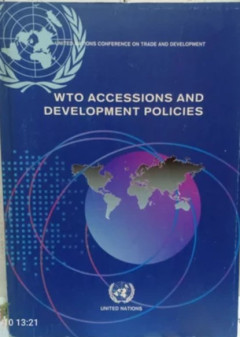
WTO accessions and development policies
Contents: 1. Ad hoc expert group meeting of the secretary-general of UNCTAD: Issues and problems arising from the integration of countries into the multilateral trading system, Geneva, 9-10 April 2001. 2. General issues in WTO accessions. 3. Tariffs, agriculture and other issues. etc.
- Edisi
- -
- ISBN/ISSN
- 92-1-112568-5
- Deskripsi Fisik
- xxiii, 383 pages : illustrations (black and white) ; 21 cm
- Judul Seri
- -
- No. Panggil
- 382.9 Nat w

The law of the world trade organization (WTO): Documents, cases & analysis
This volume discusses the institutions of the WTO, the global forum for trade liberalization. Beyond multilateral liberalization, the WTO disciplines regional trade integration (such as EU, and NAFTA). The WTO now covers not only trade in goods and services, but also provides disciplines regarding protection of intellectual property rights that 153 states must observe. It further includes a uni…
- Edisi
- -
- ISBN/ISSN
- 978-0-314-90663-2
- Deskripsi Fisik
- xcix, 1241 pages ; 26 cm
- Judul Seri
- -
- No. Panggil
- 382.9 Mav l

Intellectual property in the world trade organization: Turning it into develo…
The objective of the series is to improve understanding and appreciation of key and emerging trade policy and negotiating issues facing developing countries in international trade, the trading system and trade negotiations. The series seeks to do so by providing a balanced, objective and sound analysis of technical issues involved, drawing implications for development and poverty reduction obje…
- Edisi
- -
- ISBN/ISSN
- 1816-2878
- Deskripsi Fisik
- x, 80 pages : illustrations (black and white) ; 30 cm
- Judul Seri
- -
- No. Panggil
- 382.9 Nat i

The Doha blues: Institutional crisis and reform in the WTO
The collapse of the Doha Round hangs heavily over an already troubled world economy. Some have concluded that this failure is simply the result of a lack of political will and a pre-occupation with issues such as terrorism. But as this book reveals, the World Trade Organization needs serious structural changes, not just political backbone. It shows for instance that the WTO—now with 153 membe…
- Edisi
- -
- ISBN/ISSN
- 978-0-19-537882-5
- Deskripsi Fisik
- xx, 230 pages : illustrations (black and white) ; 24 cm
- Judul Seri
- -
- No. Panggil
- 382.92 Jon d
Le GATT
In this book, Michel Rainelli reviews the work of the GATT since its inception. He explains the historical evolution that led the community of nations to create this organization in 1948 to promote free trade. It compares GATT principles with the various forms of protectionism used by individual nations. He provides a detailed analysis of the causes of the difficulties encountered during the…
- Edisi
- -
- ISBN/ISSN
- 2-7071-2247-5
- Deskripsi Fisik
- 124 pages : illustrations (black and white) ; 18 cm
- Judul Seri
- -
- No. Panggil
- 382.9 Rai l

Why developing countries need tariffs: How WTO NAMA negotiations could deny d…
In this context, the lessons that may be drawn from economic his- tory, both past and recent, are very pertinent: virtually all of today's de- veloped and advanced developing countries have actively used tariffs in their industrialisation process. The suspension of the WTO discussions provides an invaluable window of opportunity to re-think the need for industrial policies in developing countri…
- Edisi
- Cet. 2
- ISBN/ISSN
- 92-9162-031-9
- Deskripsi Fisik
- xvi, 113 pages : illustrations (black and white) ; 21 cm
- Judul Seri
- -
- No. Panggil
- 382.9 Cha w

China's entry to the WTO: Strategic issues and quantitative assessments
This volume provides a detailed up-to-date analysis of the strategic issues and policy options of China's accession to the WTO. Quantitative analysis demonstrates how tariff reduction resulting from China's accession to the WTO will benefit the Chinese economy as well as the rest of the world. The book argues that there is no single trade policy initiative likely to result in larger gains in in…
- Edisi
- Cet. 1
- ISBN/ISSN
- 0-415-24101-4
- Deskripsi Fisik
- xiii, 227 pages : illustrations (black and white) ; 24 cm
- Judul Seri
- -
- No. Panggil
- 382.951 Dry c
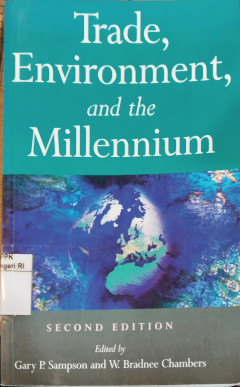
Trade, environment, and the millennium
This book contains about: 1. Trade and environment: Strengthening complementarities 2. Trade and environment: How real is the debate? 3. Breaking the deadlock: A positive agenda on trade, environment, and development 4. The WTO dispute settlement system etc.
- Edisi
- Ed. 2
- ISBN/ISSN
- 92-808-1064-2
- Deskripsi Fisik
- xi, 450 pages ; 23 cm
- Judul Seri
- -
- No. Panggil
- 382.92 Sam t

Strengthening the global trading system: From GATT to WTO
This book contains about: 1. Why the world needs the GATT/WTO 2. The multilateral trading system: What it is, how it works 3. Implications of the Uruguay round for the world economy 4. Designing national administration for good trade policy practice etc.
- Edisi
- Cet. 1
- ISBN/ISSN
- 0-86396-365-X
- Deskripsi Fisik
- xii, 238 pages : illustrations (black and white) ; 21 cm
- Judul Seri
- -
- No. Panggil
- 382.9 And s
 Karya Umum
  Filsafat
  Agama
Agama  Ilmu-ilmu Sosial
  Bahasa
  Ilmu-ilmu Murni
  Ilmu-ilmu Terapan
  Kesenian, Hiburan, dan Olahraga
  Kesusastraan
  Geografi dan Sejarah