Ditapis dengan
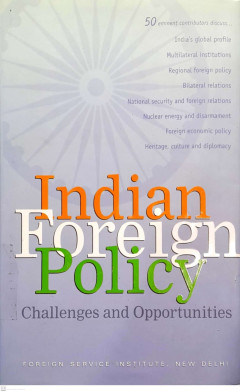
Indian foreign policy: Challenges and opportunities
The world is now engaged with India already established as a major power, advancing in every sphere of development: political, diplomatic, socio-economic, scientific, technological, and cultural. The distinguished foreign affairs analysts, scholars and eminent diplomats invited by the Foreign Service Institute (Government of India) to write chapters for this book on Indian foreign policy, have …
- Edisi
- -
- ISBN/ISSN
- 81-7188-593-4
- Deskripsi Fisik
- 1149 pages ; 24 cm
- Judul Seri
- -
- No. Panggil
- 327.54 Muk i

Weapons of terror : Freeing the world of nuclear biological and chemical arms
In this report, the Independent Weapons of Mass Destruction Commission, chaired by Hands Blix, confronts this global challenge and presents 60 recommendations on what the world community-national governments and civil society-an and should do. Contents: 1. Reviving disarmament 2. Weapons of terror : threats and responses 3. Nuclear weapons 4. Biological and toxin weapons, etc.
- Edisi
- -
- ISBN/ISSN
- 91-38-22582-4
- Deskripsi Fisik
- 227 pages : index ; 24 cm
- Judul Seri
- -
- No. Panggil
- 303.625 Bli w
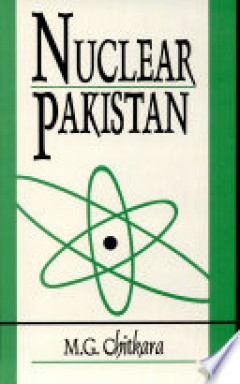
Nuclear Pakistan
Nuclear Pakistan is virtually, Pakistan's Islamic Nuclear Decoction. After the cession of Islamic States and the disintegration of Union of Soviet Socialist Republics, the destablishing process in the region has started. Pakistan's ambition to fill the void created by Weakening of Iraq and Iran and to emerge as the leader of the conglomeration of Islamic nations is a great threat to peace and s…
- Edisi
- -
- ISBN/ISSN
- 81-7024-767-5
- Deskripsi Fisik
- xv, 332 pages ; 22 cm
- Judul Seri
- -
- No. Panggil
- 355.825119 Chi n
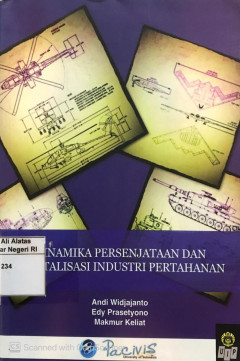
Dinamika persenjataan dan revitalisasi industri pertahanan
Dinamika persenjataan di Asia Tenggara menunjukkan kecenderungan terjadinya kompetisi persenjataan antar negara-negara utama di kawasan ini. Kompetisi persenjataan ini ditandai dengan proliferasi sistem senjata ofensif terutama untuk jenis tank, pesawat tempur dan kapal selam. Kompetisi ini juga menandai transformasi pertahanan yang mengarah ke suatu revolusi krida yudha di Asia Tenggara.
- Edisi
- -
- ISBN/ISSN
- 978-979-456-494-3
- Deskripsi Fisik
- v, 114 halaman ; 23 cm.
- Judul Seri
- -
- No. Panggil
- 338.476234 Wid d

The CTBT and the rise of nuclear nationalism in India: Linkage between nuclea…
The book is an attempt to analyse recent trends in the nuclear non-proliferation diplomacy after the Gulf crisis, with a focus on efforts to strengthen the nuclear export control regime, IAEA 'Special Inspections' based on satellite intelligence, and US policy of establishing regional nuclear non-proliferation regimes. An attempt has been made to examine how the nuclear non-proliferation regime…
- Edisi
- -
- ISBN/ISSN
- 81-7095-061-9
- Deskripsi Fisik
- x, 309 pages ; 21,5 cm
- Judul Seri
- -
- No. Panggil
- 355.825119 Pou c

India and the bomb : Public opinion and nuclear options
In 1994 the Joan B. Kroc Institute for International Peace Studies, in cooperation with the Fourth Freedom Forum, conducted the most comprehensive survey to date of the Indian public's attitude toward nuclear arms. This book examines the findings of that landmark survey. Contents: 1. Indian public opinion and nuclear weapons policy 2. Abstaining : The nonnuclear option 3. Status quo : Mai…
- Edisi
- -
- ISBN/ISSN
- -
- Deskripsi Fisik
- xiii, 160 pages ; 25 cm
- Judul Seri
- -
- No. Panggil
- 623.45 Cor i
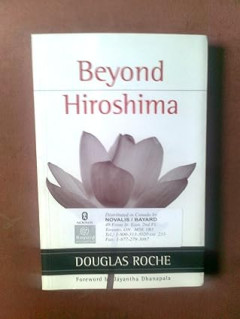
Beyond Hiroshima
Based on a recent U.N. sponsored conference on the non-proliferation of arms, Douglas Roche shows how the world has become more dangerous and more equitable through nuclear arms. This book presents a compelling case for a continued struggle to eliminate nuclear weapons. Roche explains how political, and especially religious and other civic leaders can work for a nuclear weapon-free world. Th…
- Edisi
- -
- ISBN/ISSN
- 2-89507-670-7
- Deskripsi Fisik
- 249 pages ; 21 cm
- Judul Seri
- -
- No. Panggil
- 355.8 Roc b

Are we prepared? Four WMD crises that could transform U.S. security: Failed W…
The four scenarios: the United States and its allies have begun to fear the imminent collapse of the nonproliferation regime * a state known to possess a nuclear weapons capability and suspected of possessing both chemical and biological weapons programs stands on the brink of political collapse * analysis of samples from multiple BioWatch sensors has identified a large-scale release of aerosol…
- Edisi
- -
- ISBN/ISSN
- 9781521153192
- Deskripsi Fisik
- 91 pages : illustrations (black and white) ; 25 cm
- Judul Seri
- -
- No. Panggil
- 355.825119 Man a
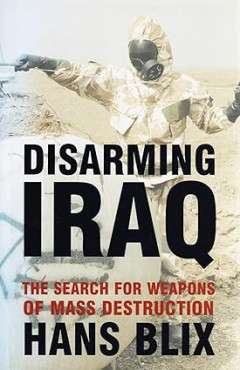
Disarming Iraq : The search for weapons of mass destruction
His book will consider a wide range of questions including- Could the war have been prevented? Was it inevitable? Does Iraq have weapons of mass destruction? Why couldn't the US and the UK secure the backing of the member states of the UN Security Council? What can be learnt from the Iraq war for the prevention of the spread and use of WMDs?. Contents: 1. Disarming Iraq 2. Inspection 3. Out…
- Edisi
- -
- ISBN/ISSN
- 0-7475-7358-1
- Deskripsi Fisik
- x, 285 pages ; 23 cm
- Judul Seri
- -
- No. Panggil
- 355.825 Bli d

Destroying surplus weapons: An assessment of experience in South America and …
This book contains: 1. South Africa's security and defence policies 2. South Africa's approach to small arms 3. Case studies 4. Evaluation of weapons destruction efforts in South Africa and Lesotho 5. Lessons learned and the future of surplus weapons destruction efforts
- Edisi
- -
- ISBN/ISSN
- 92-9405-151-3
- Deskripsi Fisik
- xvii, 84 pages ; 21 cm
- Judul Seri
- -
- No. Panggil
- 355.8 Mee d
 Karya Umum
  Filsafat
  Agama
Agama  Ilmu-ilmu Sosial
  Bahasa
  Ilmu-ilmu Murni
  Ilmu-ilmu Terapan
  Kesenian, Hiburan, dan Olahraga
  Kesusastraan
  Geografi dan Sejarah