Ditapis dengan

Invasion-They’re Coming!: The German account of the allied landings and the…
This book presents the German perspective on the Allied invasion of Normandy on June 6, 1944, and the ensuing 80 days of fighting in France. Written by Paul Carell, a former German propaganda official, this book describes the dynamics of strategy, troop movements, and the experiences of German commanders and soldiers in facing the massive attack that determined the course of World War II. With …
- Edisi
- -
- ISBN/ISSN
- -
- Deskripsi Fisik
- 288 pages : illustration ; 21,5 cm
- Judul Seri
- -
- No. Panggil
- 940.5421 CAR i
Canada and the far east 1940
This book analyzes Canada’s political, economic, and diplomatic relations with the Far East during the year 1940, in the context of rising tensions leading to World War II. Written under the Institute of Pacific Relations Inquiry Series, it examines Canada’s strategic interests, trade connections, and evolving foreign policy toward East Asian nations. The work provides historical insight in…
- Edisi
- -
- ISBN/ISSN
- -
- Deskripsi Fisik
- ix, 152 pages ; 23,5 cm 1. Judul
- Judul Seri
- -
- No. Panggil
- 327.7105 LOW c

The Kings depart: The tragedy of Germany – Versailles and the German revolu…
This book presents a historical study of Germany's transition from the collapse of the Empire at the end of World War I to the birth of the Weimar Republic. Richard M. Watt outlines various important events such as Germany's defeat in 1918, the Treaty of Versailles with its political and economic consequences, and the German Revolution of 1918–1919. Through a detailed narrative approach based…
- Edisi
- -
- ISBN/ISSN
- -
- Deskripsi Fisik
- 604 pages : illustration ; 24 cm
- Judul Seri
- -
- No. Panggil
- 943.084 WAT k
Canaris
Canaris is a biography of Admiral Wilhelm Canaris, an important figure who led the German military intelligence service (Abwehr) during the Nazi era. Written by Karl Heinz Abshagen and translated by Alan Houghton Brodrick, this book describes Canaris' life, career, and complex role in the German intelligence network. In addition to being a high-ranking officer, Canaris was known for his ambival…
- Edisi
- -
- ISBN/ISSN
- -
- Deskripsi Fisik
- 264 pages ; 22 cm
- Judul Seri
- -
- No. Panggil
- 303.6443 ABS c
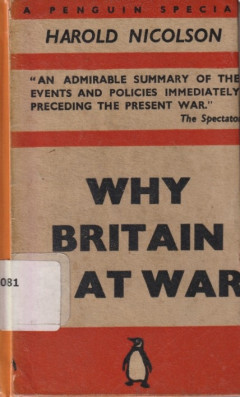
Why Britain is at war
This book contains Harold Nicolson's explanation of why Britain entered World War II, written at the very beginning of the conflict in 1939. Nicolson outlines the political conditions in Europe, the rise of Nazi Germany, the failure of appeasement, and the danger of Hitler's expansion to international security. As a diplomat and member of the British Parliament, Nicolson's views provide a direc…
- Edisi
- -
- ISBN/ISSN
- -
- Deskripsi Fisik
- 160 pages ; 18 cm
- Judul Seri
- -
- No. Panggil
- 941.081 NIC w
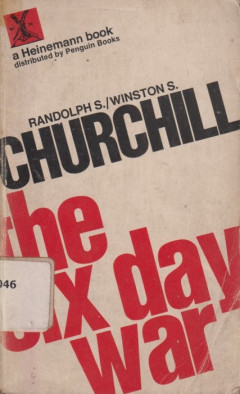
The Six day war
This book is a narrative and analytical reconstruction of the Six-Day War of 1967, written by Randolph S. Churchill and his grandson Winston S. Churchill. The authors trace the series of diplomatic, political, and military events that triggered the conflict between Israel and the Arab states, and describe the course of a war that was short but had a major impact on the geopolitics of the Middle…
- Edisi
- -
- ISBN/ISSN
- -
- Deskripsi Fisik
- 261 pages : illustration ; 18 cm
- Judul Seri
- -
- No. Panggil
- 956.04 CHU s

Winston Churchill and the second front 1940–1943
This book is a military history study that analyzes the debates, strategies, and policies behind the opening of the Second Front in World War II, particularly between 1940 and 1943. Trumbull Higgins traces the relationship between Allied leaders, especially Winston Churchill and the British government, and the dynamics of their relationship with the United States in determining the timing and l…
- Edisi
- -
- ISBN/ISSN
- -
- Deskripsi Fisik
- xii, 281 pages ; 22 cm
- Judul Seri
- -
- No. Panggil
- 940.5421 HIG w

Memoires over de tweede wereldoorlog: Ons schoonste uur – Frankrijks val, a…
This book is one of Winston Churchill's memoirs about World War II in Dutch. Ons Schoonste Uur – Frankrijks val, Alleen recounts the early days of the war when France fell to Germany in 1940, and Britain had to face the threat of invasion alone. Churchill describes the atmosphere of crisis, decisive political decisions, British defense strategies, and the spirit of the British people during t…
- Edisi
- -
- ISBN/ISSN
- -
- Deskripsi Fisik
- 622 pages : illustration ; 22,5 cm
- Judul Seri
- -
- No. Panggil
- 940.542 CHU m
The East European revolution
The East European Revolution by Hugh Seton-Watson provides an authoritative analysis of the political and social transformations that reshaped Eastern Europe after World War II. The book examines the rise of communist governments, the role of the Soviet Union in restructuring regional politics, the collapse of prewar institutions, and the emergence of new revolutionary elites. Seton-Watson offe…
- Edisi
- -
- ISBN/ISSN
- -
- Deskripsi Fisik
- xix, 435 pages : illustration ; 22 cm
- Judul Seri
- -
- No. Panggil
- 947 WAT e

Memoires over de tweede wereldoorlog: De Storm steekt op – Van oorlog tot o…
This book is part of Winston Churchill's memoir series, which reviews world developments from the end of World War I to the outbreak of World War II. In De Storm Steekt Op – Van oorlog tot oorlog 1919–1939, Churchill describes the emergence of global political tensions, the rise of totalitarian powers such as Nazi Germany, Fascist Italy, and the Soviet Union, and the failure of the internat…
- Edisi
- -
- ISBN/ISSN
- -
- Deskripsi Fisik
- 497 pages : illustration ; 22,5 cm
- Judul Seri
- -
- No. Panggil
- 940.531 CHU m
 Karya Umum
  Filsafat
  Agama
Agama  Ilmu-ilmu Sosial
  Bahasa
  Ilmu-ilmu Murni
  Ilmu-ilmu Terapan
  Kesenian, Hiburan, dan Olahraga
  Kesusastraan
  Geografi dan Sejarah