Ditapis dengan

Australia and Indonesia : current problems, future prospects
Australia's relations with Indonesia are currently at a low ebb. The optimistic prospects of the mid-1990s had collapsed almost completely by the year 2000. Senior Indonesian officials were angered after that by the triumphalist tone of John Howard's public statements after the intervention in East Timor, by the megaphone diplomacy resorted to by some Australian ministers to express their displ…
- Edisi
- 1st ed
- ISBN/ISSN
- 978-1-921004-30-8
- Deskripsi Fisik
- xviii, 155 pages : bibl: hlm 145-154 ; 21 cm.
- Judul Seri
- -
- No. Panggil
- 327.940598 Mac a

America's secret war: Inside the hidden worldwide struggle between America an…
"In America's Secret War, George Friedman identifies the United States' most dangerous enemies, delves into presidential strategies of the last quarter century, and reveals the real reasons behind the attack of 9/11- and the Bush administration's motivation for the war in Iraq. It describes in detail America's covert and overt efforts in the global war against terrorism: not only are U.S. armie…
- Edisi
- 1st ed.
- ISBN/ISSN
- 0-385-51245-7
- Deskripsi Fisik
- xii, 354 pages : maps : index ; 25 cm.
- Judul Seri
- -
- No. Panggil
- 327.73 Fri a
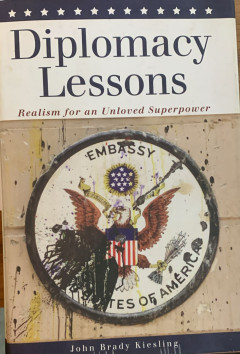
Diplomacy lessons: Realism for an unloved superpower
In Diplomacy Lessons, Kiesling reminds readers that U.S. power does not rest on military might alone and that anger at America has real consequences for U.S. national interests. The security and prosperity of the American people depend on efficient cooperation with foreigners on a range of issues, not only terrorism and nuclear nonproliferation but also trade policy, environmental protection, a…
- Edisi
- Ed. 1
- ISBN/ISSN
- 978-1-59797-017-4
- Deskripsi Fisik
- ix, 317 pages : index ; 23 cm
- Judul Seri
- -
- No. Panggil
- 327.73 Bra d

Global intelligence: The world's secret services today
This book explains how the war on terrorism povides a wholly new context for the murky world that secret services and intelligence agencies operate in. This book describes in detail how ultra-modern new technologies have vastly increased their power to spy abroad and eavesdrop at home.
- Edisi
- First Published
- ISBN/ISSN
- 1842771132
- Deskripsi Fisik
- xi, 240 pages : index ; 20 cm
- Judul Seri
- -
- No. Panggil
- 327.12 Tod g

Anti-terrorism law and foreign terrorist fighter
The contents of this book: 1. Criminal Justice System 2. Hybrid Sanctions 3. Immigration and Citizenship
- Edisi
- First Published
- ISBN/ISSN
- 978-1-138-09337-9
- Deskripsi Fisik
- xii,122 pages : index ; 22 cm
- Judul Seri
- -
- No. Panggil
- 325 Bla a

Good muslim, bad muslim: America, the cold war, and the roots of terror
In this brilliant look at the rise of political Islam, the distinguished political scientist and anthropologist Mahmood Mamdani brings his expertise and insight to bear on a question many Americans have been asking since 9/11: how did this happen? Mamdani dispels the idea of “good” (secular, westernized) and “bad” (premodern, fanatical) Muslims, pointing out that these judgments refer t…
- Edisi
- -
- ISBN/ISSN
- 978-0-385-51537-5
- Deskripsi Fisik
- xiv, 304 pages : index ; 21 cm
- Judul Seri
- -
- No. Panggil
- 320.557 Mam g

The exception to the rulers : Exposing oily politicians, war profiteers, and …
Contents: 1. Blowback 2. OILYgarchy 3. Drilling and killing : Chevron and Nigeria's oil dictatorship 4. Crackdown 5. Smackdown 6. Lockdown 7. Lies of our times 8. State media, American style, etc.
- Edisi
- -
- ISBN/ISSN
- 1-4013-0799-X
- Deskripsi Fisik
- xix, 342 pages : index ; 20 cm
- Judul Seri
- -
- No. Panggil
- 320 Goo e

Knowing the enemy: Jihadist ideology and the war on terror
After September 11, Americans agonized over why nineteen men hated the United States enough to kill three thousand civilians in an unprovoked assault. Analysts have offered a wide variety of explanations for the attack, but the one voice missing is that of the terrorists themselves. This penetrating book is the first to present the inner logic of al-Qa’ida and like-minded extremist groups by …
- Edisi
- -
- ISBN/ISSN
- 0-300-11306-4
- Deskripsi Fisik
- vi, 243 pages : index ; 21 cm
- Judul Seri
- -
- No. Panggil
- 297.272 Hab k

Terrorism for humanity: Inquiries in political philosophy
The six essays of this book, now revised after having previously been published as Violence for Equality: Inquiries in Political Philosophy, are the result of trying to inquire with an open mind into terrorism and more particularly what some people think are justifications of it or would be justifications of it. If you actually think about it, what can be said for and against terrorism or polit…
- Edisi
- -
- ISBN/ISSN
- 0-7453-2133-X
- Deskripsi Fisik
- viii, 216 pages : index ; 22 cm
- Judul Seri
- -
- No. Panggil
- 172.1 Hon t

Surveillance after September 11
The aftermath of terrorist attacks on September 11 2001 includes widespread tightening of surveillance. The responses are a prism that puts several things in perspective. One, it is premature to see decentralised and commercial surveillance simply supplanting nation-state power. Rather, the nation-state now draws upon an augmented surveillant assemblage for its own purposes. Two, reliance on hi…
- Edisi
- First Published
- ISBN/ISSN
- 0-7456-3181-9
- Deskripsi Fisik
- viii, 197 pages : index ; 19 cm
- Judul Seri
- -
- No. Panggil
- 303.33 Lyo s
 Karya Umum
  Filsafat
  Agama
Agama  Ilmu-ilmu Sosial
  Bahasa
  Ilmu-ilmu Murni
  Ilmu-ilmu Terapan
  Kesenian, Hiburan, dan Olahraga
  Kesusastraan
  Geografi dan Sejarah