Ditapis dengan

The soviet national reader: The disintegration in context
Setting the context for the crisis that has fragmented the former USSR, this reader presents key essays by notable Western scholars who have shaped the debates within the field of Soviet nationality studies. Focusing first on the historical development of the Soviet multiethnic state, the discussions then turn to specific problem areas, including federalism, elites, economy, language policy, an…
- Edisi
- -
- ISBN/ISSN
- 0-8133-1027-X
- Deskripsi Fisik
- ix, 635 pages ; 23 cm
- Judul Seri
- -
- No. Panggil
- 321.020947 Den s

The end of Soviet Politics : Election, legislatures, and the demise of the co…
This book, an analysis of Gorbachev's brand of Soviet socialist democracy, tells the story of his attempt to revive the soviets and, through them, the Soviet Union.
- Edisi
- -
- ISBN/ISSN
- 0-8133-8275-0
- Deskripsi Fisik
- xii, 241 pages : index ; 22 cm
- Judul Seri
- -
- No. Panggil
- 320.947 Kie e
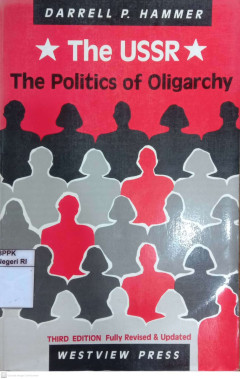
The USSR: The politics of oligarchy
The Soviet Union is changing, and its future is uncertain. For seventy years the country has been controlled by the Communist party. No organized opposition was allowed, and during most of that period the party tolerated no alternative philosophy to Marxism-Leninism, the official ideology.
- Edisi
- -
- ISBN/ISSN
- 0-8133-0781-3
- Deskripsi Fisik
- xvi, 320 pages : index ; 24 cm
- Judul Seri
- -
- No. Panggil
- 320.947 Ham u

The new cold war : Revolutions, rigged elections, and pipeline politics in th…
When the Berlin Wall fell in 1989 and the Soviet Union collapsed two years later, liberal democracy was supposed to fill the void left by Soviet Communism. Poland and Czechoslovakia made the best of reforms, but the citizens of the "Evil Empire" itself saw little of the promised freedom, and more of the same old despots and corruption. Recently, a second wave of reforms Serbia in 2000, Georgia …
- Edisi
- -
- ISBN/ISSN
- 978-0-7867-2083-5
- Deskripsi Fisik
- xvii, 313 pages : index ; 24 cm
- Judul Seri
- -
- No. Panggil
- 320.901 Kin n

Public opinion in Soviet Russia: A study in mass persuasion
This book neither pretends nor seeks to be a "definitive" investigation of the media of mass communication in the Soviet Union. The complexity of the Soviet communication system is such that a really exhaustive study of the techniques and institutions utilized for propaganda and agitation would have to be several times the length of the present work. At the same time, it should be recognized th…
- Edisi
- -
- ISBN/ISSN
- -
- Deskripsi Fisik
- xviii, 379 pages : bibl: hlm 357-364 : index ; 22 cm
- Judul Seri
- -
- No. Panggil
- 301.154 Ink p

Memoirs
Memoirs is one of the most important documents to come out of the Soviet Union, not only from a political point of view but because of the remarkable insight it gives into Gromyko's Russia.
- Edisi
- First Edition
- ISBN/ISSN
- 0385412886
- Deskripsi Fisik
- xvii, 414 pages, : illustrations ; 25 cm
- Judul Seri
- -
- No. Panggil
- 920 Gro m

A little corner of freedom : Russian nature protection from Stalin to Gorbachev
A little corner of freedom sheds new light on Soviet politics, revealing how a Russian nationalist movement used the protective umbra of environmentalism to become a cultural and political force, and how ordinary citizens used it to launch the first mass protests at the dawn of glasnost.
- Edisi
- -
- ISBN/ISSN
- 0-520-21397-1
- Deskripsi Fisik
- 556 pages : illustrations ; 25 cm
- Judul Seri
- -
- No. Panggil
- 363.7056 Wei l

Soviet military power in a changing world
This topical volume analyzes the rapidly changing Soviet military and the effects changes are having both within the Soviet Union and beyond its borders. Weighing internal and foreign policy considerations, the contributors examine divergent views on military reform held by civilian and military leaders, review Soviet nuclear and conventional forces and arms control policy, and assess the broad…
- Edisi
- -
- ISBN/ISSN
- 0-8133-8379-X
- Deskripsi Fisik
- xiv, 324 pages ; 22 cm
- Judul Seri
- -
- No. Panggil
- 355.033047 Cla s
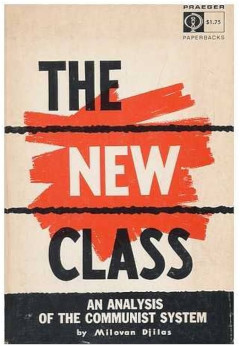
The new class: An analysis of the communist system
It is a book which exemplifies and expresses the deep agonies, the desperate yearning of the Soviet orbit's disillusioned intelligentsia for intellectual freedom, for personal dignity, for true social and economic progress; for a way out of the morass of false theories, bureaucratic ties and cruel exploitation. One of the great political documents of our time-perhaps the most important in its f…
- Edisi
- -
- ISBN/ISSN
- -
- Deskripsi Fisik
- vii, 214 pages : illustrations ; 21 cm
- Judul Seri
- -
- No. Panggil
- 902 Dji n
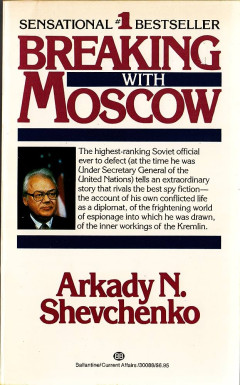
Breaking with Moscow
It is not my purpose in this memoir to instill feelings of hostility in Americans toward the Soviet people, or to complicate in any way efforts to promote peace. The world has enought madmen trying to do that.
- Edisi
- -
- ISBN/ISSN
- 0-394-52055-6
- Deskripsi Fisik
- viii, 378 pages; 24 cm
- Judul Seri
- -
- No. Panggil
- 327.120924 She b
 Karya Umum
  Filsafat
  Agama
Agama  Ilmu-ilmu Sosial
  Bahasa
  Ilmu-ilmu Murni
  Ilmu-ilmu Terapan
  Kesenian, Hiburan, dan Olahraga
  Kesusastraan
  Geografi dan Sejarah