Ditapis dengan

Asia Pacific regionalism: Reading in international economic relations
Asia Pacific Readings in International Economic Relations describes the main historical, theoretical and policy developments leading to closer economic integration and cooperation in the Asia Pacific region. With an introduction to the issues by Ross Garnaut and Peter Drysdale, this book brings together a representative part of the literature that has emerged from analysis of Asia Pacific regio…
- Edisi
- -
- ISBN/ISSN
- 0-06-312140-9
- Deskripsi Fisik
- xviii, 433 pages : illustrations (black and white) ; 23 cm
- Judul Seri
- -
- No. Panggil
- 337.5 Gar a

Economic development, social order, and world politics
Based on methodological individualism and a public-choice approach to social theory, this book provides an analysis of the interdependence of economic development, social order and interstate conflict.
- Edisi
- -
- ISBN/ISSN
- 155587620X
- Deskripsi Fisik
- xi, 203 pages ; 23,5 cm.
- Judul Seri
- -
- No. Panggil
- 338.9 Wee e

Reforms for the new era of Japan and ASEAN: For a broader and deeper partnership
Prime Minister Hashimoto is visiting Singapore at a time when his administration is seized with the ongoing crisis in Peru. His decision to proceed with the visits to the ASEAN countries is laudable. Both Singapore and ASEAN appreciate this gesture. It has demonstrated the importance that Japan accords to its relations with ASEAN. We hope that the crisis in Peru will be peacefully resolved soon.
- Edisi
- -
- ISBN/ISSN
- 981-3055-72-3
- Deskripsi Fisik
- 24 pages : illustrations ; 24 cm
- Judul Seri
- -
- No. Panggil
- 337.52598 Has r
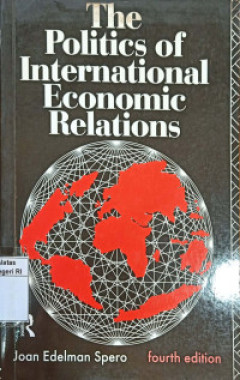
The politics of international economic relations
In this fourth edition the writer have added new material that reflects both the academic changes and the events in the years since the third edition was published. For example, the monetary chapter explores efforts at exchange rate management since the Plaza and Louvre agreements, the trade chapters examine issues being negotiated in the Uruguay Round of multilateral trade negotiations, the ch…
- Edisi
- ed.4
- ISBN/ISSN
- 0-415-08430-X
- Deskripsi Fisik
- ix, 404 pages : illustrations (black and white) ; 23 cm
- Judul Seri
- -
- No. Panggil
- 337 Spe p
Non-State actors and authority in the global system
Traditionally in international relations, power and authority were considered to rest with states. But recently, in the light of changes associated with globalisation, this has come under scrutiny both empirically and theoretically. This book analyses the continuing but changing role of states in the international arena, and their relationships with a wide range of non-state actors, which poss…
- Edisi
- -
- ISBN/ISSN
- 0-415-22085-8
- Deskripsi Fisik
- xvii, 301 pages : illustrations (black and white) ; 23 cm
- Judul Seri
- -
- No. Panggil
- 337 Hig n

Market unbound: Unleashing global capitalism
The world is on the verge of the most sweeping economic changes since the Industrial Revolution. National economies are transforming from government-controlled market systems into an open international marketplace under no one's control. The consequences will be both exhilarating and terrifying. Market Unbound is the first compelling blueprint for adapting to this new global market. According …
- Edisi
- -
- ISBN/ISSN
- 0-471-14446-0
- Deskripsi Fisik
- xvii, 268 pages : illustrations (black and white) ; 23 cm
- Judul Seri
- -
- No. Panggil
- 332.042 Bry m

The collapse of globalism: And the reinvention of the world
Globalization, like many great geopolitical ideologies before it, is now dead. Despite the almost-religious certainty with which it was originally conceived, a growing vagueness now surrounds the original promise of the global ideal that the fading power of nation states would be replaced by global markets that economics, not politics or arms, would determine the course of human events and that…
- Edisi
- -
- ISBN/ISSN
- 1-58567-629-2
- Deskripsi Fisik
- 309 pages ; 24 cm
- Judul Seri
- -
- No. Panggil
- 337 Sau c

The UN and the Bretton Woods institutions: New challenges for the twenty-firs…
The vision of the founders of the United Nations, the World Bank and the IMF some fifty years ago contrasts sharply with the often weak and limited performance of the institutions they created. The 15 papers in this volume critically assess this record in order to set out proposals for strengthening and restructuring the institutions to meet the new challenges of the 21st century. The changes p…
- Edisi
- Cet. 1
- ISBN/ISSN
- 0-312-12449-X
- Deskripsi Fisik
- xi, 268 pages : illustrations (black and white) ; 22 cm
- Judul Seri
- -
- No. Panggil
- 332.042 Haq u

China and the global economy: National champions, industrial policy and the b…
This book tells the story of China's emergence as a major economic power and the huge impact this will have on world business. Over the last five years Peter Nolan has conducted a major investigation into Chinese industry, its economic structure, and the opportunities for growth in the future. As one of just four world experts invited by the Chinese Government to consult on their application to…
- Edisi
- -
- ISBN/ISSN
- 0-333-94565-4
- Deskripsi Fisik
- xi, 244 pages ; 24 cm
- Judul Seri
- -
- No. Panggil
- 337.51 Nol c

The UN and global political economy : Trade, finance, and development
Contents: 1. The UN trade and development debates of the 194os 2. The UN recruits economists 3. Michal Kalecki, the world economic report, and McCarthyism 4. From full employment to economic development 5. The early terms-of-trade controversy 6. ECLA, Industralization, and inflation, etc.
- Edisi
- -
- ISBN/ISSN
- 0-253-21686-9
- Deskripsi Fisik
- xv, 390 pages ; 23 cm
- Judul Seri
- -
- No. Panggil
- 337 Toy u
 Karya Umum
  Filsafat
  Agama
Agama  Ilmu-ilmu Sosial
  Bahasa
  Ilmu-ilmu Murni
  Ilmu-ilmu Terapan
  Kesenian, Hiburan, dan Olahraga
  Kesusastraan
  Geografi dan Sejarah