Ditapis dengan
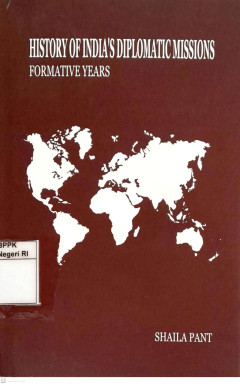
History of India's diplomatic missions: Formative years
The challenging task of executing, Nehru's vision of independent foreign policy required an innovative and dynamic diplomatic corp. The Indian state had the advantage of having a battery of officers drawn from British Raj, but could they translate the Nehruvian vision into practice? The history of evolution of Indian missions and their functioning provides an insight in to the dynamics of India…
- Edisi
- First Published
- ISBN/ISSN
- 81-902929-5-1
- Deskripsi Fisik
- ix, 201 pages : bibl: hlm 195-201 ; 23 cm
- Judul Seri
- -
- No. Panggil
- 327.54 Pan h

The long view from Delhi: To define the Indian grand strategy for foreign policy
Analyzing some of the major influences on foreign and security policy in India, this synthesis of insights assesses emerging global scenarios from an Indian perspective and details their likely impact on India's current and future national interests. This study first uses the Net Assessment method to detail the scenarios_that the country will face in 2020 and then utilizes a transparent method …
- Edisi
- -
- ISBN/ISSN
- 9788171888009
- Deskripsi Fisik
- 182 pages : 29 cm
- Judul Seri
- -
- No. Panggil
- 327.54 Men l
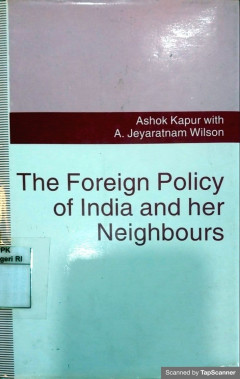
Foreign policy of India and her neighbours
This study of perceptions, interests and strategies of South Asian states reveals the analytical and empirical richness of three kinds of states in the region: India - the regional hegemon; Pakistan-India's permanent competitor; and other South Asian states who do not accept Pakistani perceptions, interests and strategies concerning India. This book assesses the diplomatic and strategic princip…
- Edisi
- First Published
- ISBN/ISSN
- 0-333-55829-4
- Deskripsi Fisik
- ix, 186 pages : illustrations : index ; 23 cm
- Judul Seri
- -
- No. Panggil
- 327.54 Kap f

Assignment Colombo
J. N. Dixit, former Foreign Secretary was India's High Commissioner in Sri Lanka from 1985 to 1989. He was an active participant in events leading to the signing of the Indo-Sri Lanka agreement and induction of the IPKF into Sri Lanka. This book is an attempt to put matters in perspective in the context of India's motivation which remain misunderstood. The author feels that the peoples of In…
- Edisi
- -
- ISBN/ISSN
- 81-220-0499-7
- Deskripsi Fisik
- xxi, 393 pages : illustrations (black and white) : index ; 22 cm
- Judul Seri
- -
- No. Panggil
- 327.54 Dix a
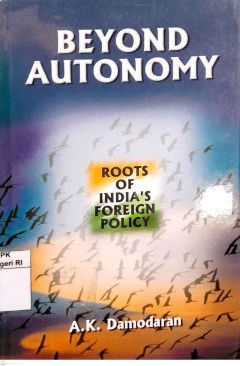
Beyond autonomy: India's foreign policy
In a world of instant communication, no country can remain in isolation. The impact of socio-cultural and economic trends receive instant reverberations the world over. This is equally true of foreign policy. While the balance of power and ideology may have undergone changes, the fundamentals of Indian diplomatic expression has remained the same, with its commitment to our national interests an…
- Edisi
- -
- ISBN/ISSN
- 81-7039-241-1
- Deskripsi Fisik
- xv, 246 pages : index ; 23 cm
- Judul Seri
- -
- No. Panggil
- 327.54 Dam b
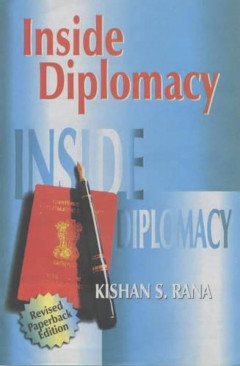
Inside diplomacy
The book deals with the functional dynamics, and the operational mechanics of the Indian Foreign Office from its inception to date.It has filled the gap in information about the implementation of India's foreign policy by providing a detailed analysis of the procedures and functional dynamics of the Ministry of External Affairs. No book in the past, to the best of one's knowledge, has made such…
- Edisi
- cet. 2
- ISBN/ISSN
- 81-7049-152-5
- Deskripsi Fisik
- 477 pages : bibl: hlm 464-466 : index ; 22 cm
- Judul Seri
- -
- No. Panggil
- 327.2 Ran i

ASEAN, India, Australia: Towards closer engagement in a new Asia
India's emergence of a great power has sensitized its regional neighbours to its growing role as a key security actor in an increasingly interdependent world. Both Australia and ASEAN now view India as a major player in the formulation and application of their own broad security agendas. This emerging trilateral compendium is particularly evident in such policy areas as maritime security, clima…
- Edisi
- First Published
- ISBN/ISSN
- 978-981-230-963-1
- Deskripsi Fisik
- xxv, 417 pages : illustrations : bibl: hlm 369-398 : index ; 24 cm
- Judul Seri
- -
- No. Panggil
- 327.1 Tow a
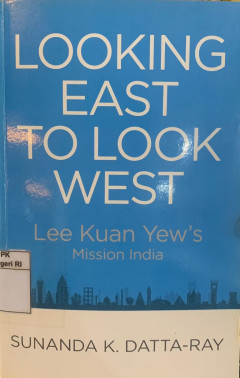
Looking east to look west: Lee Kuan Yew's mission India
This book traces the process from the earliest mention of Suvarnadbhumi in the Ramayana to Lee Kuan Yew's letter to Lal Bahadur Shastri within moments of declaring independence on 9 August 1965, from the Tata's pioneering industrial training venture in Singapore to Singapore's Information Technology Park in Bangalore. It explains the part Lee played in India's emergence as a player in the emerg…
- Edisi
- -
- ISBN/ISSN
- 978-981-4279-04-8
- Deskripsi Fisik
- xv, 384 pages : index ; 22 cm
- Judul Seri
- -
- No. Panggil
- 327 Ray l

India Foreign Relations-2006: Documents part II
The series India's foreign relations, showcasing, as the name implies, documents on India's foreign relations is published annually. The challenge before the India foreign policy establishment today is to create necessary space to exercise freedom to make policy choices in an increasingly interdependent world. The documents have been arranged thematically, region-wise and chronologically. Th…
- Edisi
- -
- ISBN/ISSN
- 81-901629-9-3
- Deskripsi Fisik
- 1324-2152 pages ; 25 cm
- Judul Seri
- -
- No. Panggil
- 327.54 Bha i

India Foreign Relations-2006: Documents part I
The series India's foreign relations, showcasing, as the name implies, documents on India's foreign relations is published annually. The challenge before the India foreign policy establishment today is to create necessary space to exercise freedom to make policy choices in an increasingly interdependent world. The documents have been arranged thematically, region-wise and chronologically. Th…
- Edisi
- -
- ISBN/ISSN
- 81-901629-9-3
- Deskripsi Fisik
- 1-1317 pages ; 25 cm
- Judul Seri
- -
- No. Panggil
- 327.54 Bha i
 Karya Umum
  Filsafat
  Agama
Agama  Ilmu-ilmu Sosial
  Bahasa
  Ilmu-ilmu Murni
  Ilmu-ilmu Terapan
  Kesenian, Hiburan, dan Olahraga
  Kesusastraan
  Geografi dan Sejarah