Ditapis dengan
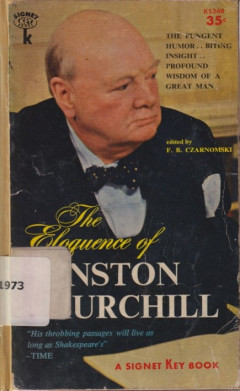
The Eloquence of Winston Churchill
This book is a collection of selected speeches by Winston Churchill, compiled and edited by F. B. Czarnomski. Through this compilation, readers can explore Churchill's rhetorical power and leadership in various political situations, especially during World War II and the period that followed. This collection showcases the language style, political vision, and decisiveness of a statesman known a…
- Edisi
- -
- ISBN/ISSN
- -
- Deskripsi Fisik
- xii, 200 pages ; 18 cm
- Judul Seri
- -
- No. Panggil
- 352.23092 CZA e

The Control of monopoly in the United Kingdom
This book comprehensively discusses the British government's policies in regulating and controlling monopolistic practices in the industrial sector. Paul H. Guénault and J. M. Jackson outline the legal framework, economic policies, and institutions involved in overseeing business competition in Britain in the mid-20th century. The analysis covers the background to the formation of anti-monopol…
- Edisi
- -
- ISBN/ISSN
- -
- Deskripsi Fisik
- ix, 197 pages ; 22 cm
- Judul Seri
- -
- No. Panggil
- 338.88 GUE c

Great Britain: Foreign policy and the Span of Empire, 1689–1971
Volume III of Great Britain: Foreign Policy and the Span of Empire, 1689–1971 is a documentary series that presents primary sources on British foreign policy and the development of the British Empire over nearly three centuries. Compiled by Joel H. Wiener, this book brings together official documents, speeches, government reports, and contemporary writings that reflect the dynamics of interna…
- Edisi
- Volume 3
- ISBN/ISSN
- 0-07-079730-7
- Deskripsi Fisik
- 2727 pages ; 24 cm
- Judul Seri
- -
- No. Panggil
- 327.42 WIE g

British Diplomacy in Asia: Persian Gulf, Soviet Central Asia, Tibet, China, I…
British Diplomacy in Asia by Mahavir P. Srivastava provides an in-depth examination of British diplomatic policy and strategy in Asia from the colonial era to the early 20th century. The discussion covers Britain's role in the Persian Gulf, Soviet Central Asia, Tibet, China, India, and Burma, as well as the geopolitical dynamics that shaped international relations in the region. The author anal…
- Edisi
- -
- ISBN/ISSN
- -
- Deskripsi Fisik
- 321 pages ; 22 cm
- Judul Seri
- -
- No. Panggil
- 327.4105 SRI b

Weapons and equipment of the Victorian soldier
This book provides a comprehensive overview of the weaponry, equipment, and protection used by British soldiers during the Victorian era. Donald Featherstone explains the development of firearms, field equipment, military uniforms, tactics, and the impact of technological change on British troops throughout the 19th century. Illustrated by John Mollo, this book is an essential reference for mil…
- Edisi
- -
- ISBN/ISSN
- 0-7137-0847-6
- Deskripsi Fisik
- 130 pages : illustration ; 25,5 cm
- Judul Seri
- -
- No. Panggil
- 355.80941 FEA w

The Realities behind diplomacy: Background influences on British external pol…
This book examines the fundamental factors that influenced British foreign policy from the mid-19th century to 1980. Paul Kennedy examines the various aspects—economic strength, geographic location, social structure, strategic interests, and global power dynamics—that shaped how Britain responded to international change. Using historical approaches and political analysis, the book explains …
- Edisi
- -
- ISBN/ISSN
- -
- Deskripsi Fisik
- 416 pages ; 19,5 cm
- Judul Seri
- -
- No. Panggil
- 327.41009 KEN r
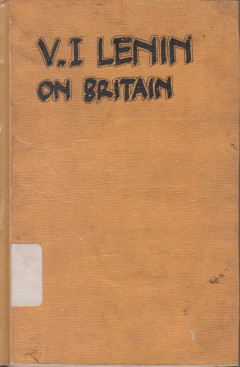
V. I. Lenin on Britain
V. I. Lenin on Britain is a curated collection of Lenin’s writings focused on British politics, labor movements, and international relations. Through speeches, articles, and correspondence, Lenin analyzes the development of capitalism in Britain, the character of the British working class, and the role of the Labour Party within the broader socialist struggle. The volume provides insight into…
- Edisi
- -
- ISBN/ISSN
- -
- Deskripsi Fisik
- 628 pages : ; 19 cm
- Judul Seri
- -
- No. Panggil
- 335.43 LEN v
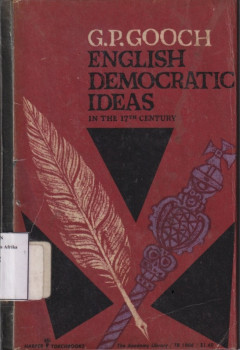
English Democratic Ideas in the Seventeenth Century
This book examines the development of democratic ideas in 17th-century England, including the thinking of figures such as the Levellers, Milton, Harrington, and other political groups during the English Revolution. G. P. Gooch traces the origins of modern democratic ideas through the political conflicts, religious upheavals, and constitutional changes that occurred during this period. This edit…
- Edisi
- -
- ISBN/ISSN
- -
- Deskripsi Fisik
- x, 309 pages ; 20,5 cm
- Judul Seri
- -
- No. Panggil
- 320.42 GOO e
Groot-Brittannië: Land van stille revoluties
This book provides an overview of the character, history, and social development of Great Britain, described as the “silent land of revolution.” Dr. H. A. Schönhage outlines the cultural, political, and economic changes that shaped modern Britain without major upheavals. Using a popular and descriptive approach, the book presents a concise analysis of British society, traditions, instituti…
- Edisi
- -
- ISBN/ISSN
- -
- Deskripsi Fisik
- 326 pages : illustration ; 24 cm
- Judul Seri
- -
- No. Panggil
- 914.2 SCH g
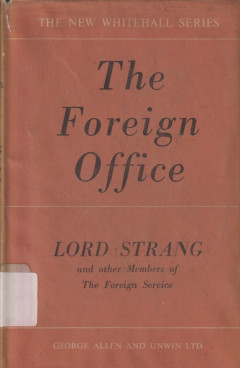
The Foreign office
This book, written by Lord Strang, former Permanent Under-Secretary of State for Foreign Affairs, provides an authoritative overview of the structure, functions, and evolution of the British Foreign Office. It explains the organization of the diplomatic service, its operational methods, and its role in shaping British foreign policy. The work offers historical insights into the development of m…
- Edisi
- -
- ISBN/ISSN
- -
- Deskripsi Fisik
- 226 pages ; 22 cm
- Judul Seri
- -
- No. Panggil
- 327.101 STR f
 Karya Umum
  Filsafat
  Agama
Agama  Ilmu-ilmu Sosial
  Bahasa
  Ilmu-ilmu Murni
  Ilmu-ilmu Terapan
  Kesenian, Hiburan, dan Olahraga
  Kesusastraan
  Geografi dan Sejarah