Ditapis dengan

Corporate society: Class, property, and contemporary capitalism
So argues John McDermott in Corporate Society, an original and far-reaching analysis of the impact of the modern corporation on contemporary social structure. Combining business history with political insight, McDermott offers a systematic critique of the post-industrial order and the illusions it fosters. He warns against the development of a "post-society industry" in which the corporate orde…
- Edisi
- -
- ISBN/ISSN
- 0-8133-0708-2
- Deskripsi Fisik
- xvi, 208 pages : index ; 23 cm
- Judul Seri
- -
- No. Panggil
- 306.36 Der c

The protestant ethic and the spirit of capitalism : A norton critical edition
This landmark work sets out the relationship between Western religious ethos and the emergence and growth of capitalism; its thesis being that the values of hard work and industry at the core of ascetic Protestantism made it possible for modern rational capitalism to flourish. This Norton Critical Edition is based on the Talcott Parsons translation (1930). It is accompanied by the Translator’…
- Edisi
- ed.1
- ISBN/ISSN
- 978-0-393-93068-9
- Deskripsi Fisik
- xii, 338 pages : illustrations (black and white) : bibl: hlm 323-326 : index ; 21 cm
- Judul Seri
- -
- No. Panggil
- 306.6 Web p

The other Davos
Each year, the Swiss mountain resort Davos is host to the meetings of the World Economic Forum. To this informal gathering of the most powerful business and financial magnates in the capitalist world are invited political leaders, cultural and religious organizations and even some trade unionists. The aim is to define global economic strategies.
- Edisi
- -
- ISBN/ISSN
- 1-85649-988-X
- Deskripsi Fisik
- ix, 132 pages : illustrations (black and white) ;21 cm
- Judul Seri
- -
- No. Panggil
- 337 Hou o
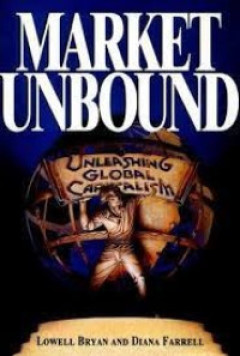
Market unbound: Unleashing global capitalism
The world is on the verge of the most sweeping economic changes since the Industrial Revolution. National economies are transforming from government-controlled market systems into an open international marketplace under no one's control. The consequences will be both exhilarating and terrifying. Market Unbound is the first compelling blueprint for adapting to this new global market. According …
- Edisi
- -
- ISBN/ISSN
- 0-471-14446-0
- Deskripsi Fisik
- xvii, 268 pages : illustrations (black and white) ; 23 cm
- Judul Seri
- -
- No. Panggil
- 332.042 Bry m

Supercapitalism: The battle for democracy in an age of big business
From one of America's foremost economic and political thinkers comes a vital analysis of our new hypercompetitive and turbo-charged global economy and the effect it is having on American democracy. With his customary wit and insight, Reich shows how widening inequality of income and wealth, heightened job insecurity, and corporate corruption are merely the logical results of a system in which p…
- Edisi
- -
- ISBN/ISSN
- 978-184831-007-0
- Deskripsi Fisik
- 272 pages : illustrations (black and white) ; 21 cm
- Judul Seri
- -
- No. Panggil
- 330.112 Rei s

Natural capitalism: Creating the next industrial revolution
Contents: 1. The next industrial revolution 2. Reinventing the wheels: Hypercars and neighborhoods 3. Waste not 4. Making the world 5. Building blocks 6. Tunneling through the cost barrier etc.
- Edisi
- Ed. 1
- ISBN/ISSN
- 0-316-35316-7
- Deskripsi Fisik
- xix, 396 pages : illustrations (black and white) ; 24 cm
- Judul Seri
- -
- No. Panggil
- 338.973 Haw n
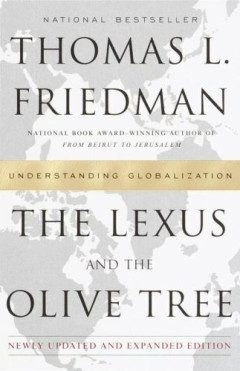
The Lexus and the olive tree: Understanding globalization
In this vivid portrait of the new business world, Thomas L. Friedman shows how technology, capital, and information are transforming the global marketplace, leveling old geographic and geopolitical boundaries. With bold reporting and acute analysis, Friedman dramatizes the conflict between globalizing forces and local cultures, and he shows why a balance between progress and the preservation of…
- Edisi
- Ed. 1
- ISBN/ISSN
- 0-385-49934-5
- Deskripsi Fisik
- xxii, 490 pages : illustrations (black and white) ; 20 cm
- Judul Seri
- -
- No. Panggil
- 337 Fri l
Architects of poverty : Why African capitalism need changing
Of an estimated 1 billion people in the world who are trapped in a cycle of grinding poverty and despair, a disproportionate number live in sub-Saharan Africa. In this innovative and challenging account, Moeletsi Mbeki analyses the plight of Africa and concludes that the fault lies not with the mass of its people but with its rulers – the political elites who contrive to keep their fellow ci…
- Edisi
- -
- ISBN/ISSN
- 978-1-77010-161-6
- Deskripsi Fisik
- xiv, 196 pages : illustrations (black and white) ; 20 cm
- Judul Seri
- -
- No. Panggil
- 330.96891 Mbe a

Compassionate capitalism: People helping people help themselves
Compassionate capitalism? How could that be? Doesn't "capitalism" mean "dog-eat-dog, law of the jungle, every person for himself"? Rich DeVos, co-founder and former president of Amway, responds to this hard-nosed approach with a resounding "no." He offers more than a vision in this extraordinary book. It is a plan. A proven plan. A plan that has made him one of America's richest men, and that h…
- Edisi
- -
- ISBN/ISSN
- 0-525-93567-3
- Deskripsi Fisik
- x, 336 pages ; 23 cm
- Judul Seri
- -
- No. Panggil
- 330.122 Dev c

The stages of economic growth: A non-communist manifesto
This book is a generalitation from the whole span of modern history. It gives an account of economic growth, based on a dynamic theory of production and interpreted in terms of actual societies. It helps to explain historical changes and to predict major political and economic trends: and it provides the significant links between economic and non-economic behavior which Karl Marx failed to discern
- Edisi
- -
- ISBN/ISSN
- -
- Deskripsi Fisik
- x, 178 pages : index ; 21 cm
- Judul Seri
- -
- No. Panggil
- 338.9 Ros s
 Karya Umum
  Filsafat
  Agama
Agama  Ilmu-ilmu Sosial
  Bahasa
  Ilmu-ilmu Murni
  Ilmu-ilmu Terapan
  Kesenian, Hiburan, dan Olahraga
  Kesusastraan
  Geografi dan Sejarah