Ditapis dengan

The Political thought of Mao Tse-Tung
The Political Thought of Mao Tse-tung explores the ideological foundations and evolution of Mao’s political philosophy, tracing its development from the early revolutionary years through the consolidation of power in the People’s Republic of China. The book examines key concepts such as the mass line, class struggle, continuous revolution, and the relationship between leadership and the peo…
- Edisi
- -
- ISBN/ISSN
- -
- Deskripsi Fisik
- ix, 319 pages : 19 cm
- Judul Seri
- -
- No. Panggil
- 320.951 SCH p
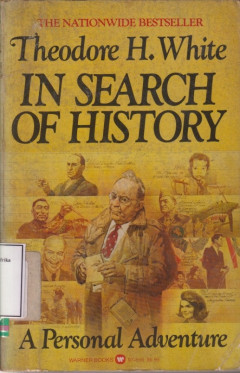
In Search of history: A Personal adventure
This book is the autobiography of Theodore H. White, a renowned American political journalist. In this reflective work, White traces his life and career as a journalist, from his youth through his wartime experiences to the landmark reporting that shaped modern political history. Through personal stories and observations, White provides an in-depth look at journalism, American politics, and the…
- Edisi
- -
- ISBN/ISSN
- 0-446-97656-3
- Deskripsi Fisik
- 561 pages ; 20,5 cm
- Judul Seri
- -
- No. Panggil
- 320.09 WHI s

International encyclopedia of the social sciences: Biographical supplement (V…
Volume 18 of the International Encyclopedia of the Social Sciences is a biographical supplement providing detailed accounts of major figures whose work has significantly shaped the development of the social sciences. Edited by David L. Sills, the volume contains authoritative biographies written by specialists across sociology, anthropology, political science, economics, psychology, and related…
- Edisi
- 18
- ISBN/ISSN
- 0-02-895690-7
- Deskripsi Fisik
- xxxviii, 820 pages ; 26 cm
- Judul Seri
- -
- No. Panggil
- 303.092 SIL i
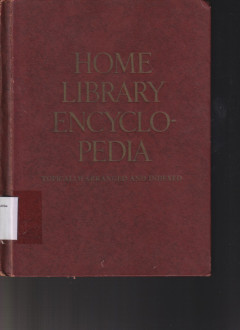
Famous people of all tim: Volume 9
Volume 9 of The Home Library Encyclopedia, titled “Famous People of All Time,” provides biographical sketches of influential individuals from various periods and regions of the world. Edited by Russell F. W. Smith, the volume highlights significant achievements and contributions in fields such as politics, science, literature, philosophy, art, and social reform. Written in an accessible and…
- Edisi
- -
- ISBN/ISSN
- -
- Deskripsi Fisik
- xiii, 415 pages : illustration ; 25 cm
- Judul Seri
- -
- No. Panggil
- 030 SMI f
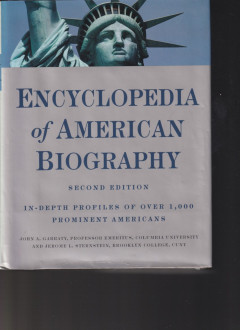
Encyclopedia of American biography
The Encyclopedia of American Biography (Second Edition) is a comprehensive reference work containing biographical entries of notable figures in the history of the United States. Edited by John A. Garraty and Jerome L. Sternstein, the volume provides concise, authoritative, and reliable profiles across various fields, including politics, science, arts, social movements, and public life. Designed…
- Edisi
- 2
- ISBN/ISSN
- 0-06-270017-0
- Deskripsi Fisik
- xvi, 1263 pages ; 24 cm
- Judul Seri
- -
- No. Panggil
- 920.073 GAR e

Notre revolte
This book is the memoir of Maurice Challe, a senior French Air Force general, which describes his role in the political and military crisis surrounding the Algerian War of Independence and his involvement in the 1961 “Putsch des Généraux” (generals' coup). Challe outlines the moral, political, and strategic reasons that led his group to oppose the French government's policy on Algeria. Th…
- Edisi
- cet 1
- ISBN/ISSN
- -
- Deskripsi Fisik
- 444 pages; 21 cm
- Judul Seri
- -
- No. Panggil
- 965.04 CHA n

Hindenburg und die Sage von der Deutschen Republik
This book is a critical biography of Paul von Hindenburg, a military figure and President of Germany during the Weimar Republic era. Emil Ludwig describes Hindenburg's life journey, from his military career and his role in World War I to his involvement in post-war German politics. In addition, this book examines the myths and legends that developed around the Weimar Republic and describes the …
- Edisi
- -
- ISBN/ISSN
- -
- Deskripsi Fisik
- 378 pages ; 20,5 cm
- Judul Seri
- -
- No. Panggil
- 943.085092 LUD h
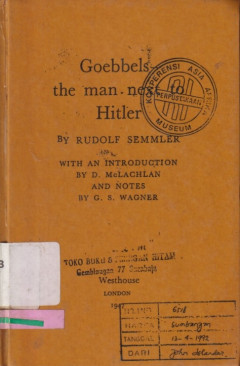
Goebbels: The Man next to Hitler
This book is the personal account of Rudolf Semmler, one of Joseph Goebbels' closest associates, the Nazi German Minister of Propaganda. Through the author's personal experiences, this book describes Goebbels' personality, leadership style, propaganda strategies, and his relationship with Adolf Hitler and the inner circle of the Nazi Party. With an introduction by D. McLachlan and additional no…
- Edisi
- -
- ISBN/ISSN
- -
- Deskripsi Fisik
- 234 pages : illustration ; 18,5 cm
- Judul Seri
- -
- No. Panggil
- 943.086092 SEM g

Hitler: The Survival myth
This book critically examines the myth surrounding Adolf Hitler's possible survival after the collapse of Nazi Germany in 1945. Donald M. McKale traces the origins of conspiracy theories about Hitler's escape, how rumors spread through propaganda, conflicting testimonies, and postwar intelligence reports. Using various historical sources and official documents, the author explains why these myt…
- Edisi
- -
- ISBN/ISSN
- 0-8154-1128-6
- Deskripsi Fisik
- xxiv, 270 pages : illustration ; 22,5 cm
- Judul Seri
- -
- No. Panggil
- 943.086092 MCK h

Canaris
Canaris is a biography of Admiral Wilhelm Canaris, an important figure who led the German military intelligence service (Abwehr) during the Nazi era. Written by Karl Heinz Abshagen and translated by Alan Houghton Brodrick, this book describes Canaris' life, career, and complex role in the German intelligence network. In addition to being a high-ranking officer, Canaris was known for his ambival…
- Edisi
- -
- ISBN/ISSN
- -
- Deskripsi Fisik
- 264 pages ; 22 cm
- Judul Seri
- -
- No. Panggil
- 303.6443 ABS c
 Karya Umum
  Filsafat
  Agama
Agama  Ilmu-ilmu Sosial
  Bahasa
  Ilmu-ilmu Murni
  Ilmu-ilmu Terapan
  Kesenian, Hiburan, dan Olahraga
  Kesusastraan
  Geografi dan Sejarah