Ditapis dengan

American dreams: The United States since 1945
For a brief, bright moment in 1945, America stood at its apex, looking back on victory not only against the Axis powers but against the Great Depression, and looking ahead to seemingly limitless power and promise. What we've done with that power and promise over the past six decades is a vitally important and fascinating topic that has rarely been tackled in one volume, and never by a historian…
- Edisi
- -
- ISBN/ISSN
- 978-1-59420-262-9
- Deskripsi Fisik
- x, 420 pages ; 24 cm
- Judul Seri
- -
- No. Panggil
- 973. 9 BRA a

The right nation: Conservative power in America
Evaluates the conservative movement that has swept across America in recent years, contending that conservatives have waged deliberate and effective campaigns against liberal advances, in an analysis that offers insight into right-wing politics and its organizers, representatives, and supporters.
- Edisi
- -
- ISBN/ISSN
- 1-59420-020-3
- Deskripsi Fisik
- 450 pages : Illustrations (blck and white) : index ; 24 cm
- Judul Seri
- -
- No. Panggil
- 320.52 MIC r
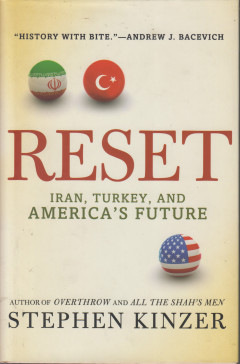
Reset: Iran, Turkey, and America’s future
“Reset: Iran, Turkey, and America’s Future” explores the complex geopolitical relationships between the United States and two pivotal Middle Eastern nations: Iran and Turkey. Stephen Kinzer argues that U.S. foreign policy has long relied on outdated assumptions and alliances, and proposes a strategic realignment that prioritizes diplomatic engagement with Iran and cooperation with Turkey.…
- Edisi
- -
- ISBN/ISSN
- 978-0-8050-9127-4
- Deskripsi Fisik
- 274 pages : illustrations ; 24,5 cm
- Judul Seri
- -
- No. Panggil
- 327.73055 KIN r
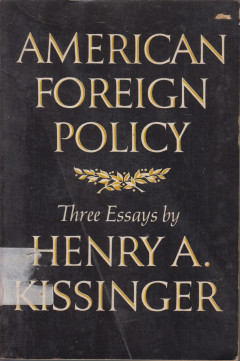
American foreign policy: Three essays
American Foreign Policy: Three Essays presents Henry A. Kissinger’s influential analyses of the strategic challenges confronting the United States during the Cold War era. In these essays, Kissinger examines the central issues of American foreign policy, the ideological and geopolitical forces shaping global power, and the need for a coherent national strategy. His reflections provide insight…
- Edisi
- -
- ISBN/ISSN
- 393-09853-2
- Deskripsi Fisik
- 143 pages ; 20,5 cm
- Judul Seri
- -
- No. Panggil
- 327.73 KIS a

The Post-American world
The Post-American World by Fareed Zakaria explores the shifting global landscape in which the dominance of the United States is challenged by the rapid rise of other nations, particularly China and India. Rather than describing the decline of America, Zakaria argues that the world is entering a “post-American” phase characterized by the rise of the rest. He examines historical patterns of g…
- Edisi
- -
- ISBN/ISSN
- 978-0-393-06235-9
- Deskripsi Fisik
- 292 pages ; 24 cm
- Judul Seri
- -
- No. Panggil
- 303.49 ZAK p

The United States of ambition: Politicians, power, and the pursuit of office
The United States of Ambition offers a penetrating analysis of how American politicians rise to power and the systemic incentives that shape their behavior. Alan Ehrenhalt examines the evolution of political ambition in the United States, exploring how cultural changes, institutional reforms, and shifting public expectations have transformed the nature of public office. Through sharp commentary…
- Edisi
- -
- ISBN/ISSN
- 0-8129-2027-9
- Deskripsi Fisik
- xxiii, 309 pages : illustrations ; 21 cm
- Judul Seri
- -
- No. Panggil
- 324.973 EHR u

The Politics of foreign aid: American experience in Southeast Asia
The Politics of Foreign Aid examines the political dynamics behind America's foreign aid programs in Southeast Asia during the early Cold War era. John D. Montgomery analyzes how strategic, economic, and ideological considerations shaped U.S. assistance initiatives, and how these programs influenced local political structures and development policies. This study highlights the complexities, suc…
- Edisi
- -
- ISBN/ISSN
- -
- Deskripsi Fisik
- xv, 336 pages ; 20,5 cm
- Judul Seri
- -
- No. Panggil
- 327.73 MON p

Homeland insecurity: How Washington politicians have made America less safe
Homeland Insecurity examines how political decisions in Washington weakened the effectiveness of U.S. law enforcement and national security agencies, particularly the FBI. Drawing from their direct experience in counterterrorism, Terry D. Turchie and Kathleen M. Puckett reveal how partisan politics, bureaucratic changes, and misguided reforms undermined efforts to keep America safe. The authors…
- Edisi
- -
- ISBN/ISSN
- 978-1-933909-33-2
- Deskripsi Fisik
- xiii, 313 pages ; 23,5 cm
- Judul Seri
- -
- No. Panggil
- 363.25 TUR h

Then Everything changed: Stunning alternate histories of American politics
This book presents a series of alternate historical scenarios that reimagine pivotal moments in modern American politics. Jeff Greenfield explores how small, often overlooked events—such as a driver’s mistake, a medical decision, or a brief moment of chance—could have profoundly changed the careers of prominent political figures like John F. Kennedy, Robert F. Kennedy, Jimmy Carter, Geral…
- Edisi
- -
- ISBN/ISSN
- 978-0-399-15706-6
- Deskripsi Fisik
- xiv, 434 pages : illustrations ; 23,5 cm
- Judul Seri
- -
- No. Panggil
- 973.92 GRE t

The rise and fall of the American left
The American Left was born in America, not, as some would have it in Europe or the Third World, and the American Left was nurtured by intellectuals and activists who read Jefferson and Whitman before the read Marx or Mao. One lesson this brilliant history teaches us in that the fury of radical innocence and wounded idealism so peculiar to American intellectual history springs from native soil
- Edisi
- -
- ISBN/ISSN
- 0-393-03075-X
- Deskripsi Fisik
- 432 pages : illustrations ; 22 cm
- Judul Seri
- -
- No. Panggil
- 303.484 DIG r
 Karya Umum
  Filsafat
  Agama
Agama  Ilmu-ilmu Sosial
  Bahasa
  Ilmu-ilmu Murni
  Ilmu-ilmu Terapan
  Kesenian, Hiburan, dan Olahraga
  Kesusastraan
  Geografi dan Sejarah