Ditapis dengan
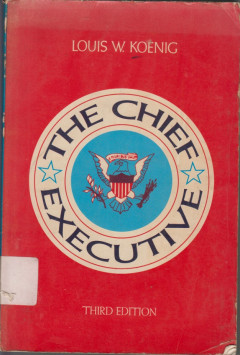
The Chief executive
This third edition of Louis W. Koenig’s influential work offers a comprehensive examination of the American presidency as the central institution of executive power in the United States. The book analyzes the constitutional foundations, political dynamics, administrative responsibilities, and leadership roles of the president. Koenig explores the evolution of presidential power, the relations…
- Edisi
- 3
- ISBN/ISSN
- 0-15-506672-2
- Deskripsi Fisik
- x, 452 pages ; 23,5 cm
- Judul Seri
- -
- No. Panggil
- 352.23 KOE c
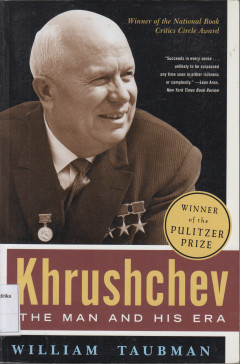
Khrushchev: The Man and His era
This Pulitzer Prize–winning biography offers an extensive and deeply researched portrait of Nikita Khrushchev, one of the most pivotal leaders of the Soviet Union. William Taubman reconstructs Khrushchev’s life—from his rise through the Communist Party under Stalin, to his surprising emergence as premier, and his attempts to reform the Soviet system while managing the dangers of the Cold …
- Edisi
- -
- ISBN/ISSN
- 978-0-393-05279-5
- Deskripsi Fisik
- xx, 871 pages : illustrations ; 23,5 cm
- Judul Seri
- -
- No. Panggil
- 947.084092 TAU k
The Oxford history of the twentieth century
This book presents a comprehensive overview of 20th-century world history through contributions from leading international historians. Edited by Michael Howard and William Roger Louis, this work examines the political, economic, social, cultural, and technological developments that shaped the modern world. Major themes such as the world wars, colonialism and decolonization, global economic chan…
- Edisi
- -
- ISBN/ISSN
- 0–19–820428–0
- Deskripsi Fisik
- xxii, 458 pages : illustration ; 24 cm
- Judul Seri
- -
- No. Panggil
- 909.82 HOW o

The Reagan record: An Assessment of America’s changing domestic priorities
This Urban Institute study provides a comprehensive assessment of the domestic policies implemented during the Reagan administration. Edited by John L. Palmer and Isabel V. Sawhill, the volume examines major shifts in economic policy, social welfare programs, federal–state fiscal relations, taxation, and public spending priorities. The contributors analyze the intended and actual impacts of R…
- Edisi
- -
- ISBN/ISSN
- 0-88730-001-4
- Deskripsi Fisik
- xvii, 415 pages : illustrations ; 22,5 cm
- Judul Seri
- -
- No. Panggil
- 338.973 PAL r

Hostage in Peking
This book is a firsthand account of Anthony Grey, a Reuters correspondent who was held as a political hostage by the People's Republic of China government for two years (1967–1969) during the Cultural Revolution. Through personal narrative, Grey describes his experiences of detention, the psychological pressures, his interactions with local authorities, and the political and social situation …
- Edisi
- -
- ISBN/ISSN
- 0–297–79503–1
- Deskripsi Fisik
- 343 pages : illustration ; 21,5 cm
- Judul Seri
- -
- No. Panggil
- 365.450924 GRE h
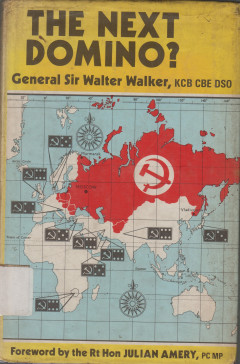
The Next domino?
The Next Domino? examines the geopolitical tensions of the late Cold War through the perspective of General Sir Walter Walker, former NATO Commander-in-Chief of Allied Forces Northern Europe. The book analyzes the perceived threat of Soviet expansion and the possibility of a "domino effect" in global political instability. Walker discusses military strategy, ideological confrontation, and Weste…
- Edisi
- -
- ISBN/ISSN
- 0-85205-005-4
- Deskripsi Fisik
- xvi, 371 pages : illustrations ; 24 cm
- Judul Seri
- -
- No. Panggil
- 327.41047 WAL n
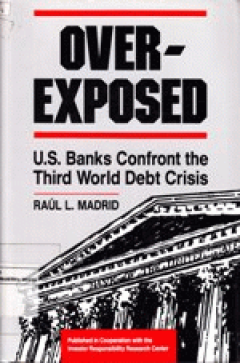
Over-exposed: U.S. Banks confront Third World debt crisis
Raul Madrid's Over-exposed represents the first in-depth study of the involvement of U.S. banks in the Third World debt crisis. Based on extensive interviews with commercial bankers, the book examines the decision-making process at U.S. banks that led to the lending boom of the 1970s and early 1980s as well as the role the banks played in the management of the debt crisis. Madrid argues that ba…
- Edisi
- -
- ISBN/ISSN
- 0-931-035-50-3
- Deskripsi Fisik
- xvi, 260 pages ; 24 cm
- Judul Seri
- -
- No. Panggil
- 336.343 MAD o

The Realities behind diplomacy: Background influences on British external pol…
This book examines the fundamental factors that influenced British foreign policy from the mid-19th century to 1980. Paul Kennedy examines the various aspects—economic strength, geographic location, social structure, strategic interests, and global power dynamics—that shaped how Britain responded to international change. Using historical approaches and political analysis, the book explains …
- Edisi
- -
- ISBN/ISSN
- -
- Deskripsi Fisik
- 416 pages ; 19,5 cm
- Judul Seri
- -
- No. Panggil
- 327.41009 KEN r

Sino-Soviet crisis politics: A Study of political change and communication
Richard Wich's Sino-Soviet Crisis Politics is an in-depth study of the political dynamics and communication between the People's Republic of China and the Soviet Union during a period of heightened ideological and strategic tensions during the Cold War. Through analysis of archives, political statements, and communication patterns between the two countries, Wich outlines how the crisis and conf…
- Edisi
- -
- ISBN/ISSN
- 0-674-80935-1
- Deskripsi Fisik
- 313 pages ; 23,5 cm
- Judul Seri
- -
- No. Panggil
- 327.51047 WIC s

The Sino-Soviet conflict: A Global perspective
This book is a collection of papers presented at a conference organized by the Center for Contemporary Chinese and Soviet Studies, University of Washington, in 1980. It discusses the Sino-Soviet conflict from a global perspective, including the dynamics of political and strategic relations between the People's Republic of China and the Soviet Union. The analysis in this book highlights the hist…
- Edisi
- -
- ISBN/ISSN
- 0-295-95873-1
- Deskripsi Fisik
- xxii, 408 pages ; 23,5 cm
- Judul Seri
- -
- No. Panggil
- 327.51047 ELL s
 Karya Umum
  Filsafat
  Agama
Agama  Ilmu-ilmu Sosial
  Bahasa
  Ilmu-ilmu Murni
  Ilmu-ilmu Terapan
  Kesenian, Hiburan, dan Olahraga
  Kesusastraan
  Geografi dan Sejarah