Ditapis dengan

India's foreign policy: Nehru to Rao
India's foreign policy is a culmination of the past ways of thinking of the people and the past declarations of their leaders. The stand of the Indian National Congress at its Madras Session 1927 was very much against the use of India as a base for the Britishers launching attacks on the freedom of other people. Shri Jawaharlal Nehru, the first Prime Minister of Independent India, was a partici…
- Edisi
- -
- ISBN/ISSN
- -
- Deskripsi Fisik
- x, 184 pages : illustrations : index ; 23 cm
- Judul Seri
- -
- No. Panggil
- 327.54 Jos i
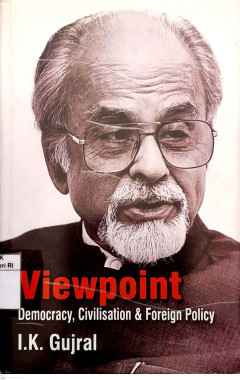
Viewpoint: Democracy, Civilisation and foreign policy
The French Revolution broke down the barriers of class and estate. It propelled the world forward into the modern age, one that placed the individual at the centre of the political system, and gave birth to the modern Republic and to the nation state. We in India have been keen students of the Revolution and the subsequent development of democratic institutions in France.
- Edisi
- -
- ISBN/ISSN
- 81-7764-626-5
- Deskripsi Fisik
- viii, 292 pages : ilustrations : index ; 25 cm
- Judul Seri
- -
- No. Panggil
- 327.54 Guj v
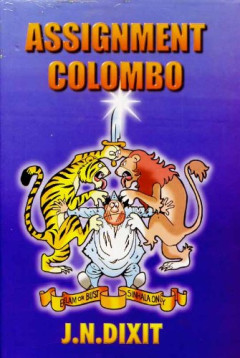
Assignment Colombo
J. N. Dixit, former Foreign Secretary was India's High Commissioner in Sri Lanka from 1985 to 1989. He was an active participant in events leading to the signing of the Indo-Sri Lanka agreement and induction of the IPKF into Sri Lanka. This book is an attempt to put matters in perspective in the context of India's motivation which remain misunderstood. The author feels that the peoples of In…
- Edisi
- -
- ISBN/ISSN
- 81-220-0499-7
- Deskripsi Fisik
- xxi, 393 pages : illustrations (black and white) : index ; 22 cm
- Judul Seri
- -
- No. Panggil
- 327.54 Dix a

Across borders : Fifty years of India's foreign policy
In the course of this illuminating narrative the author projects, in a dronological order, the various facets of India's foreign policy as they evolved. He also describes their immact on both the national and international fronts. This volume puts into perspective significant epoch-making events which profoundly affected the orientation of India's foreign policy priorities and also incisively a…
- Edisi
- -
- ISBN/ISSN
- 81-87285-02-8
- Deskripsi Fisik
- xii, 453 pages : index ; 23 cm
- Judul Seri
- -
- No. Panggil
- 327.54 Dix a
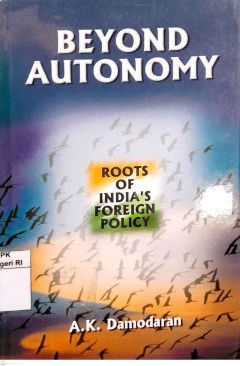
Beyond autonomy: India's foreign policy
In a world of instant communication, no country can remain in isolation. The impact of socio-cultural and economic trends receive instant reverberations the world over. This is equally true of foreign policy. While the balance of power and ideology may have undergone changes, the fundamentals of Indian diplomatic expression has remained the same, with its commitment to our national interests an…
- Edisi
- -
- ISBN/ISSN
- 81-7039-241-1
- Deskripsi Fisik
- xv, 246 pages : index ; 23 cm
- Judul Seri
- -
- No. Panggil
- 327.54 Dam b
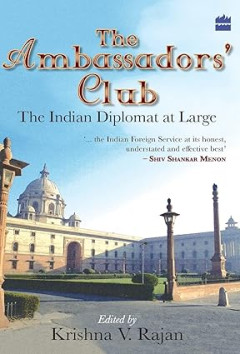
The ambassador's Club : The Indian diplomat at large
The role of the Indian diplomat is a varied one, as Desai's and other'S accounts in The Ambassador's Club show, and Krishna V. Rajan, himself a skilful diplomat, has brought together, for the first time, a selection of experiences that shows the Indian Foreign Service in a remarkable new light. With a fine sense of observation and considerable writing skills, the contributions included here sho…
- Edisi
- -
- ISBN/ISSN
- 978-93-5029-097-2
- Deskripsi Fisik
- xx, 330 pages : index ; 22 cm
- Judul Seri
- -
- No. Panggil
- 327.2092 Raj a
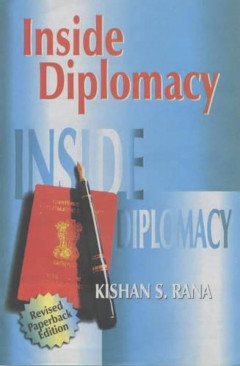
Inside diplomacy
The book deals with the functional dynamics, and the operational mechanics of the Indian Foreign Office from its inception to date.It has filled the gap in information about the implementation of India's foreign policy by providing a detailed analysis of the procedures and functional dynamics of the Ministry of External Affairs. No book in the past, to the best of one's knowledge, has made such…
- Edisi
- cet. 2
- ISBN/ISSN
- 81-7049-152-5
- Deskripsi Fisik
- 477 pages : bibl: hlm 464-466 : index ; 22 cm
- Judul Seri
- -
- No. Panggil
- 327.2 Ran i

Understanding international conflicts: An introduction to theory and history
In revising classic works in political science, Longman celebrates the contributions its authors and their research have made to the discipline The Longman Classics in Political Science series honors these authors and their work Providing students with an updated context, each title in the series includes a foreword, written by one of today's top scholars, offering a fresh, in-depth analysis of…
- Edisi
- fifth edition
- ISBN/ISSN
- 0-321-20945-1
- Deskripsi Fisik
- xii, 276 pages : illustrations : index ; 24 cm
- Judul Seri
- -
- No. Panggil
- 327.16 Nye u

ASEAN, India, Australia: Towards closer engagement in a new Asia
India's emergence of a great power has sensitized its regional neighbours to its growing role as a key security actor in an increasingly interdependent world. Both Australia and ASEAN now view India as a major player in the formulation and application of their own broad security agendas. This emerging trilateral compendium is particularly evident in such policy areas as maritime security, clima…
- Edisi
- First Published
- ISBN/ISSN
- 978-981-230-963-1
- Deskripsi Fisik
- xxv, 417 pages : illustrations : bibl: hlm 369-398 : index ; 24 cm
- Judul Seri
- -
- No. Panggil
- 327.1 Tow a

India's foreign policy and non-alignment
This book attempts to trace the origin and growth of the concept of non-alignment and how it shaped India's foreign policy. The books purports to analyze the position India enjoys in the Non-Aligned Movement especially after the 'healing touch' provided to the Movement under the leadership of Indira Gandhi, who assumed the chairpersonship of the Movement in the New Delhi Conference.
- Edisi
- -
- ISBN/ISSN
- 81-86565-72-8
- Deskripsi Fisik
- viii, 349 pages : bibl: hlm 320-335 : index ; 22 cm
- Judul Seri
- -
- No. Panggil
- 327.1 Jai i
 Karya Umum
  Filsafat
  Agama
Agama  Ilmu-ilmu Sosial
  Bahasa
  Ilmu-ilmu Murni
  Ilmu-ilmu Terapan
  Kesenian, Hiburan, dan Olahraga
  Kesusastraan
  Geografi dan Sejarah