Ditapis dengan

Non-Aligned movement in the era of globalization: With Reference to informati…
This book discusses the role and relevance of the Non-Aligned Movement (NAM) in the era of globalization, with particular emphasis on issues of information and communication. Harmoko explores how developing countries can strengthen cooperation, maintain independence, and ensure fair access to global information flows. The work highlights the challenges faced by NAM member states in responding t…
- Edisi
- -
- ISBN/ISSN
- -
- Deskripsi Fisik
- 110 pages : illustrations ; 23 cm
- Judul Seri
- -
- No. Panggil
- 327.17 HAR n

KTT X Gerakan Non Blok : Tenth conference of heads of state or government of …
The book "X Non-Aligned Movement Summit: Tenth Conference of Heads of State or Government of Non-Aligned Countries" is the official documentation of the 10th Non-Aligned Movement Summit held in Jakarta in 1992 and published in 1993. This book contains a series of activities, decisions, and political declarations produced by the heads of state and government of Non-Aligned Movement members in re…
- Edisi
- -
- ISBN/ISSN
- -
- Deskripsi Fisik
- 618 pages : illustrations ; 28 cm
- Judul Seri
- -
- No. Panggil
- 327.172 TIM k

The Bandung Conference and Japan’s Return to Asia: Between the United State…
This book examines Japan’s diplomatic position during the early Cold War, focusing on its participation and political stance surrounding the 1955 Bandung Conference. Miyashiro analyzes Japan’s attempt to reintegrate into Asia while balancing pressure from the United States and its own regional ambitions. The work provides insight into Japan’s foreign policy transformation, regional identi…
- Edisi
- -
- ISBN/ISSN
- 9784794210357
- Deskripsi Fisik
- vii, 229 pages ; 19,5 cm
- Judul Seri
- -
- No. Panggil
- 327.52 DAI b

XII Summit conference of heads of state or government of the non-aligned move…
This volume contains the basic documents of the Twelfth Summit Conference of Heads of State or Government of the Non-Aligned Movement, held in Durban, South Africa, from 29 August to 3 September 1998. It includes declarations, resolutions, statements, and administrative documents adopted during the summit. The publication reflects the Movement's collective positions on global political, economi…
- Edisi
- -
- ISBN/ISSN
- 0-7970-3752-7
- Deskripsi Fisik
- vi, 266 pages ; 21 cm
- Judul Seri
- -
- No. Panggil
- 327.17 DEP t t

Indonesian notebook: A Sourcebook on Richard Wright and the Bandung Conference
Indonesian Notebook presents a rare compilation of writings, reflections, and contextual documents surrounding the participation of African American author Richard Wright in the 1955 Bandung Conference. Edited by Brian Russell Roberts and Keith Foulcher, the book offers insights into Wright’s encounters in Indonesia, his observations on Afro-Asian political solidarity, and the global signific…
- Edisi
- -
- ISBN/ISSN
- 978-0-8223-6067-4
- Deskripsi Fisik
- xxiv, 262 pages : illustrations ; 23 cm
- Judul Seri
- -
- No. Panggil
- 327.0958 ROB i

Tito and non-alignment: President Tito's addresses at conferences of non-alig…
World stability has been discussed for years now as wholly dependent on a balance of power and fear, and bloc negotiation. At the same time, however, we have been witness to persisting instability, as the end result of precisely these presumptions. There is no particular need to point out that non-aligned policy has been the political force that has imparted positive elements of stability to an…
- Edisi
- -
- ISBN/ISSN
- -
- Deskripsi Fisik
- 119 pages ; 20 cm
- Judul Seri
- -
- No. Panggil
- 327.17 TIT t
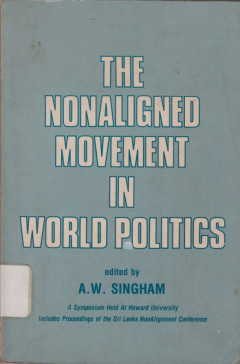
The Nonaligned movement in world politics
This volume examines the emergence, evolution, and political significance of the Non-Aligned Movement within the context of global politics during the Cold War. It analyzes the movement’s ideological foundations, its responses to major world conflicts, and its role in representing the interests of developing nations. Through contributions from various scholars, the book explores how nonalignm…
- Edisi
- -
- ISBN/ISSN
- 0-88208-069-9
- Deskripsi Fisik
- 273 pages ; 23 cm
- Judul Seri
- -
- No. Panggil
- 327.17 TIM n

Twenty Years of Bandung and Problems of Peace and Security in Asia: A Collect…
This volume presents a collection of scholarly articles reflecting on the twenty years following the historic 1955 Bandung Conference. Edited by Shashi Bhushan, the book discusses the challenges of peace and security in Asia, the evolution of Asian-African political solidarity, and the broader implications for international relations during the Cold War era. It examines regional conflicts, dipl…
- Edisi
- -
- ISBN/ISSN
- -
- Deskripsi Fisik
- xiv, 151 pages ; 22 cm
- Judul Seri
- -
- No. Panggil
- 327.095 BHU t
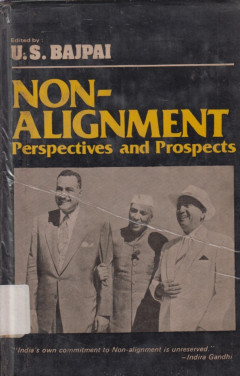
Non-alignment: perspectives and prospects
This volume presents a comprehensive collection of perspectives on the Non-Aligned Movement, examining its historical evolution, political foundations, and emerging challenges in the international system. Edited by U. S. Bajpai, the book gathers contributions from scholars and diplomats who analyze the principles, relevance, and strategic role of non-alignment in global affairs. It explores how…
- Edisi
- -
- ISBN/ISSN
- -
- Deskripsi Fisik
- xxii, 309 pages ; 25 cm
- Judul Seri
- -
- No. Panggil
- 327.17 BAJ n
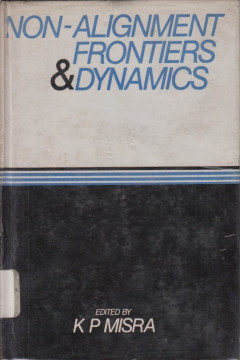
Non-alignment: Frontiers & dynamics
This book provides a comprehensive examination of the frontiers and evolving dynamics of the Non-Aligned Movement (NAM). Edited by K. P. Misra, it explores the historical background, ideological foundations, political strategies, and global roles of non-aligned countries during the Cold War era. The volume analyzes the shifting international environment and the challenges faced by NAM in mainta…
- Edisi
- -
- ISBN/ISSN
- -
- Deskripsi Fisik
- xi, 512 pages ; 24,5 cm
- Judul Seri
- -
- No. Panggil
- 327.17 MIS n
 Karya Umum
  Filsafat
  Agama
Agama  Ilmu-ilmu Sosial
  Bahasa
  Ilmu-ilmu Murni
  Ilmu-ilmu Terapan
  Kesenian, Hiburan, dan Olahraga
  Kesusastraan
  Geografi dan Sejarah