Ditapis dengan

The paradox of American power: Why the worlds only superpower can't go it alone
Not since Rome has any nation had so much economic, cultural, and military power, but that power does not allow us to solve global problems like terrorism, environmental degradation, and the proliferation of weapons of mass destruction without involving other nations. The author focuses on the rise of these and other new challenges and explains clearly why America must adopt a more cooperative …
- Edisi
- -
- ISBN/ISSN
- 0195150880
- Deskripsi Fisik
- 222 pages : 25 cm.
- Judul Seri
- -
- No. Panggil
- 327. 73 Nye p

The turn: From the cold war to a new era: The United States & the Soviet Union
The Turn is the gripping narrative history of the most important international development of our time-the passage of the United States and the Soviet Union from the Cold War to a hopeful new era. The dramatic change in relations between two former great enemies took place so rapidly and in such unexpected ways that even today it remains difficult to grasp. Now, in a brilliant and authoritative…
- Edisi
- -
- ISBN/ISSN
- 0-671-70783-3
- Deskripsi Fisik
- 514 pages : index ; 23 cm
- Judul Seri
- -
- No. Panggil
- 327.73047 Obe t

The faces of power: Constancy and change in United States foreign policy from…
The book focuses on the basic assumptions of U.S. foreign policy makers, their concepts of the priority interests of the United States, their assessments of the threats to those interests, and their premises about the power of the United States to affect the international situation. The substance of these assumptions is shown to be a crucial determinant of the constancy as well as the change in…
- Edisi
- -
- ISBN/ISSN
- 0-231-04737-1
- Deskripsi Fisik
- xi, 672 pages : index ; 23 cm
- Judul Seri
- -
- No. Panggil
- 327.73 Bro f

Talking to strangers: Improving American diplomacy at home and abroad
In this discerning book, Monteagle Stearns, a former career diplomat and ambassador, argues that U.S. foreign policymakers do not need a new doctrine, as some commentators have suggested, but rather a new attitude toward international affairs and, most especially, new ways of learning from the Foreign Service. True, the word strangers in his title refers to foreigners. However, it also refers t…
- Edisi
- -
- ISBN/ISSN
- 0-691-01130-3
- Deskripsi Fisik
- xxv, 201 pages ; 24 cm
- Judul Seri
- -
- No. Panggil
- 327.73 Ste t
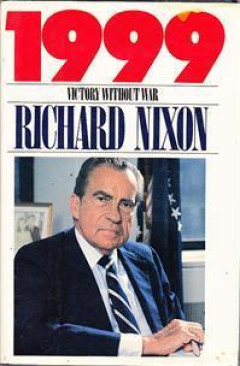
1999 Victory without war
In 1999 the former President answers all these questions and others. He gives us the basis for understanding how the world operates and how the United States should operate in the world. As we come to the end of this century of war and wonder of unprecedented bloodshed and political turmoil 1999 is an indispensable guide for avoiding repetition of our past mistakes as a nation, and fulfilling o…
- Edisi
- -
- ISBN/ISSN
- 0671627120
- Deskripsi Fisik
- 336 pages : index ; 25 cm
- Judul Seri
- -
- No. Panggil
- 327.73 Nix v

From dominoes to dynamos: The transformations of Southeast Asia
The demise of America's Cold War-era foreign policy, has transformed Southeast Asia's relationship with the United States. No longer seen in the political context of communist containment, the countries of Southeast Asia - Thailand, Indonesia, Malaysia, Singapore, the Philippines, and Vietnam - are becoming increasingly powerful players in the world economy. Their unparalleled economic growth w…
- Edisi
- -
- ISBN/ISSN
- 0-87609-166-4
- Deskripsi Fisik
- x, 115 pages : ilustrasi ; 23 cm
- Judul Seri
- -
- No. Panggil
- 330. 959053 Bre f
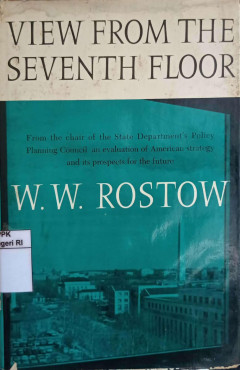
View from the seventh floor
This book contains the relationship between American diplomacy and military policy and global strategy. The book's five sections cover the broad lines of America's strategy and the relation between force and diplomacy; the home base for our foreign policy: our relations with the free world's more advanced nations and our efforts to build a global partner- ship which will supplant the postwar re…
- Edisi
- -
- ISBN/ISSN
- -
- Deskripsi Fisik
- xi, 178 pages : index ; 22 cm
- Judul Seri
- -
- No. Panggil
- 337.73 Ros v

The price of power: Kissinger in the Nixon White House
This book is an account of the foreign policy of the United States, led by Henry Kissinger, during Richard Nixon's first term in the White House. It is also a story of a collaborative relationship that appears to be a series of diplomatic victories that can be reshaped. These were the years when China was reclaimed by American diplomacy; when the much-touted agreement on Strategic Arms Limitati…
- Edisi
- -
- ISBN/ISSN
- 0-671-44760-2
- Deskripsi Fisik
- 698 pages ; 24 cm
- Judul Seri
- -
- No. Panggil
- 327.73 Her p

The intemperate zone: The third world challenge to U.S foreign policy
There is at last a lucid, penetrating and comprehensive guidebook for U.S. policy in the Third World. And Richard Feinberg has written it. The Intemperate Zone displays encyclopedic knowledge at the command of a mind equally at home with strategic and moral issues. A gracefully written book for experts and amateurs alike
- Edisi
- -
- ISBN/ISSN
- 0-393-30143-5
- Deskripsi Fisik
- 287 pages : index ; 20 cm
- Judul Seri
- -
- No. Panggil
- 327.73 Fei i

Self-determination in the new world order
In this book, the authors review U.S. and international responses to self-determination claims during and after the Cold War. Arguing that outdated Cold War perspectives continue to influence the current policies of the United States and the international community toward self-determination movements, they provide a framework for evaluating the nature and legitimacy of self-determination moveme…
- Edisi
- -
- ISBN/ISSN
- 0-87003-018-3
- Deskripsi Fisik
- xiv, 178 pages ; 23 cm
- Judul Seri
- -
- No. Panggil
- 327.73 Hal s
 Karya Umum
  Filsafat
  Agama
Agama  Ilmu-ilmu Sosial
  Bahasa
  Ilmu-ilmu Murni
  Ilmu-ilmu Terapan
  Kesenian, Hiburan, dan Olahraga
  Kesusastraan
  Geografi dan Sejarah