Ditapis dengan

The Road to Tahrir square: Egypt and the United States from the rise of Nasse…
The Road to Tahrir Square chronicles the complex and often turbulent relationship between Egypt and the United States from the 1950s to the early 2010s. Lloyd C. Gardner traces how successive American administrations engaged with Egyptian leaders—from Gamal Abdel Nasser through Anwar Sadat to Hosni Mubarak—shaping the political trajectory of the Middle East’s most influential nation. The …
- Edisi
- -
- ISBN/ISSN
- 978-1-59558-721-3
- Deskripsi Fisik
- x, 230 pages ; 21 cm
- Judul Seri
- -
- No. Panggil
- 327.73062 GAR r
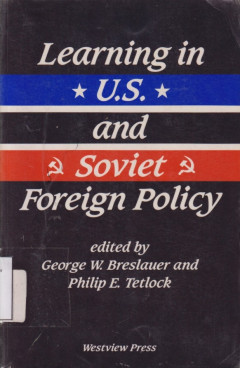
Learning in U.S. and Soviet foreign policy
This volume examines how political leaders and institutions in the United States and the Soviet Union learn from past experiences in shaping their foreign policy decisions. Through comparative case studies, the contributors analyze the cognitive, organizational, and political factors that influence learning in both superpowers during the Cold War era. The book explores how successes and failure…
- Edisi
- -
- ISBN/ISSN
- 0-8133-8264-5
- Deskripsi Fisik
- xiv, 881 pages ; 23 cm
- Judul Seri
- -
- No. Panggil
- 327.730 BRE l

Failed states: The Abuse of power and the assault on democracy
In this book, Noam Chomsky argues that the United States increasingly exhibits the characteristics of a “failed state”—one that disregards international law, undermines democratic principles, and relies on military force to pursue global dominance. Chomsky examines U.S. foreign policy after 2001, focusing on unilateral actions, the Iraq War, counterterrorism strategies, and the erosion of…
- Edisi
- -
- ISBN/ISSN
- 978-0-8050-7912-8
- Deskripsi Fisik
- 311 pages ; 24 cm
- Judul Seri
- -
- No. Panggil
- 327.73 CHO f
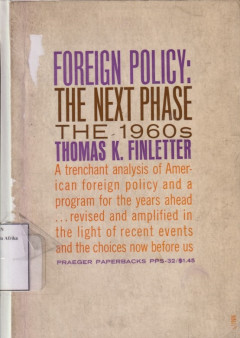
Foreign policy: The Next phase — the 1960s
This book examines the challenges and strategic choices facing United States foreign policy as the nation entered the 1960s. Finletter discusses the political, military, and economic factors shaping America’s role in the postwar world, emphasizing the need for new approaches to emerging Cold War realities. The work analyzes key issues including nuclear strategy, international alliances, and t…
- Edisi
- -
- ISBN/ISSN
- -
- Deskripsi Fisik
- 235 pages ; 20 cm
- Judul Seri
- -
- No. Panggil
- 327.73 FIN f

Diplomacy in peace and war: Recollections and reflections
This memoir by T. N. Kaul offers personal reflections on his long diplomatic career and provides insights into India’s foreign policy during critical moments of the twentieth century. The book recounts Kaul’s experiences in major postings and international negotiations, while also examining the broader dynamics of peace, war, and global diplomacy. Combining autobiographical narrative with p…
- Edisi
- -
- ISBN/ISSN
- 0-7069-0749-3
- Deskripsi Fisik
- x, 251 pages : illustration ; 21 cm
- Judul Seri
- -
- No. Panggil
- 327.54 KAU d

President Ho Chi Minh’s visit to Indonesia (February 27 – March 8, 1959)
This publication documents President Ho Chi Minh’s official visit to Indonesia from February 27 to March 8, 1959. Prepared by the Foreign Languages Publishing House in Hanoi, the book records the meetings, speeches, receptions, and public events that took place during the visit. It highlights the significance of early diplomatic relations between Vietnam and Indonesia and reflects the warm fr…
- Edisi
- -
- ISBN/ISSN
- -
- Deskripsi Fisik
- 167 halaman : ilustrasi ; 22,5 cm
- Judul Seri
- -
- No. Panggil
- 327.5970598 FOR p

Fifty years of Vietnamese diplomacy 1945–1995 (Volume II: 1975–1995)
This volume presents a detailed account of Vietnam’s diplomatic activities during the two decades following national reunification in 1975. Written by diplomat and scholar Lưu Văn Lợi, the book highlights the country’s foreign policy strategies, regional engagements, and international negotiations from 1975 to 1995. It explores Vietnam’s efforts to rebuild its global relationships, na…
- Edisi
- -
- ISBN/ISSN
- -
- Deskripsi Fisik
- 335 pages ; 21 cm
- Judul Seri
- -
- No. Panggil
- 327.597 LUU f
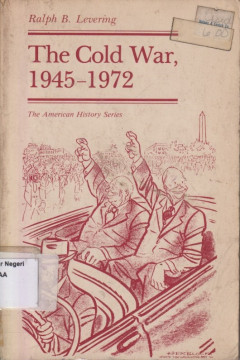
The Cold war, 1945–1972
The Cold War, 1945–1972 by Ralph B. Levering offers a concise and analytical overview of the political, diplomatic, and ideological tensions between the United States and the Soviet Union during the early decades of the Cold War. As part of The American History Series, the book provides a clear narrative covering the origins of the conflict, the development of containment policies, crises suc…
- Edisi
- -
- ISBN/ISSN
- 0-88295-811-9
- Deskripsi Fisik
- xi, 165 pages : illustrations ; 20 cm
- Judul Seri
- -
- No. Panggil
- 327.73 LEV t

Clash of titans: Africa and U.S. foreign policy
This book examines the dynamics of relations between the United States and African countries during the Cold War. Edward W. Chester analyzes America's strategic, political, and economic interests in Africa, and how US foreign policy shaped African political developments. This work evaluates global conflicts of interest, the influence of great powers, and the responses of African countries to in…
- Edisi
- -
- ISBN/ISSN
- 0-88344-065-2
- Deskripsi Fisik
- ix, 361 pages ; 24 cm
- Judul Seri
- -
- No. Panggil
- 327.7306 CHE c
Africa and the west
"Africa and the West" is a collection of academic writings edited by Michael A. Samuels, examining the dynamics of political, economic, and strategic relations between African countries and the Western world. Published as part of the Westview Special Studies on Africa, this book explores the role of Western powers in the development of African countries, the impact of colonialism and postcoloni…
- Edisi
- -
- ISBN/ISSN
- 0-89158-764-0
- Deskripsi Fisik
- xiii, 114 pages ; 23,5 cm
- Judul Seri
- -
- No. Panggil
- 327.096 SAM a
 Karya Umum
  Filsafat
  Agama
Agama  Ilmu-ilmu Sosial
  Bahasa
  Ilmu-ilmu Murni
  Ilmu-ilmu Terapan
  Kesenian, Hiburan, dan Olahraga
  Kesusastraan
  Geografi dan Sejarah