Ditapis dengan

Japan's changing political and security role: Domestic and international aspects
The central objective of this study is to describe and analyse the politics of security policy change in Japan and its significance to the Asia-Pacific region as a whole.
- Edisi
- -
- ISBN/ISSN
- 981-3035-98-6
- Deskripsi Fisik
- 57 pages ; 24 cm
- Judul Seri
- -
- No. Panggil
- 327.3433952 Kat j

Deterrence in the second nuclear age
Keith Payne begins by asking, "Did we really learn how to deter predictably and reliably during the Cold War?" He answers cautiously in the negative, pointing out that we know only that our policies toward the Soviet Union did not fail. What we can be more certain of, in Payne's view, is that such policies will almost assuredly fail in the Second Nuclear Age―a period in which direct nuclear t…
- Edisi
- -
- ISBN/ISSN
- 0-8131-0895-0
- Deskripsi Fisik
- xiv, 168 pages : index ; 23 cm
- Judul Seri
- -
- No. Panggil
- 327.17 Pay d

The security dilemmas of Southeast Asia
By examining ethnic tensions in Southeast Asia the book provides an analysis of one of the security dilemma's most recent utilisations. In particular, the book adds to the growing literature on the security dilemma and ethnic conflict by locating the analysis of ethnic tensions in Burma and Malaysia, among others, within the security literature of the Third World. In intra-ASEAN relations the…
- Edisi
- -
- ISBN/ISSN
- 981-230-108-9
- Deskripsi Fisik
- xi, 237 pages : index ; 22 cm
- Judul Seri
- -
- No. Panggil
- 327.160959 Col s

The challenge of conventional arms proliferation in Southeast Asia
This is an inquiry into the arms build-up in Southeast Asia and the measures that can be taken to control the proliferation of conventional arms in the region. It is not a plea for arms control or disarmament as much as an attempt to highlight the armament policies of countries in the region.
- Edisi
- 1st edition
- ISBN/ISSN
- 979-8026-31-4
- Deskripsi Fisik
- vi, 110 pages ; 21 cm
- Judul Seri
- -
- No. Panggil
- 327.117040959 Sin c

Hatta and Indonesia's independent and Active foreign policy : Retrospect and …
This book gathers a dozen rising scholars and analysts of Indonesian foreign policy to examine the conditions and extent to which “independent and active principle” - first articulated by Vice President Mohammad Hatta in 1948 - has been used and abused in various strategic policy issues. The book launch event aims to introduce this book to the public, especially stakeholders related to the…
- Edisi
- -
- ISBN/ISSN
- 978-979-1295-44-4
- Deskripsi Fisik
- v, 181 pages : bibl: hlm 155 ; 25 cm
- Judul Seri
- -
- No. Panggil
- 327.1 Lak h

Security and international relations
This new textbook presents security studies as a branch of international relations theory, providing readers with the critical conceptual tools to develop their expertise. The author evaluates the claims of rival theories- realism, neorealism, liberal institutionalism, classical economic liberalism, and Marxism-to explain why international actors choose or eschew force and coercive threats in o…
- Edisi
- First published
- ISBN/ISSN
- 0-521-00116-1
- Deskripsi Fisik
- xi, 349 pages : index ; 23 cm
- Judul Seri
- -
- No. Panggil
- 327.1 Kol s
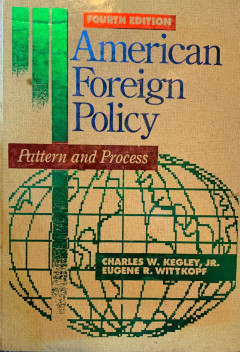
American foreign policy: Pattern and process
kegley and wittkopf have responded to the tumultuos changes of the past eighteen months with major revisions in the text of American foreign policy. The fourth edition includes: Discussions of the implications for American foreign policy of the Gorbachev-era reforms in the Soviet Union and the changes in Eastern Europe in particular, the text considers the future of "containment" and shifts …
- Edisi
- Ed. 4
- ISBN/ISSN
- 0-312-03656-6
- Deskripsi Fisik
- xii, 643 pages : index ; 25 cm
- Judul Seri
- -
- No. Panggil
- 327.1 Keg a

India's foreign policy and non-alignment
This book attempts to trace the origin and growth of the concept of non-alignment and how it shaped India's foreign policy. The books purports to analyze the position India enjoys in the Non-Aligned Movement especially after the 'healing touch' provided to the Movement under the leadership of Indira Gandhi, who assumed the chairpersonship of the Movement in the New Delhi Conference.
- Edisi
- -
- ISBN/ISSN
- 81-86565-72-8
- Deskripsi Fisik
- viii, 349 pages : bibl: hlm 320-335 : index ; 22 cm
- Judul Seri
- -
- No. Panggil
- 327.1 Jai i
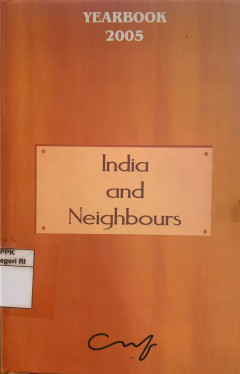
India and neighbours
While India has quietly moved from cold war politics to globalizations, barring China, India's other neighbours are yet to overcome the Cold War mentality. The result is that a section of the ruling elite among India's neighbours perceive things in terms of pressure points vis-a-vis India or try to thrive on anti-India sentiment. This has retarded the growth of healthier relations between India…
- Edisi
- -
- ISBN/ISSN
- 81-89357-00-X
- Deskripsi Fisik
- 283 pages : bibl: hlm 269-275 : index ; 22 cm
- Judul Seri
- -
- No. Panggil
- 327.1 Fea i

Contemporary European foreign policy
This major new book introduces and examines the latest developments in European foreign policy. It provides a complete overview of the ways in which the very nature of foreign policy in Europe has changed and advances new insights into contemporary European foreign policy analysis. The book is structured around three parts. Part one provides a concise overview of the latest theories and concep…
- Edisi
- -
- ISBN/ISSN
- 0-4129-0001-8
- Deskripsi Fisik
- x, 278 pages : illustrations (black and white) : index ; 24 cm
- Judul Seri
- -
- No. Panggil
- 327.1 Car c
 Karya Umum
 Filsafat
 Agama
 Ilmu-ilmu Sosial
 Bahasa
 Ilmu-ilmu Murni
 Ilmu-ilmu Terapan
 Kesenian, Hiburan, dan Olahraga
 Kesusastraan
 Geografi dan Sejarah