Ditapis dengan
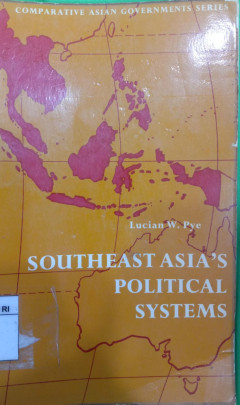
Southeast Asia's political systems
This series is dedicated to the proposition that it is no longer valid or profitable to study comparative politics within an essentially North American and European-centered frame of reference. Although admittedly more familiar, more comprehensible, and in the past, at least-closer and more important to us, the political histories, ideologies, and institutions of these areas constitute only a s…
- Edisi
- -
- ISBN/ISSN
- -
- Deskripsi Fisik
- xi, 98 pages : maps, index ; 23 cm
- Judul Seri
- Comparative Asian governments series
- No. Panggil
- 320.959 Pye s
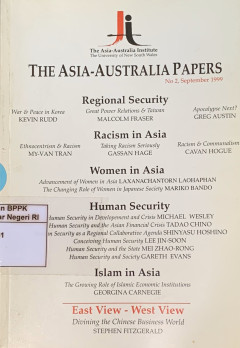
The Asia-Australia papers
War & Peace on the Korean Peninsula (pp. 1-11) by Kevin Rudd; Apocalypse Next: Will Asia become the Next Arena for Great Power Conflict? (pp. 12-17) by Greg Austin; Great Power Relations and the issue of Taiwan in the Asia-Pacific (pp. 18-23) by Malcolm Fraser; Human Security in Development and Crisis: How to Capture Human Security in Regional Institutional Arrangements? (pp. 24-34) by Micha…
- Edisi
- -
- ISBN/ISSN
- 1442-3103
- Deskripsi Fisik
- v, 122 pages ; 21 cm
- Judul Seri
- -
- No. Panggil
- 327.051 Aus a
The neutralization of Southeast Asia
The idea of neutralizing Southeast Asia--a historical battlefield of both indigenous and forces--is a subject that has attracted the attention of many statesmen and scholars alike for many years.
- Edisi
- -
- ISBN/ISSN
- 0-275-09110-4
- Deskripsi Fisik
- xviii, 206 pages : index ; 23 cm
- Judul Seri
- Praeger special studies in international politics and government
- No. Panggil
- 327.0959 Wil n

The quest for world order: Perspectives of a pragmatic idealist
A collection of speeches and writings by Professor Tommy Koh, Singapore's long-time ambassador to the UN. He provides an insider's view of the workings and failings of the UN system, multilateral negotiations, bargaining, and Singapore's economic progress and foreign policy options. Accessible to general readers, policy makers, and academic specialists interested in international organizations …
- Edisi
- Cetakan Pertama
- ISBN/ISSN
- 981-210-108-x
- Deskripsi Fisik
- xxxi, 416 pages : illustrations, index ; 22 cm
- Judul Seri
- -
- No. Panggil
- 327.1 Koh q
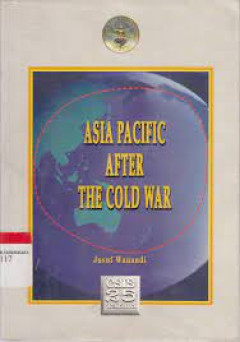
Asia Pacific after the Cold War
This book, entitled Asia Pacific after the cold war, presents a complication of papers written by Jusuf Wanandi from 1989 to 1996. Of the papers compiled, some were presented at conferences, seminars as well as at workshops in various countries, and the others are revised articles already published in newspapers and journals.
- Edisi
- -
- ISBN/ISSN
- 979-8026-48-9
- Deskripsi Fisik
- vi, 245 pages ; 25 cm
- Judul Seri
- -
- No. Panggil
- 327.116 Wan a
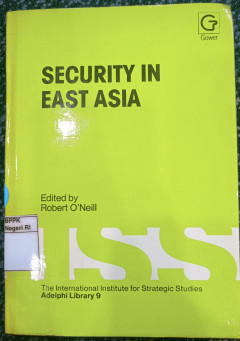
Security in East Asia
The International Institute for Strategic Studies was founded in 1985 as a centre for the provision of information on and research into the problems of international security, defence and arms control in the nuclear age.
- Edisi
- -
- ISBN/ISSN
- 0-566-00674-x
- Deskripsi Fisik
- ix, 195 pages ; 23 cm.
- Judul Seri
- -
- No. Panggil
- 327.5 O'ne s

The new Taipans: A vital source book on the people and business of the Pasifi…
It is crucial to understand the mindset of the new taipans. They are the business supremos of the fastest-growing economies in the world, and their fundamental business values are of vital importance to everyone who wishes to do business with them. The importance of family and filial piety and of the work ethic cannot be over-estimated and must be thoroughly understood by anyone wishing to gain…
- Edisi
- -
- ISBN/ISSN
- 0-7126-61328
- Deskripsi Fisik
- iv, 188 pages : index ; 24 cm
- Judul Seri
- -
- No. Panggil
- 338.04091823 Cra n

The strategic quadrangle: Russia, China, Japan, and the United States in East…
In The Strategic Quadrangle five experts on East Asia explore the new shape of power among the major players in the region-Russia, China, Japan, and the United States. The authors examine the web of alliances, historical rivalries, and conflicting worldviews that define the relations among these four powers and analyze how the interactions among them will affect East Asia and the international …
- Edisi
- -
- ISBN/ISSN
- 0876091680
- Deskripsi Fisik
- vii, 221 pages : index ; 22 cm
- Judul Seri
- -
- No. Panggil
- 327.5 Man s

From dominoes to dynamos: The transformations of Southeast Asia
The demise of America's Cold War-era foreign policy, has transformed Southeast Asia's relationship with the United States. No longer seen in the political context of communist containment, the countries of Southeast Asia - Thailand, Indonesia, Malaysia, Singapore, the Philippines, and Vietnam - are becoming increasingly powerful players in the world economy. Their unparalleled economic growth w…
- Edisi
- -
- ISBN/ISSN
- 0-87609-166-4
- Deskripsi Fisik
- x, 115 pages : ilustrasi ; 23 cm
- Judul Seri
- -
- No. Panggil
- 330. 959053 Bre f
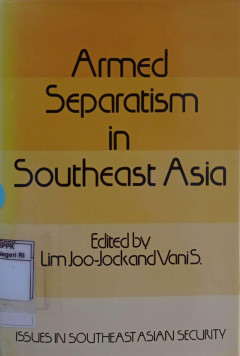
Armed separatism in Southeast Asia
This book is the second in a series Issues in Southeast Asian Security and deals with armed separatism in Southeast Asia. The situation differs markedly in the several countries studied. Besides the analyses of the politics of separatism and its military aspects, the questions of development, of culture and ethnicity are centrally relevant to the growth of separatist tendencies. All these are e…
- Edisi
- -
- ISBN/ISSN
- 9971902516
- Deskripsi Fisik
- vii, 270 pages : maps ; 23 cm
- Judul Seri
- -
- No. Panggil
- 363.959 Lim a
 Karya Umum
  Filsafat
  Agama
Agama  Ilmu-ilmu Sosial
  Bahasa
  Ilmu-ilmu Murni
  Ilmu-ilmu Terapan
  Kesenian, Hiburan, dan Olahraga
  Kesusastraan
  Geografi dan Sejarah