Ditapis dengan

Out of control: Global turmoil on the eve of the twenty-first century
This book is not a prediction but an urgent warning. It is about the state of global politics today, about what may happen by the onset of the twenty-first century, and also about what must not be allowed to happen. My concern that global change is out of control involves a necessarily subjective interpretation of the political meaning and message of our time.
- Edisi
- -
- ISBN/ISSN
- 0-684-19630-1
- Deskripsi Fisik
- 240 pages : index ; 21 cm
- Judul Seri
- -
- No. Panggil
- 909.829 Brz o

Foreign policy making and the American political system
The contents of this book: 1. The Foreign Policy Presidency: Power and Problems 2. The Development of the National Security Council System 3. The National Security Council System at the End of the Cold War 4. Congress and Foreign Policy, etc.
- Edisi
- ed. 3
- ISBN/ISSN
- 0-8018-4772-9
- Deskripsi Fisik
- ix, 323 pages ; 25 cm
- Judul Seri
- -
- No. Panggil
- 353.0089 Nat f

A question of balance: The president, the congress, and foreign policy
In recent years, a more active and aggressive Congress has often sharply disagreed with the president over the ends and means of American foreign policy. The normal tensions that arise in the U.S. system of separate institutions sharing power have been exacerbated by the contemporary pattern of split-party control of the two branches. The ensuing conflict in areas ranging from Central America t…
- Edisi
- -
- ISBN/ISSN
- 0-8157-5453-1
- Deskripsi Fisik
- ix, 265 pages ; 23 cm
- Judul Seri
- -
- No. Panggil
- 353.0089 Man q
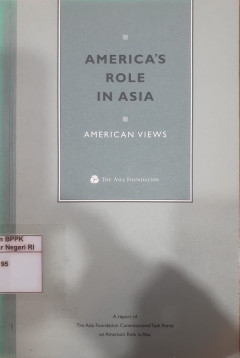
America's role in Asia: American views
In the post-Cold War world, U.S.-Asian relations remain central to U.S. policy. Fault lines in the Taiwan Straits and on the Korean peninsula require the daily vigilance of U.S. and Asian policymakers. Asia's continued recovery from the 1997 financial crisis depends in part upon the health of the American economy. And as domestic political change accelerates across Asia, relations must be recal…
- Edisi
- ed. 1
- ISBN/ISSN
- 1-892325-02-0
- Deskripsi Fisik
- xi, 62 pages : iIlustrations ; 23 cm
- Judul Seri
- -
- No. Panggil
- 330.97395 Fou a

U.S Policy in the Asia-Pacific region: Meeting the challeges of the post cold…
The contens of this book: 1. opening Addres - Lee Kuan Yew 2. U.S Policy in the Asia-Pacific region: meeting the challeges of the post cold-war era - George Bush 3, Discussion 4. CLosing Remarks - K.S Sandhu
- Edisi
- -
- ISBN/ISSN
- 981-3016-24-8
- Deskripsi Fisik
- 18 pages ; 24 cm
- Judul Seri
- -
- No. Panggil
- 355.02 Bus u

U.S. governmental information operations and strategic communication: A discr…
Through the prism of operations in Afghanistan, the author examines how the U.S. Government’s Strategic Communication (SC) and, in particular, the Department of Defense’s (DoD) Information Operations (IO) and Military Information Support to Operations (MISO) programs, have contributed to U.S. strategic and foreign policy objectives. It assesses whether current practice, which is largely pre…
- Edisi
- -
- ISBN/ISSN
- 1-58487-600-x
- Deskripsi Fisik
- xiii, 80 pages ; 23 cm
- Judul Seri
- -
- No. Panggil
- 355.07 Tat u

Japan, the United States, and prospects for the Asia-Pasific century: Three s…
This book provides a framework for considering the ramifications of Japan's expanding role and influence in the Asia-Pacific region. It documents Japan's emergence as the regional "core economy"; reviews the factors that may influence Tokyo's future political and military role; poses alternative scenarios for the evolving Asia-Pacific economic, political and security order; analyses the factors…
- Edisi
- -
- ISBN/ISSN
- 981-3016-22-1
- Deskripsi Fisik
- xiv, 155 pages : ilustrasi ; 23 cm
- Judul Seri
- -
- No. Panggil
- 327.52 Cro j

The best and the brightest
The Best and the Brightest answers these questions more directly and more completely than any other book written on America in the last decade. From the self-doubting of the post-McCarthy era to the phenomenal hubris of the mid-sixties, America is captured within these pages with a lucidity and intelligence that is fascinating. The Best and the Brightest is an enormously important book.
- Edisi
- -
- ISBN/ISSN
- 0394461630
- Deskripsi Fisik
- 688 pages ; 25 cm
- Judul Seri
- -
- No. Panggil
- 973.922 Hal b

Turmoil and triumph: My years as Secretary of State
I was tired after six and one-half tumultuous years, and I felt that memoirs couldeasily be self-serving. Turn over the documents to the historians, I thought. Soon my energy returned and, as I looked into my record, I felt a renewed sense of excitement about what had happaned on my watch, and a desire to set out the flow of events as they appeared from my own point of view.
- Edisi
- -
- ISBN/ISSN
- 0-684-19325-6
- Deskripsi Fisik
- 1182 pages : index ; 25 cm
- Judul Seri
- -
- No. Panggil
- 973.927092 Shu t
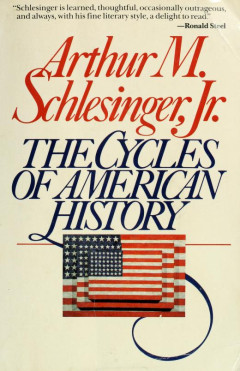
The cycles of American history
This book offers a historian's reflection on the past and the future of the American experiment. The word 'experiment' is used advisedly. The men who established the United States of America believed that they were trying something new under the sun. The idea that a democratic republic might endure ran against all the teachings of history. The vindication of this idea, said Washington in his fi…
- Edisi
- -
- ISBN/ISSN
- 0-395-45400-xx
- Deskripsi Fisik
- xiii, 498 pages : index ; 24 cm
- Judul Seri
- -
- No. Panggil
- 973 Sch c
 Karya Umum
  Filsafat
  Agama
Agama  Ilmu-ilmu Sosial
  Bahasa
  Ilmu-ilmu Murni
  Ilmu-ilmu Terapan
  Kesenian, Hiburan, dan Olahraga
  Kesusastraan
  Geografi dan Sejarah