Ditapis dengan

Why nations fail: The origins of power, prosperity, and poverty
Daron Acemoglu and James Robinson conclusively show that it is man-made political and economic institutions that underlie economic success (or lack of it). Korea, to take just one of their fascinating examples, is a remarkably homogeneous nation, yet the people of North Korea are among the poorest on earth while their brothers and sisters in South Korea are among the richest. The south forged a…
- Edisi
- First Edition
- ISBN/ISSN
- 978-0-307-71922-5
- Deskripsi Fisik
- 529 pages : illustration : bibl: hlm 465-482 : index ; 25 cm
- Judul Seri
- -
- No. Panggil
- 330 Ace w
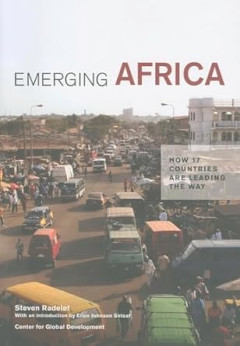
Emerging Africa: How 17 countries are leading the way
Emerging Africa describes the too-often-overlooked positive changes that have taken place in much of Africa since the mid-1990s. In 17 countries, five fundamental and sustained breakthroughs are making old assumptions increasingly untenable: - The rise of democracy brought on by the end of the Cold War and apartheid - Stronger economic management - The end of the debt crisis and a more cons…
- Edisi
- -
- ISBN/ISSN
- 978-1-933286-51-8
- Deskripsi Fisik
- xv, 169 pages : illustrations : index ; 25 cm
- Judul Seri
- -
- No. Panggil
- 330.96 Rad e
Mexico: The remaking of an economy
Today Mexico is viewed as a success story in the management of economic adjustment and structural reform. Inflation is under control, capital and foreign investment are returning, and out growth has increased. Mexico's recovery, however, has been neither smooth nor rapid. In mid-1982, Mexico was in deep economic crisis compounded by an unfavorable international environment. Mexico was saddled w…
- Edisi
- -
- ISBN/ISSN
- 0-8157-5313-6
- Deskripsi Fisik
- xviii, 186 pages : index ; 23 cm.
- Judul Seri
- -
- No. Panggil
- 330.972 Lus m

In the shadows of the sun: Caribbean development alternatives and U,S, policy
In the shadows of the Sun examines the region's disastrous experience in the 1980s, when sharp economic declines resulted from the debt crisis and the poor performance of regional exports. It focuses on alternative development strategies that have emerged in recent years, based on the goals of meeting basic needs and ending poverty; of eliminating discrimination based on gender, race, and ethni…
- Edisi
- -
- ISBN/ISSN
- 0-8133-1028-8
- Deskripsi Fisik
- xvii, 246 pages : illustrations (black and white) : index ; 23 cm
- Judul Seri
- -
- No. Panggil
- 330.9729 Dee i
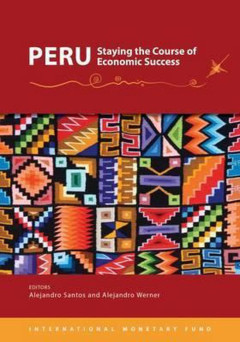
Peru: Staying the course of economic success
Peru stands out among Latin American countries as an example of successful economic reforms over the past decade. This comprehensive look at Peru's economy traces that country's journey from a debt crisis in the 1980s to having buffers in place that allowed it to emerge unscathed from the global financial crisis.
- Edisi
- -
- ISBN/ISSN
- 978-1-51359-974-8
- Deskripsi Fisik
- xv, 441 pages ; illustrations ; 24 cm
- Judul Seri
- -
- No. Panggil
- 330.985 San p

America at the crossroads: Democracy, power, and the neoconservative legacy
Francis Fukuyama’s criticism of the Iraq war put him at odds with neoconservative friends both within and outside the Bush administration. Here he explains how, in its decision to invade Iraq, the Bush administration failed in its stewardship of American foreign policy. First, the administration wrongly made preventive war the central tenet of its foreign policy. In addition, it badly misjudg…
- Edisi
- -
- ISBN/ISSN
- 978-0-300-11399-0
- Deskripsi Fisik
- xiv, 226 pages : index ; 21 cm
- Judul Seri
- -
- No. Panggil
- 327.73 Fuk a

How America got it right: The U.S. march to military and political supremacy
As the world's dominant political force and military power, he says, we are the only nation that will actually go into the world and strike down evil. And we must not shirk that responsibility - especially because we cannot rely on our so-called allies to defend our freedoms. Alexander tells the dramatic and sometimes surprising story of how, from the American Revolution to the War on Terror, A…
- Edisi
- -
- ISBN/ISSN
- 1-4000-5288-2
- Deskripsi Fisik
- viii, 309 pages : bibl: hlm 293-296 : index ; 25 cm
- Judul Seri
- -
- No. Panggil
- 327.73 Ale h

Beyond fifty years of Nigeria's foreign policy: Issues, challenges, and prosp…
How does one predict the future course a country should take to achieve its "vision" in a globalizing world that is very dynamic? It is important to understand the nature of the global order in order to be able to craft a foreign policy that serves, Nigeria's national interest.
- Edisi
- -
- ISBN/ISSN
- 978-002-092-6
- Deskripsi Fisik
- xxiv, 536 pages : index ; 23 cm
- Judul Seri
- -
- No. Panggil
- 327.669 Eze b

Nigerian politics and moral behavior: A study in politics and ethics
This book examines political concepts and processes in relation to principles of behaviour. It discusses ethical concept and principles which underlie and validate political law and constitution. Discussions about moral behavior politics include conduct of population census, electoral process, political language, crises and violence.
- Edisi
- Cet.1
- ISBN/ISSN
- 978-36421-0-3
- Deskripsi Fisik
- xii, 115 pages : bibl: hlm 99-108 : index ; 23 cm
- Judul Seri
- -
- No. Panggil
- 327.669 Dzu n

The U.S.-Japan security alliance: Why it matters and how to strengthen it
For more than three decades, the multifaceted alliance between the United States and Japan has contributed significantly to the security of Japan and the maintenance of peace and security in the Far East.
- Edisi
- -
- ISBN/ISSN
- 0-275-97806-0
- Deskripsi Fisik
- xvi, 106 pages : bibl: hlm 93-98 : index ; 22 cm
- Judul Seri
- -
- No. Panggil
- 327.52 Osi u
 Karya Umum
 Filsafat
 Agama
 Ilmu-ilmu Sosial
 Bahasa
 Ilmu-ilmu Murni
 Ilmu-ilmu Terapan
 Kesenian, Hiburan, dan Olahraga
 Kesusastraan
 Geografi dan Sejarah