Ditapis dengan

Japan and the United States: Troubled partners in a changing world
in the 1990s, the United States faces a rapidly unfolding security environment in the Asia-Pacific area. Its principal features are familiar : the economic dynamism of market economies ; the normalization of relations between China and the Soviet Union , symbolized by Gorbachev's visit to japan.
- Edisi
- First Edition
- ISBN/ISSN
- 0-08-041074-X
- Deskripsi Fisik
- xii, 144 pages ; 23 cm
- Judul Seri
- -
- No. Panggil
- 303.48273052 Moc j

Japan swings: Politics, culture and sex in the new Japan
In the 1990s Japan swung swiftly and suddenly from being an unstoppable economic colossus to a creaky house of cards on the brink of collapse. Once cautious banks and bureaucrats fell in with cowboy businessmen and gangsters. The political system crumbled along with many of the real life myths and cultural certitudes built up around Japan and its economic miracle over the past half century. The…
- Edisi
- -
- ISBN/ISSN
- 4-900737-49-6
- Deskripsi Fisik
- vii, 328 pages ; 18 cm
- Judul Seri
- -
- No. Panggil
- 952 Mcg j
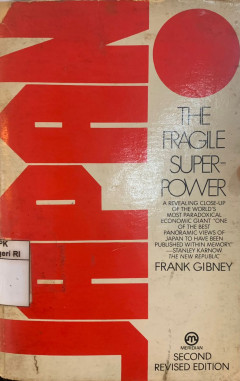
Japan: The fragile superpower
What is the secret of Japan's economic success? What are the country's prospects for the future? Japan: The Fragile Superpower sets out to answer these intriguing questions and at the same time provides a penetrating analysis of the inner dynamics of Japanese business, politics, and culture. This book widely acclaimed book was long required reading for anyone interested in modern Japan. Nearly …
- Edisi
- Ed. 2
- ISBN/ISSN
- 0-452-00776-3
- Deskripsi Fisik
- xvi, 430 pages ; 21 cm
- Judul Seri
- -
- No. Panggil
- 952 Gib j

The Book of correction: Reflection on the national crisis during the Japanese…
The Book of Corrections (Chingbirok) is a record of the events surrounding the Japanese invasion of Korea later known as the Imjin War (1592–1598). The author, vividly portrays all the major developments of the crisis, as well as the men who were involved in it.
- Edisi
- Korea Research Monograph 28
- ISBN/ISSN
- 1-55729-076-8
- Deskripsi Fisik
- xi, [7], 249 pages : illustrations ; 23 cm
- Judul Seri
- -
- No. Panggil
- 951.9 Son b

Bridging troubled waters: China, Japan, and maritime order in the East China Sea
In this book, James Manicom contests the orthodox view that the strategic rivalry between China and Japan will escalate into a full blown military conflict. The book concedes that the East China Sea will be the likely medium for Sino-Japanese military rivalry and cyclical tensions will persist; however, it makes the compelling case that cooperation will endure.
- Edisi
- -
- ISBN/ISSN
- 978-1-62616-035-4
- Deskripsi Fisik
- xii, 266 pages ; 23 cm
- Judul Seri
- -
- No. Panggil
- 341.4 Man b
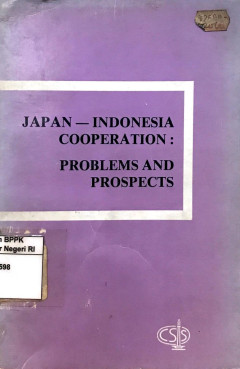
Japan-Indonesia cooperation: Problems and prospects
Papers presented at the fifth Japan-Indonesian Conference, Cisarua, Novenber 17-19 1977. This book contains: 1. Japan and ASEAN: Policies towards promoting closer cooperation 2. Japan and Indonesia: Dimensions of cultural cooperation 3. Cooperation in agricultural development 4. Cooperation fisheries development
- Edisi
- -
- ISBN/ISSN
- -
- Deskripsi Fisik
- 191 pages ; 22 cm.
- Judul Seri
- -
- No. Panggil
- 338.9952598 Stu j

Prajurit Jepang yang tidak kembali: Membaca catatan harian prajurit Jepang ya…
Buku ini berisi: 1. Pertemuan Kembali - Suara Mantan Prajurit dan Semangat Generasi Kedua 2. Alasan Tidak Kembali: Sejarah dan Pilihan Hidup Manusia 3. Menghadapai Serangan Perjuangan untuk Merdeka 4. Di Tengah Perjuangan Saat yang Tak Terlupakan, etc.
- Edisi
- -
- ISBN/ISSN
- 978-979-18223-0-5
- Deskripsi Fisik
- xii, 128 halaman : ilustrasi ; 22 cm
- Judul Seri
- -
- No. Panggil
- 923.5 Kat p

Japan pride: A proposal for revival
This book, Japan Pride: A Proposal for Revival, contains all of the social commentary essays published over the past year in the monthly magazine Apple Town under the pen name "Seiji Fuji."
- Edisi
- -
- ISBN/ISSN
- -
- Deskripsi Fisik
- 87 pages : illustrations ; 20 cm
- Judul Seri
- -
- No. Panggil
- 808. 84 Fuj j

The China factor in modern Japanese thought: The case of Tachibana Shiraki, 1…
The China Factor in Modern Japanese Thought examines the ideas of Tachibana Shiraki, 1881–1945, a revisionist within the Japanese Kangaku tradition, which focused on incorporating Chinese elements into Japanese culture. Tachibana advocated the study of popular culture as the key to understanding contemporary society. When militarism was on the ascendant, Tachibana was a vocal critic of mil…
- Edisi
- -
- ISBN/ISSN
- 0-7914-3039-1
- Deskripsi Fisik
- x, 171 pages ; 22 cm
- Judul Seri
- -
- No. Panggil
- 951 Lin c
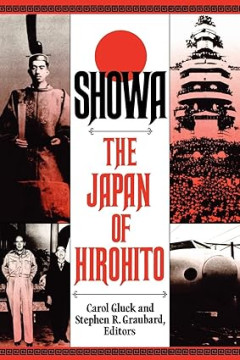
Showa: The Japan of Hirohito
This "stimulating and comprehensive" (Kirkus Reviews) collection of original essays on twentieth-century Japan's history and culture provides a unique mix of American and Japanese perspectives on Showa. With an important, substantial Introduction by Carol Gluck, the volume explores the strengths of the Japanese economy, the issue of democracy and Japan's political culture, Japan's achievements …
- Edisi
- -
- ISBN/ISSN
- 0-393-02984-0
- Deskripsi Fisik
- Ixii, 315 pages ; 24 cm
- Judul Seri
- -
- No. Panggil
- 952 Glu s
 Karya Umum
  Filsafat
  Agama
Agama  Ilmu-ilmu Sosial
  Bahasa
  Ilmu-ilmu Murni
  Ilmu-ilmu Terapan
  Kesenian, Hiburan, dan Olahraga
  Kesusastraan
  Geografi dan Sejarah