Ditapis dengan
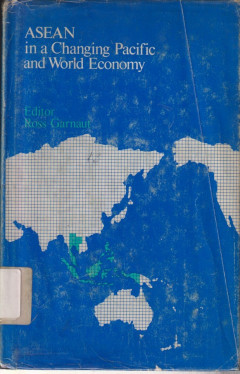
ASEAN in a changing pacific and world economy
This edited volume analyzes the role of ASEAN within a rapidly changing Pacific and global economic environment. The contributors examine the external economic relations of Southeast Asian nations, the development of regional industries, and the broader impact of international economic trends on ASEAN member states. The book discusses shifts in global trade patterns, resource-based industries, …
- Edisi
- -
- ISBN/ISSN
- 0-7081-1304-4
- Deskripsi Fisik
- xxiii, 557 pages ; 24,5 cm
- Judul Seri
- -
- No. Panggil
- 337.59 GAR a
Southeast Asian perceptions of foreign assistance
This volume presents the papers and proceedings of a workshop held at Chulalongkorn University in June 1976, jointly organized by the Institute of Southeast Asian Studies (Singapore) and the Institute of Asian Studies of Chulalongkorn University. The book explores how Southeast Asian countries perceive foreign assistance, examining political, economic, and social dimensions of aid in the region…
- Edisi
- -
- ISBN/ISSN
- -
- Deskripsi Fisik
- x, 185 pages ; 21 cm
- Judul Seri
- -
- No. Panggil
- 337.159 LIM s
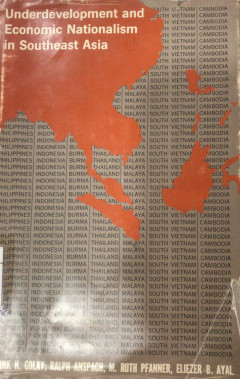
Underdevelopment and economic nationalism in Southeast Asia
This book provides an in-depth analysis of the economic underdevelopment of Southeast Asia and the rise of economic nationalism in the region. The authors examine the historical foundations of Southeast Asia’s economic structures, the legacy of colonialism, and the challenges faced by developing states in pursuing autonomous economic policies. The work evaluates nationalist responses to exter…
- Edisi
- First Published
- ISBN/ISSN
- 8014-0493-2
- Deskripsi Fisik
- xv, 494 pages : index ; 24 cm
- Judul Seri
- -
- No. Panggil
- 330.959 GOL u
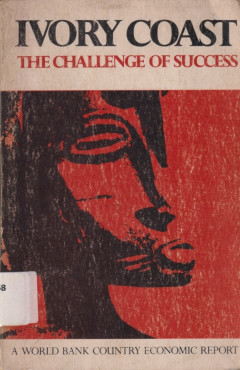
Ivory Coast: The Challenge of success
Ivory Coast: The Challenge of Success is an in-depth economic analysis authored by B. A. den Tuinder for the World Bank. The book examines the rapid economic growth of Côte d'Ivoire during the post-independence period and explores the structural factors that contributed to its development performance. It discusses the country's agricultural expansion, industrialization strategies, macroeconomi…
- Edisi
- -
- ISBN/ISSN
- -
- Deskripsi Fisik
- xxi, 445 pages ; 23 cm
- Judul Seri
- -
- No. Panggil
- 338.96668 TUI i
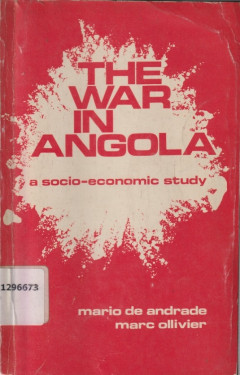
The War in Angola: A Socio-economic study
The War in Angola: A Socio-Economic Study provides an analytical overview of the armed struggle in Angola against Portuguese colonial rule, focusing on the period leading up to independence. Written by Mario de Andrade and Marc Ollivier, the book examines the root causes of the conflict, the development of liberation movements, and the socio-economic structure shaped by colonial exploitation. I…
- Edisi
- -
- ISBN/ISSN
- -
- Deskripsi Fisik
- x, 128 pages : illustration ; 21,5 cm
- Judul Seri
- -
- No. Panggil
- 968.8702 AND w

The Great crash ahead: Strategies for a world turned upside down
This book presents Harry S. Dent Jr.’s predictions of a looming major economic downturn based on demographic, financial, and market-cycle analysis. Dent argues that structural shifts in consumer spending, aging populations, and excessive debt will trigger a global economic crash and reshape financial markets. The book provides strategic guidance for investors and individuals seeking to naviga…
- Edisi
- -
- ISBN/ISSN
- -
- Deskripsi Fisik
- xvi, 341 pages : illustration ; 23,5 cm
- Judul Seri
- -
- No. Panggil
- 330.973 DEN g

The Vast majority: A Journey to the world’s poor
This book offers Michael Harrington’s firsthand account of global poverty, based on his travels through some of the world’s poorest regions. Harrington examines the economic, political, and social forces that shape underdevelopment, highlighting the impact of global inequality and the failures of international aid. Through vivid descriptions and critical analysis, he challenges readers to c…
- Edisi
- -
- ISBN/ISSN
- 0-671-22529-4
- Deskripsi Fisik
- 281 pages ; 21 cm
- Judul Seri
- -
- No. Panggil
- 330.917 HAR v

Building a peace economy: Opportunities and problems of post–cold war defen…
This book analyzes the economic and policy implications of reducing military spending in the aftermath of the Cold War. Lall and Marlin, along with contributing researchers, examine the challenges and opportunities created by defense budget cuts, focusing on economic conversion, labor impacts, industrial restructuring, and national budget priorities. The authors explore how shifting resources f…
- Edisi
- -
- ISBN/ISSN
- 0-8133-8433-8
- Deskripsi Fisik
- x, 294 pages ; 23,5 cm
- Judul Seri
- -
- No. Panggil
- 355.62 LAL b
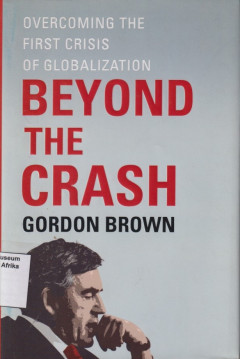
Beyond the crash: Overcoming the first crisis of globalization
In this book, Gordon Brown offers an inside perspective on the global financial crisis of 2008–2009 and outlines strategies for overcoming what he calls the first crisis of globalization. Drawing on his experience as the United Kingdom’s prime minister and former chancellor of the exchequer, Brown analyzes the structural weaknesses of the international financial system, the failures of glob…
- Edisi
- -
- ISBN/ISSN
- 978-1-4516-2405-2
- Deskripsi Fisik
- xx, 314 pages ; 23,5 cm
- Judul Seri
- -
- No. Panggil
- 330.90511 BRO b

Global paradox: The Bigger the world economy, the more powerful its smallest …
Global Paradox explores one of John Naisbitt’s central ideas: as the global economy becomes increasingly interconnected and expansive, power paradoxically shifts toward smaller, more agile players—small nations, small companies, and even individuals. Naisbitt analyzes global economic trends, technological change, and the rise of the information society, arguing that decentralization and reg…
- Edisi
- -
- ISBN/ISSN
- 0-688-12791-6
- Deskripsi Fisik
- 304 pages ; 24 cm
- Judul Seri
- -
- No. Panggil
- 330.900112 NAI g
 Karya Umum
 Filsafat
 Agama
 Ilmu-ilmu Sosial
 Bahasa
 Ilmu-ilmu Murni
 Ilmu-ilmu Terapan
 Kesenian, Hiburan, dan Olahraga
 Kesusastraan
 Geografi dan Sejarah