Ditapis dengan
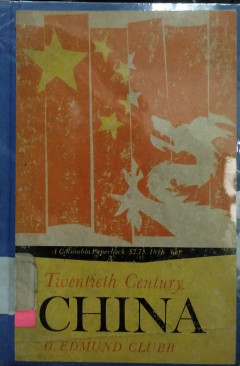
Twentieth century China
20th Century China by O. Edmund Clubb provides an analytical overview of China’s political, social, and diplomatic developments throughout the twentieth century. Written by a former U.S. Consul General in Peiping, the book offers firsthand insights into the transformation of China from imperial collapse to the rise of the People’s Republic. Clubb examines key events including the fall of th…
- Edisi
- -
- ISBN/ISSN
- -
- Deskripsi Fisik
- 470 pages ; 20,5 cm
- Judul Seri
- -
- No. Panggil
- 951.04 CLU t
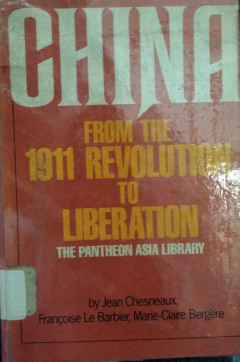
China from the 1911 revolution to liberation
China from the 1911 Revolution to Liberation presents a comprehensive and analytic history of China’s turbulent transformation from the fall of the Qing dynasty in 1911 to the Communist victory in 1949. Written by renowned French scholars Jean Chesneaux, Françoise Le Barbier, and Marie-Claire Bergère, the book examines major political, social, and ideological shifts that shaped modern China…
- Edisi
- -
- ISBN/ISSN
- 0-394-73322-0
- Deskripsi Fisik
- 372 pages : Ilustration ; 23,3 cm
- Judul Seri
- -
- No. Panggil
- 951.04 CHE c

China's watergate : Political and economic conflicts, 1969-1977
Leo Goodstadt is uniquely qualified to write an inside report on the crises which have shaken China throughout this decade. He has devoted his entire career since 1962 to research and writing on Chinese events. In this book, he brings together a fascinating account of the background to the collapse of Mao Tse-tung's entourage and of respect for his immediate family within a month of his death i…
- Edisi
- -
- ISBN/ISSN
- 0-7069-0725-6
- Deskripsi Fisik
- 219 pages ; 22 cm
- Judul Seri
- -
- No. Panggil
- 951.05 GOO c
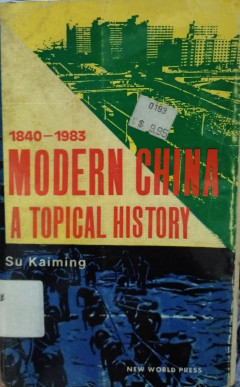
Modern China: A Topical history
Modern China: A Topical History by Su Kaiming provides a concise and accessible overview of China’s political, social, and cultural development in the modern era. Written for international readers, the book discusses key historical events, major political transformations, and influential figures that shaped China from the late Qing dynasty to the period of modernization. Organized by themes r…
- Edisi
- -
- ISBN/ISSN
- 0-8351-1397-3
- Deskripsi Fisik
- 279 pages : Ilustrations ; 21 cm
- Judul Seri
- -
- No. Panggil
- 951.083 KAI m
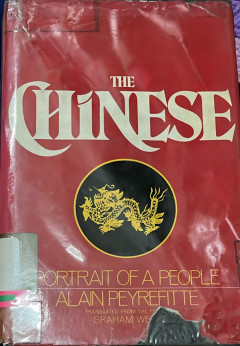
The Chinese : Potrait of people
Timely and incisive, this is the first book about modern China since the death of Mao Tse-tung. Written by one of Europe's leading diplomats, THE CHINESE explores mainland China's relations with the West, the richness of its past, and the enigma of its future. It covers the Long March and the Great Leap Forward, exposing the terror of the Red Guard and the stories behind the overthrowing of Li…
- Edisi
- -
- ISBN/ISSN
- 0-672-52005-2
- Deskripsi Fisik
- 419 pages : illustrations ; 23 cm
- Judul Seri
- -
- No. Panggil
- 951.05 PEY c

Modern China and its revolutionary process: Recurrent challenges to the tradi…
Modern China and Its Revolutionary Process provides a comprehensive scholarly analysis of China’s political, social, and ideological transformations between 1850 and 1920. Robert A. Scalapino and George T. Yu examine the recurrent revolutionary challenges to China’s traditional imperial structure, beginning with the Taiping Rebellion and extending through late Qing reform attempts and the e…
- Edisi
- -
- ISBN/ISSN
- 0-520-05030-4
- Deskripsi Fisik
- xiii, 814 pages :
- Judul Seri
- -
- No. Panggil
- 951.03 SCA m
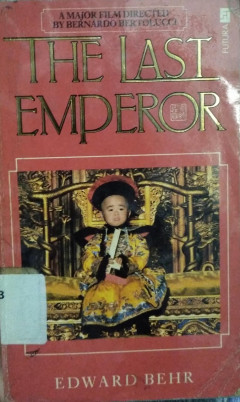
The Last emperor
The Last Emperor by Edward Behr is a compelling biographical narrative about the life of Puyi, the final emperor of China. Drawing on historical documents, eyewitness accounts, and cinematic interpretations, the book traces Puyi’s extraordinary journey from his enthronement as a child ruler of the Qing dynasty, through his removal from power, exile, and brief restoration under Japanese occupa…
- Edisi
- -
- ISBN/ISSN
- 0-7088-3651-8
- Deskripsi Fisik
- 335 pages : Ilustrations ; 18 cm
- Judul Seri
- -
- No. Panggil
- 951.03 BEH t

China's imperial past : An Introduction to Chinese history and culture
A work unique in the sweep of its design and scope, intended expressly for the general reader interested in human history and culture, this is a vivid panoramic survey of the vast course of Chinese civilization from prehistory to 1850, when the old China began the agonizing transition to the new. Historical surveys of China tend to be dynasty-by-dynasty chronicles with a profusion of names and …
- Edisi
- -
- ISBN/ISSN
- -
- Deskripsi Fisik
- 474 pages : illustrations ; 24 cm
- Judul Seri
- -
- No. Panggil
- 951.1 HUC c
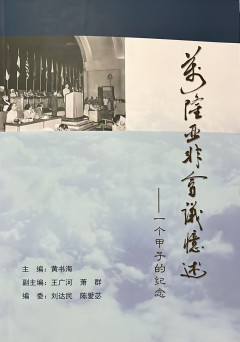
Dāng yuàn Yà–Fēi yánshuō yìshù
This book presents a collection of essays and personal recollections on the Asian-African Conference and the enduring legacy of Zhou Enlai in shaping China’s diplomacy during the mid-20th century. Through contributions from diplomats, scholars, journalists, and eyewitnesses, the book highlights the historical significance of the Bandung Conference, the challenges and achievements of China’s…
- Edisi
- -
- ISBN/ISSN
- -
- Deskripsi Fisik
- 192 pages : illustrations ; 24 cm
- Judul Seri
- -
- No. Panggil
- 327.5106 SHU d
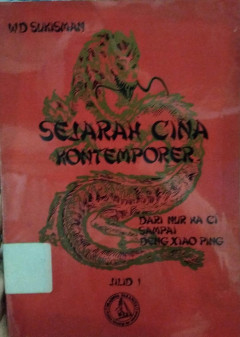
Selarah China kontemporere: Jilid 1
Sejarah Tiongkok Kontemporer, Volume 1 menelusuri perkembangan sejarah Tiongkok sejak kebangkitan Nurhaci dan berdirinya Dinasti Qing, melalui berbagai transformasi politik, sosial, dan militer yang mengarah ke era Deng Xiaoping. Ditulis oleh W. D. Sukisman, volume ini memberikan gambaran umum tentang perubahan-perubahan dinasti besar, pengaruh asing, konflik internal, gerakan revolusioner, dan…
- Edisi
- -
- ISBN/ISSN
- 979-408-317-8
- Deskripsi Fisik
- xiii, 180 halaman : Ilustrasi ; 20,8 cm
- Judul Seri
- -
- No. Panggil
- 951 SUK s
 Karya Umum
  Filsafat
  Agama
Agama  Ilmu-ilmu Sosial
  Bahasa
  Ilmu-ilmu Murni
  Ilmu-ilmu Terapan
  Kesenian, Hiburan, dan Olahraga
  Kesusastraan
  Geografi dan Sejarah