Ditapis dengan

The Role of middle powers in the Pacific: Indonesia–Canada relations toward…
This book presents a collection of papers from the First Indonesia–Canada Conference, held in Sanur, Bali, in February 1985. It explores the evolving roles of middle powers in the Pacific region, focusing particularly on Indonesia–Canada relations and their strategic outlook towards the year 2000. The discussions address political cooperation, economic engagement, regional security, and the…
- Edisi
- -
- ISBN/ISSN
- 979-8026-00-4
- Deskripsi Fisik
- vi, 193 pages ; 21,5 cm
- Judul Seri
- -
- No. Panggil
- 327.598 CEN r

Le Moyen-Orient au XXᵉ siècle: Sociétés politiques et relations internat…
This book presents an analytical overview of the political evolution and international relations of the Middle East during the twentieth century. Jean-Pierre Derriennic examines the region’s various political systems, social structures, interstate dynamics, and the major conflicts that shaped contemporary Middle Eastern societies. Emphasizing comparative political analysis, the work explores …
- Edisi
- -
- ISBN/ISSN
- -
- Deskripsi Fisik
- 282 pages : illustrations ; 23 cm
- Judul Seri
- -
- No. Panggil
- 956.05 DER l
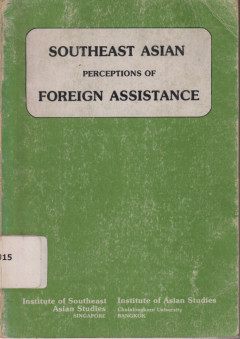
Southeast Asian perceptions of foreign assistance
This volume presents the papers and proceedings of a workshop held at Chulalongkorn University in June 1976, jointly organized by the Institute of Southeast Asian Studies (Singapore) and the Institute of Asian Studies of Chulalongkorn University. The book explores how Southeast Asian countries perceive foreign assistance, examining political, economic, and social dimensions of aid in the region…
- Edisi
- -
- ISBN/ISSN
- -
- Deskripsi Fisik
- x, 185 pages ; 21 cm
- Judul Seri
- -
- No. Panggil
- 337.159 LIM s

Israel in Lebanon: Report of the international commission to enquire into rep…
This volume presents the findings of the International Commission established to investigate alleged violations of international law by Israel during its 1982 invasion of Lebanon. The report examines the legal, political, and humanitarian dimensions of the conflict, documenting incidents involving civilian casualties, destruction of property, and breaches of international humanitarian norms. Dr…
- Edisi
- -
- ISBN/ISSN
- 0-903729-96-2
- Deskripsi Fisik
- xxii, 280 pages : illustration ; 21,5 cm
- Judul Seri
- -
- No. Panggil
- 341.5694 INT i

From Bandung to Colombo: Conferences of the non-aligned countries, 1955–75
This book provides a comprehensive overview of the Non-Aligned Movement from the 1955 Bandung Conference to the 1975 Colombo Conference. Edited by A. W. Singham and Tran Van Dinh, the volume presents key documents, speeches, resolutions, and commentary on the political and diplomatic evolution of the non-aligned countries during the Cold War. It examines the struggle for independence, global so…
- Edisi
- -
- ISBN/ISSN
- 0-89388-220-8
- Deskripsi Fisik
- v, 223 pages : illustrations ; 28 cm
- Judul Seri
- -
- No. Panggil
- 327.172 SIN f

Southeast Asia in international politics, 1941-1956
This book provides a comprehensive analysis of Southeast Asia’s position in international politics from 1941 to 1956, a period marked by World War II, Japanese occupation, postwar reconstruction, and the emergence of nationalist movements throughout the region. Evelyn Colbert examines how global power rivalries—particularly between the United States, the United Kingdom, and emerging Asian s…
- Edisi
- -
- ISBN/ISSN
- 0-8014-0971-3
- Deskripsi Fisik
- 372 pages ; 23,5 cm
- Judul Seri
- -
- No. Panggil
- 327.0959 COL s
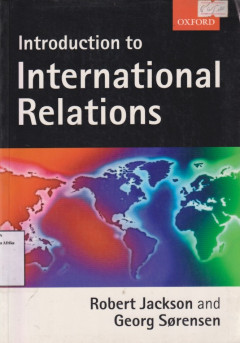
Introduction to international relations
This book provides a comprehensive introduction to the study of international relations. Jackson and Sørensen outline the major theoretical perspectives—including realism, liberalism, and alternative approaches—while also exploring key global issues such as security, conflict, international institutions, globalization, and the changing nature of the international system. Designed for begin…
- Edisi
- First published
- ISBN/ISSN
- ISBN 0–19–878196–2
- Deskripsi Fisik
- xvii, 294 pages : illustration ; 24,5 cm
- Judul Seri
- -
- No. Panggil
- 327 JAC i
International relations
International Relations by M. Margaret Ball and Hugh B. Killough provides a foundational overview of the major concepts, actors, and dynamics shaping relations among states. Published under the auspices of the London Institute of World Affairs, this work examines the historical evolution of international systems, the role of diplomacy, conflict and cooperation among nations, and the influence o…
- Edisi
- -
- ISBN/ISSN
- -
- Deskripsi Fisik
- viii, 667 pages : illustration ; 23,5 cm
- Judul Seri
- -
- No. Panggil
- 327.1 BAL i

International law in a changing world: Cases, documents, and readings
This book provides a comprehensive collection of cases, documents, and readings that illustrate the dynamic nature of international law in a rapidly changing world. Edited by Edward Collins, Jr., the volume presents essential materials that explore the evolution of legal principles, state behavior, global governance, and the challenges faced by the international community. Designed for students…
- Edisi
- -
- ISBN/ISSN
- -
- Deskripsi Fisik
- xvi, 493 pages ; 24 cm
- Judul Seri
- -
- No. Panggil
- 341 COL i
Principles of international law
This classic work by Hans Kelsen presents a systematic and theoretical foundation of international law. As one of the most influential legal philosophers of the twentieth century, Kelsen explores the nature, structure, and function of international legal norms within the global order. The book examines the validity of international law, the relationship between domestic and international legal …
- Edisi
- -
- ISBN/ISSN
- -
- Deskripsi Fisik
- xvii, 461 pages ; 22 cm
- Judul Seri
- -
- No. Panggil
- 341 KEL p
 Karya Umum
  Filsafat
  Agama
Agama  Ilmu-ilmu Sosial
  Bahasa
  Ilmu-ilmu Murni
  Ilmu-ilmu Terapan
  Kesenian, Hiburan, dan Olahraga
  Kesusastraan
  Geografi dan Sejarah