Ditapis dengan
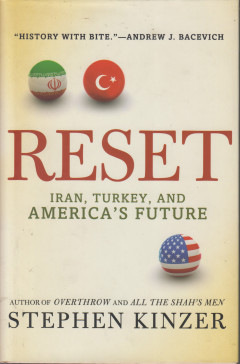
Reset: Iran, Turkey, and America’s future
“Reset: Iran, Turkey, and America’s Future” explores the complex geopolitical relationships between the United States and two pivotal Middle Eastern nations: Iran and Turkey. Stephen Kinzer argues that U.S. foreign policy has long relied on outdated assumptions and alliances, and proposes a strategic realignment that prioritizes diplomatic engagement with Iran and cooperation with Turkey.…
- Edisi
- -
- ISBN/ISSN
- 978-0-8050-9127-4
- Deskripsi Fisik
- 274 pages : illustrations ; 24,5 cm
- Judul Seri
- -
- No. Panggil
- 327.73055 KIN r
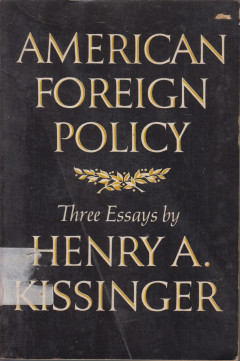
American foreign policy: Three essays
American Foreign Policy: Three Essays presents Henry A. Kissinger’s influential analyses of the strategic challenges confronting the United States during the Cold War era. In these essays, Kissinger examines the central issues of American foreign policy, the ideological and geopolitical forces shaping global power, and the need for a coherent national strategy. His reflections provide insight…
- Edisi
- -
- ISBN/ISSN
- 393-09853-2
- Deskripsi Fisik
- 143 pages ; 20,5 cm
- Judul Seri
- -
- No. Panggil
- 327.73 KIS a
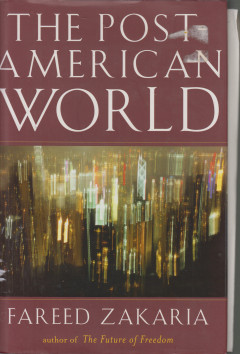
The Post-American world
The Post-American World by Fareed Zakaria explores the shifting global landscape in which the dominance of the United States is challenged by the rapid rise of other nations, particularly China and India. Rather than describing the decline of America, Zakaria argues that the world is entering a “post-American” phase characterized by the rise of the rest. He examines historical patterns of g…
- Edisi
- -
- ISBN/ISSN
- 978-0-393-06235-9
- Deskripsi Fisik
- 292 pages ; 24 cm
- Judul Seri
- -
- No. Panggil
- 303.49 ZAK p

The Politics of foreign aid: American experience in Southeast Asia
The Politics of Foreign Aid examines the political dynamics behind America's foreign aid programs in Southeast Asia during the early Cold War era. John D. Montgomery analyzes how strategic, economic, and ideological considerations shaped U.S. assistance initiatives, and how these programs influenced local political structures and development policies. This study highlights the complexities, suc…
- Edisi
- -
- ISBN/ISSN
- -
- Deskripsi Fisik
- xv, 336 pages ; 20,5 cm
- Judul Seri
- -
- No. Panggil
- 327.73 MON p

French foreign policy under de Gaulle
Alfred Grosser's French Foreign Policy Under de Gaulle is a comprehensive study of the direction and character of French foreign policy during the reign of Charles de Gaulle during the Fifth Republic. It analyzes French diplomatic moves, efforts to strengthen national independence, and relations with the United States, NATO, the Soviet Union, and developing countries. Packed with academic persp…
- Edisi
- -
- ISBN/ISSN
- -
- Deskripsi Fisik
- xiv, 175 pages ; 22 cm
- Judul Seri
- -
- No. Panggil
- 327.44 GRO f

The Irony of manifest destiny: The Tragedy of America’s foreign policy
This book offers a critical examination of the evolution of American foreign policy in the modern era. William Pfaff analyzes how the longstanding ideology of “Manifest Destiny” has shaped the United States’ international actions and contributed to strategic failures and global tensions. Through historical insight and contemporary evaluation, Pfaff argues that America's pursuit of moral a…
- Edisi
- -
- ISBN/ISSN
- 978-0-8027-1699-6
- Deskripsi Fisik
- xiv, 222 pages ; 21,5 cm
- Judul Seri
- -
- No. Panggil
- 327.73 PFA i

The Frugal superpower: America’s global leadership in a cash-strapped era
The Frugal Superpower examines how the financial constraints of the early 21st century reshape the global role of the United States. Michael Mandelbaum argues that the era of expansive American international engagement—supported by ample economic resources—is ending, giving rise to a more restrained foreign policy. By analyzing geopolitical shifts, budget limitations, and global expectation…
- Edisi
- -
- ISBN/ISSN
- 978-1-58648-916-8
- Deskripsi Fisik
- ix, 213 pages : illustrations ; 22 cm
- Judul Seri
- -
- No. Panggil
- 327.73 MAN f

The Bandung Conference and Japan’s Return to Asia: Between the United State…
This book examines Japan’s diplomatic position during the early Cold War, focusing on its participation and political stance surrounding the 1955 Bandung Conference. Miyashiro analyzes Japan’s attempt to reintegrate into Asia while balancing pressure from the United States and its own regional ambitions. The work provides insight into Japan’s foreign policy transformation, regional identi…
- Edisi
- -
- ISBN/ISSN
- 9784794210357
- Deskripsi Fisik
- vii, 229 pages ; 19,5 cm
- Judul Seri
- -
- No. Panggil
- 327.52 DAI b

The People’s Republic of China Foreign Affairs archives compilation (Volume…
This volume presents a curated selection of diplomatic archives from the Ministry of Foreign Affairs of the People’s Republic of China, focusing on the Chinese delegation’s participation in the 1955 Asian-African Conference in Bandung. The documents provide insights into China’s foreign policy strategies, diplomatic interactions, preparatory communications, and the geopolitical context su…
- Edisi
- -
- ISBN/ISSN
- -
- Deskripsi Fisik
- 260 pages : illustrations ; 24,5 cm
- Judul Seri
- -
- No. Panggil
- 327.51 MIN p

35 Years of non-aligned movement: Documents 1961–1996. Volume III
This volume is part of the multi-volume collection 35 Years of Non-Aligned Movement: Documents 1961–1996, presenting official declarations, resolutions, communiqués, and statements issued by the Non-Aligned Countries between 1988 and 1996. Covering key meetings from Nicosia to New York, the compilation reflects the evolving priorities of the Movement during the post-Cold War transition. It i…
- Edisi
- -
- ISBN/ISSN
- 81-7128-045-5
- Deskripsi Fisik
- 1714 pages ; 25,5 cm
- Judul Seri
- -
- No. Panggil
- 327.172 NON t
 Karya Umum
  Filsafat
  Agama
Agama  Ilmu-ilmu Sosial
  Bahasa
  Ilmu-ilmu Murni
  Ilmu-ilmu Terapan
  Kesenian, Hiburan, dan Olahraga
  Kesusastraan
  Geografi dan Sejarah