Ditapis dengan

Confronting environmental change in East & Southeast Asia: Eco-politics, fore…
An edited collection of essays by a group of international experts and scholars that address the politics and policy of environmental change and sustainable development in East and Southeast Asia. The book pays particular attention to the ways in which foreign policy and international relations theories help explain eco-politics and sustainable development in the region. Case studies cover e…
- Edisi
- -
- ISBN/ISSN
- 9280811134
- Deskripsi Fisik
- xviii, 269 pages : illustrations (black and white) ; 23 cm
- Judul Seri
- -
- No. Panggil
- 333.72095 Har c
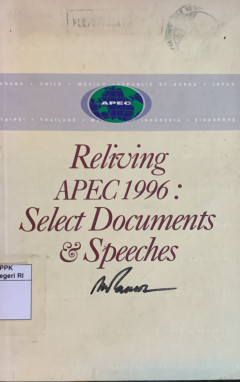
Reliving APEC 1996: Select documents & speeches
This book contains: 1. The President on APEC 2. Building the spirit of community 3. Trade and investment liberalization and facilitation 4. Economic and technical cooperation 5. Select APEC 1996 documents
- Edisi
- -
- ISBN/ISSN
- -
- Deskripsi Fisik
- 165 pages ; 23 cm.
- Judul Seri
- -
- No. Panggil
- 337.1 Mac r

The politics of environment in Southeast Asia
Southeast Asia is a site of intense and ominous contradictions between economic growth and environmental protection, as well as between different social groups with competing interests in the natural resource base. Rapid industrialisation has brought both increased consumption of natural resources and increased competition for them.
- Edisi
- ed. 1
- ISBN/ISSN
- 0-415-17299-3
- Deskripsi Fisik
- x, 325 pages : illustrasi ; 24 cm
- Judul Seri
- -
- No. Panggil
- 333.70959 Hir p
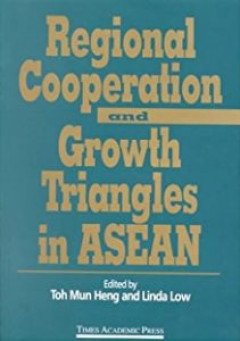
Regional cooperation and growth triangles in ASEAN
Comprising papers presented at an international symposium on the Growth Triangle, this book analyses (a) the development of the Southern Growth Triangle - which consists of Singapore, Johor in Malaysia and the Riau Islands in Indonesia; (b) the potential of a Northern Growth Triangle; and (c) external views of the Growth Triangle. The economic and political implications to establish similar int…
- Edisi
- -
- ISBN/ISSN
- 9812100210
- Deskripsi Fisik
- xx, 236 pages ; 23 cm
- Judul Seri
- -
- No. Panggil
- 334.0959 Hen r

Piracy, maritime terrorism and securing the Malacca Straits
Maritime piracy continues to persist as a significant phenomenon manifesting a range of social, historical, geo-political, security and economic issues. Today, the waters of Southeast Asia serve as the dominant region for the occurrence of piracy and the challenges it poses to regional security and Malacca Straits security. As a second installment within the Series on Maritime Issues and Piracy…
- Edisi
- Cet. 1
- ISBN/ISSN
- 978-981-230-391-2
- Deskripsi Fisik
- xxxvi, 266 pages : illustrations (black and white) ; 23 cm
- Judul Seri
- -
- No. Panggil
- 345.02 Web p

China and East Asian strategic dynamics: The shaping of a new regional order
This book examines the impact of China's rise on the strategic dimension in East Asian international politics and security. We attempt to address and analyze the following set of questions. First , how has China's strategic approach to its international relations in East Asia evolved? How successful has China been able to consolidate its strategic position in the region? How have other regional…
- Edisi
- -
- ISBN/ISSN
- 978-0-7391-8596-4
- Deskripsi Fisik
- xxi, 289 pages ; 23 cm
- Judul Seri
- -
- No. Panggil
- 355.033051 Lee c

Secret trades, porous borders: Smuggling and states along a Southeast Asian f…
Over the course of the half century from 1865 to 1915, the British and the Dutch delineated colonial spheres in the process of creating new frontiers. This book analyzes the development of these frontiers in Insular Southeast Asia as well as the accompanying smuggling activities of the opium traders, currency runners and human traffickers who pierced such newly drawn borders with growing succes…
- Edisi
- Cet. 1
- ISBN/ISSN
- 978-9971-69-385-5
- Deskripsi Fisik
- xvi, 437 pages : illustrations (black and white) ; 23 cm
- Judul Seri
- -
- No. Panggil
- 364.133 Tag s
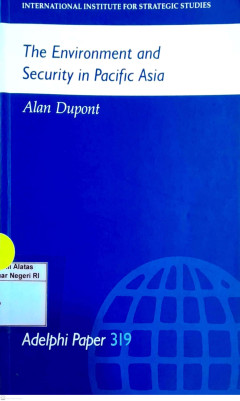
The environment and security in Pacific Asia
Pacific Asia faces environmental challenges ranging from pollution and rapid population growth to increasing water, energy and food scarcity. To what extent will these issues shape the regional security agenda? This paper argues that, in themselves, environmental difficulties are unlikely to be the primary cause of major conflict between the states. Nonetheless, Pacific Asia suffers from many t…
- Edisi
- Cet. 1
- ISBN/ISSN
- 0-19-922370-X
- Deskripsi Fisik
- 94 pages : illustrations (black and white) ; 24 cm
- Judul Seri
- -
- No. Panggil
- 363.7 Dup e
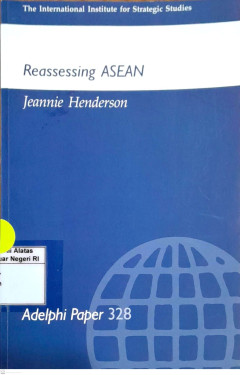
Reassessing ASEAN
With Cambodia's admission on 30 April 1999, the Association of South-East Asian Nations (ASEAN) finally incorporated all ten South-East Asian states. But ASEAN in 1999 is a pale imitation of the organisation which emerged from the Cold War as a model regional institution. Since July 1997, the enlarged Association has faced unprecedented challenges. Its members are beset with economic difficulti…
- Edisi
- -
- ISBN/ISSN
- 0199224315
- Deskripsi Fisik
- 85 pages : illustrations, maps, charts ; 24 cm
- Judul Seri
- -
- No. Panggil
- 341.2473 Hen r

APEC in the 21st century
APEC is a unique organization that promotes economic cooperation in the Asia-Pacific region. It remains an informal intergovernmental organization that provides a useful platform for leaders, ministers, businessmen and experts to discuss regional issues on a regular basis. This book examines APECs accomplishments in recent years and the challenges it faces in the new century. These challenges i…
- Edisi
- -
- ISBN/ISSN
- 981-230-253-0
- Deskripsi Fisik
- xi, 302 pages ; 23 cm.
- Judul Seri
- -
- No. Panggil
- 382.095 Mir a
 Karya Umum
  Filsafat
  Agama
Agama  Ilmu-ilmu Sosial
  Bahasa
  Ilmu-ilmu Murni
  Ilmu-ilmu Terapan
  Kesenian, Hiburan, dan Olahraga
  Kesusastraan
  Geografi dan Sejarah