Ditapis dengan

Socialist transformation of Indian economy: A Study in social analysis, criti…
Socialist Transformation of Indian Economy by Gyan Chand provides an analytical study of India’s efforts to shape its economic development within a socialist-oriented framework. The book evaluates India’s economic structure, social conditions, and political foundations during the transition from colonial rule to a planned economic system. Chand examines major policy initiatives, land reform…
- Edisi
- -
- ISBN/ISSN
- -
- Deskripsi Fisik
- vii pages ; 22,5 cm
- Judul Seri
- -
- No. Panggil
- 330.954 CHA s
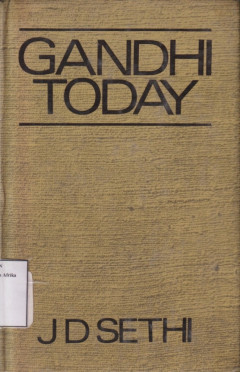
Gandhi Today
Gandhi Today examines the enduring relevance of Mahatma Gandhi’s ideas on nonviolence, social justice, and political transformation in contemporary society. J. D. Sethi discusses how Gandhian philosophy continues to influence modern political movements, social reform initiatives, and grassroots activism in India and beyond. The book highlights Gandhi’s perspectives on truth, moral leadershi…
- Edisi
- -
- ISBN/ISSN
- -
- Deskripsi Fisik
- 211 pages ; 22 cm
- Judul Seri
- -
- No. Panggil
- 320.55 SET g
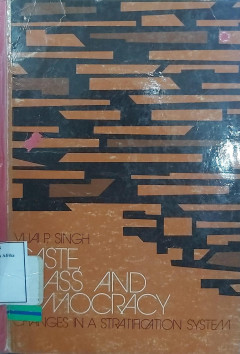
Caste, class and democracy: Changes in a stratification system
This book examines the dynamics of caste, class, and democratic change in India through a sociological analysis of its stratification system. Vijai P. Singh explores how traditional caste hierarchies have adapted to modern political and economic developments, highlighting the shifting relationships between caste-based identities, emerging class structures, and the functioning of democratic inst…
- Edisi
- -
- ISBN/ISSN
- 978-87073-577-2
- Deskripsi Fisik
- viii, 158 pages ; 22 cm
- Judul Seri
- -
- No. Panggil
- 300.54 SIN c
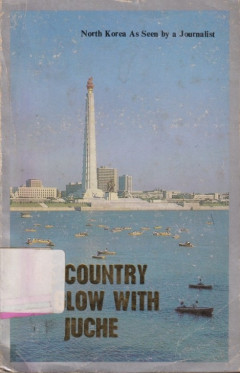
The Country aglow with juche
This book presents an account of the Democratic People’s Republic of Korea as observed by journalist Ishikawa Sho. Published in 1988 by the Foreign Languages Publishing House in Pyongyang, the work describes the social, political, and ideological landscape of North Korea, focusing particularly on the Juche ideology and its influence on the country’s development. Through the author’s persp…
- Edisi
- -
- ISBN/ISSN
- -
- Deskripsi Fisik
- 235 pages : illustrations ; 18 cm
- Judul Seri
- -
- No. Panggil
- 951.93 SHO c
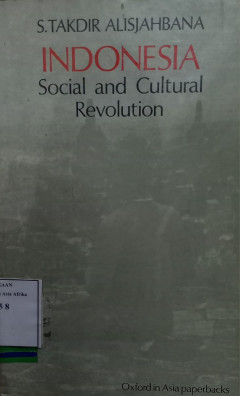
Indonesia social and cultural revolution
The major transformations in Indonesian society during the post-independence period. The author highlights shifts in values, mindsets, language, and cultural patterns as part of the nation’s modernization process. Alisjahbana emphasizes the need for a new orientation—rational, progressive, and grounded in scientific thinking—to build a modern and dynamic society. This work offers an impor…
- Edisi
- -
- ISBN/ISSN
- 0-19-638082-0
- Deskripsi Fisik
- ix, 206 pages ; 21,5 cm
- Judul Seri
- -
- No. Panggil
- 306.5988 ALI i

Gandhi's way: A Handbook of conflict resolution
Juergensmeyer’s book is something of a Gandhian tour de force—a careful analysis and series of applications of Gandhi’s concept of satyagraha to everyday situations of conflict. A crisply written and cogently argued little manual, this book explores the practical implications of satyagraha (truth force). It is a manual of instruction in the best sense: a popular reassessment of Gandhian c…
- Edisi
- -
- ISBN/ISSN
- 0-520-24497-4
- Deskripsi Fisik
- xi, 174 pages ; 21 cm
- Judul Seri
- -
- No. Panggil
- 303.6 JUE g

The Democratic People’s Republic of Korea
This book is an official publication providing an overview of the Democratic People's Republic of Korea (DPRK). It includes information on the history, political system, economic development, culture, and social life of North Korea in the 1980s. Published by Korea Pictorial in Pyongyang, the book is designed to introduce the DPRK to the international community through textual descriptions and i…
- Edisi
- -
- ISBN/ISSN
- -
- Deskripsi Fisik
- 320 pages : illustrations ; 29,5 cm
- Judul Seri
- -
- No. Panggil
- 951.9 PIC d
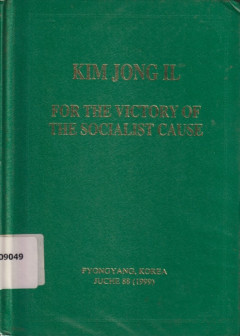
Kim Jong Il: For the victory of the socialist cause
This work presents the ideological principles, policies, and strategic viewpoints of Kim Jong Il regarding the building and strengthening of the socialist cause in the Democratic People’s Republic of Korea. Published in 1999 by the Foreign Languages Publishing House in Pyongyang, the book outlines the theoretical foundations of socialism, the role of leadership, and the tasks necessary to ens…
- Edisi
- -
- ISBN/ISSN
- -
- Deskripsi Fisik
- 261 pages ; 21 cm
- Judul Seri
- -
- No. Panggil
- 951.9043 KIM k
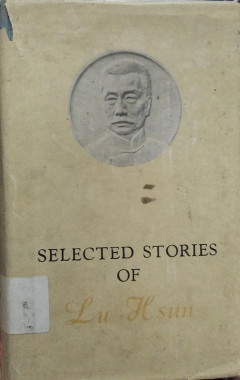
Selected stories of Lu Hsun
This volume presents a collection of classic short stories by Lu Xun (Lu Hsun), one of the most influential writers in modern Chinese literature. Written during the early 20th century, Lu Xun’s stories explore the social hardships, moral struggles, and cultural transformations experienced by the Chinese people during a period of national upheaval. Through incisive satire, vivid characterizati…
- Edisi
- -
- ISBN/ISSN
- -
- Deskripsi Fisik
- 306 pages : Ilustrations ; 22 cm
- Judul Seri
- -
- No. Panggil
- 929 LUH s

Society in India: Continuity and change
Mandelbaum analyzes the caste system, the role of kinship networks, and the relationships between and within jatis (caste groups). He shows that the Indian social system, though very old and seemingly rigid, actually possesses powerful psychological and cultural dynamics particularly in family structure and the sense of belonging among its members.
- Edisi
- 1
- ISBN/ISSN
- 0-520-01623-8
- Deskripsi Fisik
- xi, 323 pages ; 24 cm
- Judul Seri
- -
- No. Panggil
- 954 MAN s
 Karya Umum
  Filsafat
  Agama
Agama  Ilmu-ilmu Sosial
  Bahasa
  Ilmu-ilmu Murni
  Ilmu-ilmu Terapan
  Kesenian, Hiburan, dan Olahraga
  Kesusastraan
  Geografi dan Sejarah