Ditapis dengan
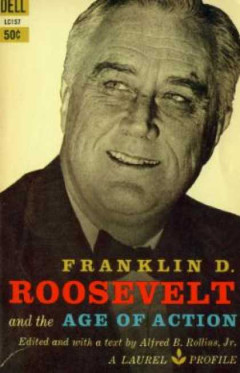
Roosevelt and the age of action
Franklin D. Roosevelt and the Age of Action provides an accessible profile of the life, leadership, and political legacy of the 32nd President of the United States. Edited and written by Alfred B. Rollins, Jr., the book explores Roosevelt’s rise to national prominence, his response to the Great Depression, and the transformative policies of the New Deal. It also examines the social, economic,…
- Edisi
- -
- ISBN/ISSN
- -
- Deskripsi Fisik
- 384 pages, 16 x 11 cm
- Judul Seri
- -
- No. Panggil
- 973.917 ROL f
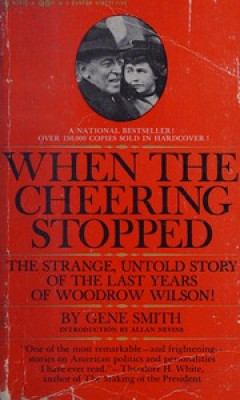
When the cheering stopped
When the Cheering Stopped is a compelling historical narrative that explores the final years of President Woodrow Wilson, focusing on his declining health, political struggles, and the downfall of his dream for the League of Nations. Gene Smith offers an intimate portrayal of Wilson’s personal and political challenges after World War I, revealing the tensions within his administration, his de…
- Edisi
- -
- ISBN/ISSN
- -
- Deskripsi Fisik
- xiii, 305 pages ; 17,5 cm
- Judul Seri
- -
- No. Panggil
- 973.913 SMI w
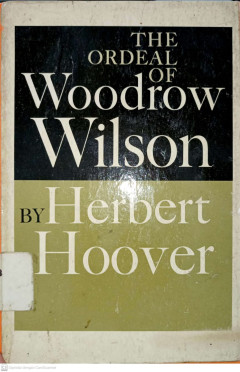
The Ordeal of Woodrow Wilson
The Ordeal of Woodrow Wilson is Herbert Hoover’s personal and political account of President Woodrow Wilson during the turbulent years surrounding World War I and its aftermath. Drawing from his close relationship with Wilson as head of wartime relief efforts, Hoover offers an insider’s perspective on Wilson’s struggles to negotiate peace, lead the United States through global crisis, and…
- Edisi
- -
- ISBN/ISSN
- -
- Deskripsi Fisik
- xiii, 318 pages : illustrations ; 20,1 cm
- Judul Seri
- -
- No. Panggil
- 973.913 HOO o
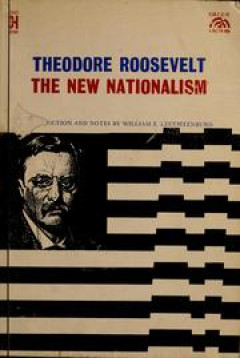
The New nationalism
The New Nationalism presents Theodore Roosevelt’s influential political philosophy advocating for stronger government regulation, social justice, and national unity during the Progressive Era. Through his speeches and writings, Roosevelt argues for reforms to balance the interests of labor, capital, and the public, emphasizing the need for fairness and responsibility in industrial society. Th…
- Edisi
- -
- ISBN/ISSN
- -
- Deskripsi Fisik
- xii, 173 pages ; 20 cm
- Judul Seri
- -
- No. Panggil
- 973.911 ROO n
America enters the world: A people's history of the Progressive Era and Worl…
America Enters the World is Volume Seven of Page Smith’s multi-volume narrative history of the American people. This volume explores the United States during the Progressive Era and its entry into World War I. Smith examines political reforms, social movements, changing national identity, and the rise of American influence abroad. Through a detailed, story-driven approach, the book traces how…
- Edisi
- Volume 7
- ISBN/ISSN
- 0070585733
- Deskripsi Fisik
- xiii, 1089 pages : maps ; 24 cm
- Judul Seri
- -
- No. Panggil
- 973 SMI a
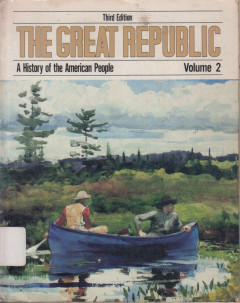
The Great republic: A History of the American people, volume 2
This volume of The Great Republic provides a comprehensive survey of American history from the Reconstruction era through the rise of modern America. Written by leading historians Frank Freidel, Richard N. Current, T. Harry Williams, and Alan Brinkley, the book explores political developments, social transformations, economic expansion, and cultural change in the United States. As part of a wid…
- Edisi
- -
- ISBN/ISSN
- 0-669-91390-4
- Deskripsi Fisik
- xlviii, 869 pages : illustrations ; 25,5 cm
- Judul Seri
- -
- No. Panggil
- 973 FRE g
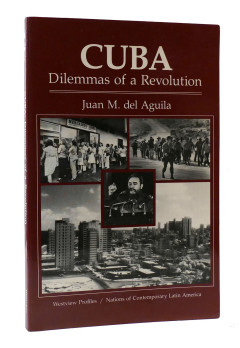
Cuba dilemmas of a revolution
"This book examines Cuba's political journey since the 1959 Revolution, focusing on the internal and external dilemmas facing the revolutionary government. Juan M. Del Aguila analyzes power dynamics, economic challenges, social policies, and Cuba's relations with other countries within the context of the Cold War. As part of the Nations of Contemporary Latin America series, this book provides a…
- Edisi
- -
- ISBN/ISSN
- 0-8133-0032-0
- Deskripsi Fisik
- 193 pages; 23 cm
- Judul Seri
- -
- No. Panggil
- 972.91064 AGU c
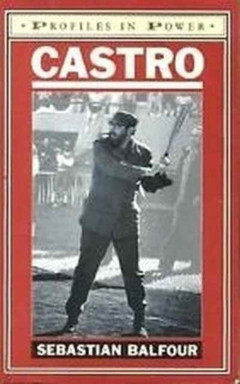
Castro
This book, part of the Profiles in Power series, provides a comprehensive analysis of the political life of Fidel Castro, the leader of the Cuban revolution and a central figure in Latin American politics for more than five decades. Sebastian Balfour examines Castro's background, the development of his ideology, the political and economic policies of his presidency, and his influence on interna…
- Edisi
- -
- ISBN/ISSN
- 0-582-02972-4
- Deskripsi Fisik
- 184 pages; 22 cm
- Judul Seri
- -
- No. Panggil
- 972.91064092 BAL c
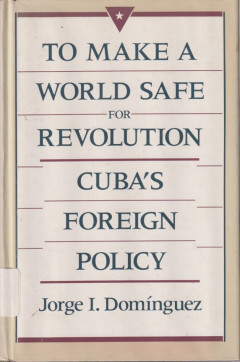
To Make a world safe for revolution: Cuba’s foreign policy
This book is an in-depth academic study of Cuban foreign policy after the 1959 Revolution. Jorge I. Domínguez, a leading expert on Latin American studies, analyzes how Fidel Castro's government devised a foreign strategy aimed at expanding Cuba's revolutionary influence and maintaining its national security. Discussions cover Cuba's relations with the Soviet Union, Latin American countries, an…
- Edisi
- -
- ISBN/ISSN
- 0-674-89325-5
- Deskripsi Fisik
- viii, 365 pages ; 24 cm
- Judul Seri
- -
- No. Panggil
- 327.7291 DOM m
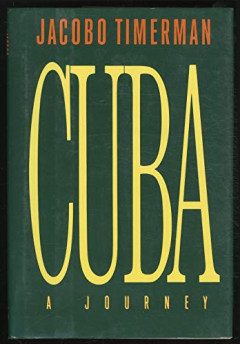
Cuba: A Journey
This book is Jacobo Timerman's travelogue and political analysis of Cuba in the post-1959 era. Written from a previously unpublished Spanish manuscript, it describes the political, social, and human rights conditions in Cuba after the revolution and the changes that occurred under Fidel Castro's rule. Using a journalistic and reflective approach, Timerman presents a critical view of modern Cuba…
- Edisi
- -
- ISBN/ISSN
- 0-679-73631-X
- Deskripsi Fisik
- 129 pages; 20 cm
- Judul Seri
- -
- No. Panggil
- 972.9106 TIM c
 Karya Umum
  Filsafat
  Agama
Agama  Ilmu-ilmu Sosial
  Bahasa
  Ilmu-ilmu Murni
  Ilmu-ilmu Terapan
  Kesenian, Hiburan, dan Olahraga
  Kesusastraan
  Geografi dan Sejarah