Ditapis dengan

Ensiklopedi sunda: alam, manusia, dan budaya (Termasuk budaya Cirebon dan Bet…
Ensiklopedi ini menyajikan gambaran menyeluruh mengenai alam, manusia, sejarah, dan kebudayaan masyarakat Sunda, termasuk budaya Cirebon dan Betawi. Di bawah pimpinan redaksi Ajip Rosidi dan Édi S. Ekadjati, buku ini memuat berbagai informasi penting mengenai adat-istiadat, kesenian, bahasa, kepercayaan, hingga perkembangan sosial masyarakat Sunda. Disusun dengan dukungan The Toyota Foundation…
- Edisi
- Cetakan pertama
- ISBN/ISSN
- 979-419-259-7
- Deskripsi Fisik
- xv, 719 halaman : ilustrasi ; 28,5 cm
- Judul Seri
- -
- No. Panggil
- 915.922 AJI e
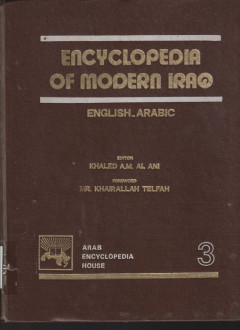
The Encyclopedia of Modern Iraq : Volume III
The Encyclopedia of Modern Iraq (Volume III) provides an extensive reference covering the political, historical, cultural, and social development of Iraq in the modern era. Edited by Khaled A.M. Al A'ni, this volume includes detailed entries on key events, institutions, personalities, and issues shaping contemporary Iraq. Designed for researchers and readers seeking an authoritative source on m…
- Edisi
- -
- ISBN/ISSN
- -
- Deskripsi Fisik
- 1528 pages : illustration ; 29 cm
- Judul Seri
- -
- No. Panggil
- 956.7 03 ANI e
Shiji: Records of the grand historian (Volume 3)
Shiji (Records of the Grand Historian), Volume 3, is part of the Simplified Chinese Edition of the Twenty-Four Histories published by the Zhonghua Book Company. Written by Sima Qian during the Han Dynasty, Shiji is considered the foundation of traditional Chinese historiography, documenting events from early legendary rulers to the Western Han. This volume includes classical annotations by Pei …
- Edisi
- -
- ISBN/ISSN
- -
- Deskripsi Fisik
- 2545 pages ; 21,5 cm
- Judul Seri
- -
- No. Panggil
- 931 QIA s
Shiji: Records of the Grand Historian. Volume 2
Shiji (Records of the Grand Historian), Volume 2, is part of the Simplified Chinese Edition of the Twenty-Four Histories published by the Zhonghua Book Company. Written by Sima Qian of the Han Dynasty, Shiji is one of the foundational works of Chinese historiography, covering events from prehistoric rulers to the early Han period. This volume includes classical annotations and commentaries by P…
- Edisi
- -
- ISBN/ISSN
- -
- Deskripsi Fisik
- 1693 pages ; 21,5 cm
- Judul Seri
- Twenty-Four Histories – Simplified Chinese Edition
- No. Panggil
- 931 QIA s
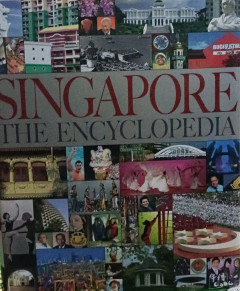
Singapore: The Encyclopedia
Singapore: The Encyclopedia is a comprehensive reference work presenting detailed, authoritative information on the history, culture, society, politics, geography, and notable personalities of Singapore. Published by Editions Didier Millet in association with the National Heritage Board, this richly illustrated encyclopedia features contributions from leading scholars, historians, and subject s…
- Edisi
- -
- ISBN/ISSN
- 981-4155-63-2
- Deskripsi Fisik
- 639 pages : illustration ; 29 cm
- Judul Seri
- -
- No. Panggil
- 959.57 KOH s
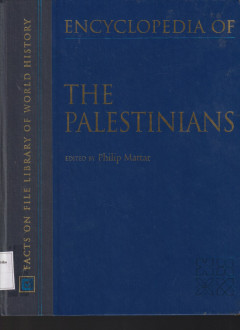
Encyclopedia of the Palestinians
Encyclopedia of the Palestinians, edited by Philip Mattar, provides a comprehensive and authoritative reference on the history, culture, society, politics, and notable figures of the Palestinian people. This volume brings together contributions from leading scholars and includes detailed entries on key historical events, cultural traditions, political movements, and biographies of influential P…
- Edisi
- -
- ISBN/ISSN
- 0-8160-3043-X
- Deskripsi Fisik
- xi, 514 pages : illustration ; 28,5 cm
- Judul Seri
- -
- No. Panggil
- 909.04927403 MAT e
Hanshu: Book of Han (Volume 2)
Hanshu (Book of Han), Volume 2, is part of the Simplified Chinese Edition of the Twenty-Four Histories published by Zhonghua Book Company. Authored by Ban Gu during the Eastern Han Dynasty, the Hanshu is a foundational historical text documenting the political, cultural, and social development of the Western Han era. This volume includes authoritative annotations by Tang dynasty scholar Yan Shi…
- Edisi
- -
- ISBN/ISSN
- -
- Deskripsi Fisik
- 2071 pages ; 21,5 cm
- Judul Seri
- -
- No. Panggil
- 931 NGU h
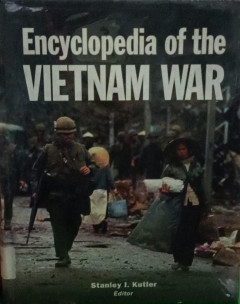
Encyclopedia of the Vietnam War
The Encyclopedia of the Vietnam War, edited by Stanley I. Kutler, is a comprehensive reference work covering the people, events, military strategies, political developments, and historical context of the Vietnamese Conflict from 1961 to 1975. Featuring contributions from leading historians and scholars, the encyclopedia presents detailed entries supported by bibliographical references and cross…
- Edisi
- -
- ISBN/ISSN
- 0-13-276932-8
- Deskripsi Fisik
- xxxiv, 711 pages : illustration ; 28,5 cm
- Judul Seri
- -
- No. Panggil
- 959.7043 STA e
Worldmark encyclopedia of the nations: Africa
This volume of the Worldmark Encyclopedia of the Nations provides comprehensive, authoritative reference entries on the nations of Africa. It includes factual information on geography, population, history, government, economy, communications, and international relations. Designed as an essential reference tool, the volume offers concise and reliable data supplemented with maps, statistical tabl…
- Edisi
- -
- ISBN/ISSN
- 0-471-88622-X
- Deskripsi Fisik
- 378 pages : illustration ; 28,5 cm
- Judul Seri
- -
- No. Panggil
- 910.3 WOR w

Records of the three kingdoms (Sanguozhi)
Records of the Three Kingdoms (Sanguozhi) is one of the official Chinese historical works included in the Twenty-Four Histories. Compiled by Chen Shou during the Western Jin dynasty, the text documents the political, military, and social history of the Three Kingdoms period (Wei, Shu, and Wu). This edition contains the extensive and authoritative annotations by Pei Songzhi from the Liu-Song dyn…
- Edisi
- -
- ISBN/ISSN
- -
- Deskripsi Fisik
- 1108 pages ; 21,5 cm
- Judul Seri
- -
- No. Panggil
- 931.04 SHO r
 Karya Umum
  Filsafat
  Agama
Agama  Ilmu-ilmu Sosial
  Bahasa
  Ilmu-ilmu Murni
  Ilmu-ilmu Terapan
  Kesenian, Hiburan, dan Olahraga
  Kesusastraan
  Geografi dan Sejarah