Ditapis dengan

Falling off the edge: Globalization world peace & other lies
Since the fall of the Berlin Wall, international corporations and governments have embraced the idea of a global village: a shrinking, booming world in which everyone benefits. What if that's not the case? Alex Perry, award-winning foreign correspondent, travels from the South China Sea to the highlands of Afghanistan to the Sahara to see first-hand globalization at the sharp end -- and it's no…
- Edisi
- -
- ISBN/ISSN
- 978-0-230-70689-7
- Deskripsi Fisik
- 342 pages ; 21,5 cm
- Judul Seri
- -
- No. Panggil
- 382 Per f

Descent into chaos: The United States and the failure of nation building in P…
Ahmed Rashid is the voice of reason amid the chaos of Central Asia today. His unique knowledge of this complex, war-torn region gives him a panoramic vision and grasp of nuance that no Western writer can emulate. In Descent Into Chaos, Rashid reviews the regional conditions since 9/11 and the catastrophic aftermath of America’s failed war on terror. The underlying theme is clear, devastating …
- Edisi
- -
- ISBN/ISSN
- 978-0-670-01970-0
- Deskripsi Fisik
- lviii, 484 pages ; 24 cm
- Judul Seri
- -
- No. Panggil
- 355.02 Ras d
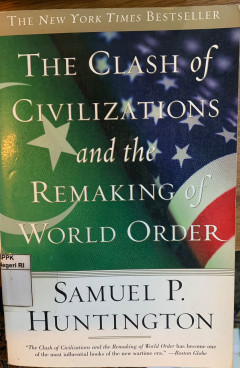
The clash of civilizations and the remaking of world order
Spurred by modernization, global politics is being reconfigured along cultural lines. Peoples and countries with similar cultures are coming together. Peoples and countries with different cultures are coming apart. Alignments defined by ideology and superpower relations are giving way to alignments defined by culture and civilization. Political bound- aries are increasingly redrawn to coincide …
- Edisi
- -
- ISBN/ISSN
- 0-684-84441-9
- Deskripsi Fisik
- 367 pages ; 25 cm
- Judul Seri
- -
- No. Panggil
- 909.829 Hun c
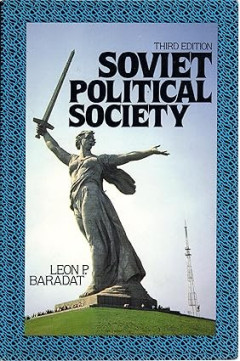
Soviet political society
This revised edition examines the Soviet political system from the perspective of geography, history, cultural factors and social problems as well as from the traditional aspects of the Communist Party and government. Contents: 1. Geography 2. Russian history 3. Soviet history 4. The communist and other parties 5. Soviet governmet, etc.
- Edisi
- ed.3
- ISBN/ISSN
- 0-13-824962-8
- Deskripsi Fisik
- xvi, 461 pages : illustrations (black and white) ; 23 cm
- Judul Seri
- -
- No. Panggil
- 947 Bar s

100 Years of permanent revolution: Results and prospects
One hundred years after their first appearance in Leon Trotsky's Results and Prospects, this book critically reevaluates two key Marxist theories: uneven and combined development, and permanent revolution. It brings together a formidable array of Marxist intellectuals from across the world including Daniel Bensaid, Michael Lowy, Hillel Ticktin and Patrick Bond. Marx saw societies progressing…
- Edisi
- -
- ISBN/ISSN
- 0-7453-2521-1
- Deskripsi Fisik
- vi, 257 pages ; 21 cm
- Judul Seri
- -
- No. Panggil
- 950 Dun y
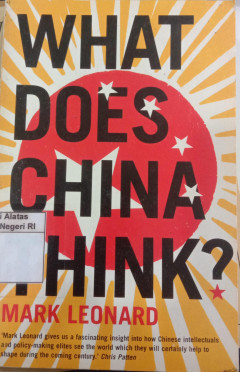
What does China think ?
Although dozens of books have been published about China's rise, most authors treat it as an economic, political or military bloc rather than seeing it as a powerhouse of ideas that could influence our world. They have little to say about China's intellectual debates, or the ideological competition they might pose to the European and American world-views.
- Edisi
- -
- ISBN/ISSN
- 978-0-00-723068-6
- Deskripsi Fisik
- 164 pages : illustration (black and white) ; 20 cm
- Judul Seri
- -
- No. Panggil
- 951 Leo w

Deng Xiaoping and the Chinese revolution: A political biography
This book attempts to reach beyond the spectacular economic success of recent years to understand Deng's own particular role and the sources of his political power. David Goodman has been able to draw on the substantial documentary sources that have become available from China since 1989 as well as the analysis of Deng's political life that has proliferated inside the People's Republic in recen…
- Edisi
- -
- ISBN/ISSN
- 0-415-11253-2
- Deskripsi Fisik
- xxii, 209 pages ; 23 cm
- Judul Seri
- -
- No. Panggil
- 923.2 Goo d
Preparing India for the next century
The contents of this book: 1. Demography and Development 2. Education 3. Political System and Constitutions 4. Governance 5. Economy
- Edisi
- -
- ISBN/ISSN
- 81-7095-063-5
- Deskripsi Fisik
- xvii, 380 pages ; 22 cm
- Judul Seri
- -
- No. Panggil
- 954 Nan p

A bitter revolution: China's struggle with the modern world
The defining moment in the development of a modern China is shown to be 4 May 1919 at the Tian'anmen gate in Beijing, where a new generation rejected Confucianism and traditional Chinese culture, and protested violently against the Paris Peace Conference. Chinese cities at that time still bore the imprints of their ancient past, with narrow lanes and sacred temples, but they were starting to ch…
- Edisi
- -
- ISBN/ISSN
- 0-19-280341-7
- Deskripsi Fisik
- xix, 357 pages : illustrations (black and white) ; 25 cm
- Judul Seri
- -
- No. Panggil
- 951 Mit b

My south block years: Memoirs of a foreign secretary
J.N Dixit tenure as the foreign secretary of India witnessed, both in the national and international arenas - as series of dramatic, profound and epoch-making events, which marked a phase of significant transition. Momentous happenings - such as the disintegration of the gigantic Soviet Union, the ethnic conflicts among the constituents of former Yugoslavia, the destruction of the Babri mosque …
- Edisi
- -
- ISBN/ISSN
- 81-7476-132-2
- Deskripsi Fisik
- 485 pages : illustratios ; 22 cm
- Judul Seri
- -
- No. Panggil
- 923.2 Dix s
 Karya Umum
  Filsafat
  Agama
Agama  Ilmu-ilmu Sosial
  Bahasa
  Ilmu-ilmu Murni
  Ilmu-ilmu Terapan
  Kesenian, Hiburan, dan Olahraga
  Kesusastraan
  Geografi dan Sejarah