Ditapis dengan

Twenty-Seventh meeting of the ASEAN economic ministers
- Edisi
- -
- ISBN/ISSN
- 0854-6258
- Deskripsi Fisik
- 28 pages : illustrations ; 29 cm
- Judul Seri
- -
- No. Panggil
- 330.959 Min t
- Edisi
- -
- ISBN/ISSN
- 0854-6258
- Deskripsi Fisik
- 28 pages : illustrations ; 29 cm
- Judul Seri
- -
- No. Panggil
- 330.959 Min t

Twenty-Sixth meeting of the ASEAN economic ministers
This book contains: 1. Fifth AFTA ministerial council meeting 2. Twenty-Sixth meeting of the ASEAN economic ministers 3. Post AEM with MITI-Japan
- Edisi
- -
- ISBN/ISSN
- 0854-6258
- Deskripsi Fisik
- 22 pages ; 29 cm
- Judul Seri
- -
- No. Panggil
- 330.959 Min t
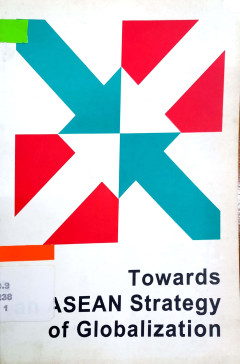
Towards an ASEAN strategy of globalization
This book was going for about decision makers in developing countries to adopt adequate policies that make use of the opportunities and minimize the negative effects of globalization. With the focus on the discussions of an ASEAN strategy of globalization, this book is organized into five parts. It begins with introduction, followed by a part presenting four views, which is the reproduction of…
- Edisi
- -
- ISBN/ISSN
- 979-8026-73-X
- Deskripsi Fisik
- v, 158 pages ; 25 cm.
- Judul Seri
- -
- No. Panggil
- 337.959 Stu t
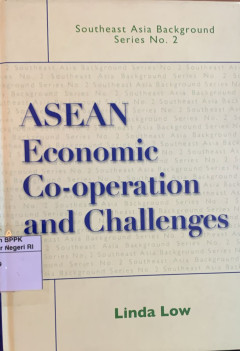
ASEAN economic co-operation and challenges
This book is written in an easily understood style. It explains the background of the origin of ASEAN (Association of Southeast Asian Nations) of which there are 10 member-countries. The author looks at the progress made, as well as the problems that the association faces. This is the 2nd book in the ISEAS Southeast Asia Background Series. Table of …
- Edisi
- -
- ISBN/ISSN
- 981-230-264-6
- Deskripsi Fisik
- vi, 80 pages ; 21 cm
- Judul Seri
- -
- No. Panggil
- 330.59 Low a
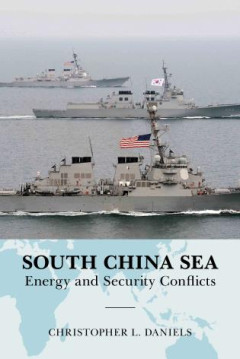
South China Sea: Energy and security conflicts
In South China Sea: Energy and Security Conflicts, foreign policy analyst Christopher L. Daniels analyzes the core causes of the dispute over territorial claims in the South China Sea, which separates some of the world’s fastest-growing economies. Starting with the question of access to the billions of barrels of oil and trillions of cubic feet of natural gas presently thought to lie beneath …
- Edisi
- -
- ISBN/ISSN
- 978-0-8108-8645-2
- Deskripsi Fisik
- v, 152 pages ; 24 cm
- Judul Seri
- -
- No. Panggil
- 355.033 Dan s

The Paracel Islands and U.S. interests and approaches in the South China Sea
The region around the Paracel Islands and the South China Sea is important to the economies of the surrounding states in terms of the fish resources and potential for energy reserves, which result in diplomatic and physical clashes. The large flow of maritime commerce around the Paracel Islands is also crucial to the economic well-being of the region and the world, and occupation of the islands…
- Edisi
- -
- ISBN/ISSN
- 1-58487-623-9
- Deskripsi Fisik
- 199 pages : illustrations (black and white) ; 23 cm
- Judul Seri
- -
- No. Panggil
- 355.07 Bou p
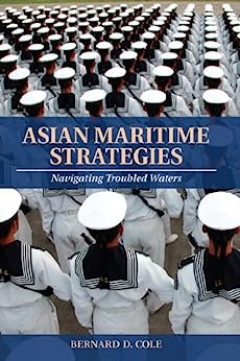
Asian maritime strategies: Navigating troubled waters
Asian Maritime Strategies explores one of the world's most complex and dangerous maritime arenas. Asia, stretching from the Aleutian Islands to the Persian Gulf, contains the world's busiest trade routes. It is also the scene of numerous maritime territorial disputes, pirate attacks, and terrorist threats. In response, the nations of the region are engaged in a nascent naval arms race. In t…
- Edisi
- First Printing
- ISBN/ISSN
- 978-1-59114-162-4
- Deskripsi Fisik
- xiv, 304 pages : 25 cm.
- Judul Seri
- -
- No. Panggil
- 359. 03095 Col a

Red star over the Pacific: China's rise and the challenge to U.S maritime str…
Combining Yoshihara's close knowledge of Asia and an ability to cap Chinese-language sources with Holmes' naval combat experience and expertise in sea power theory, both authors are able to assess how the rise of Chinese sea power will affect U.S maritime strategy in Asia. They argue that China is laying in the groundwork for a sustained challenge to American primacy in maritime Asia. To defend…
- Edisi
- cet.1
- ISBN/ISSN
- 978-1-59114-979-8
- Deskripsi Fisik
- ix, 292 halaman ; 23 cm
- Judul Seri
- -
- No. Panggil
- 359.030951 Yos r
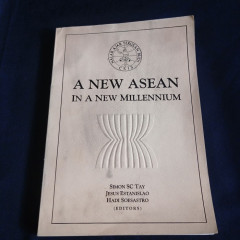
A new ASEAN in a new millennium
In July 2000, the ASEAN Foreign Ministers met in Bangkok, Thailand, for their annual meeting. The worst of the crisis that had begin in that capital in mid 1997 seemed to be over for most of the region. Some expected that, as such, things would return to the years of rapid growth, when ASEAN was part of the "Asian miracle".
- Edisi
- -
- ISBN/ISSN
- 979-8026-69-1
- Deskripsi Fisik
- x, 246 pages ; 25 cm
- Judul Seri
- -
- No. Panggil
- 341.2473 Tay n
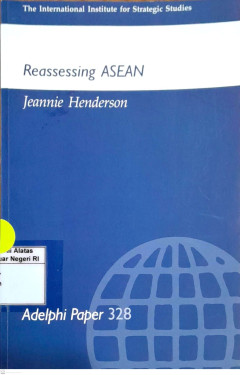
Reassessing ASEAN
With Cambodia's admission on 30 April 1999, the Association of South-East Asian Nations (ASEAN) finally incorporated all ten South-East Asian states. But ASEAN in 1999 is a pale imitation of the organisation which emerged from the Cold War as a model regional institution. Since July 1997, the enlarged Association has faced unprecedented challenges. Its members are beset with economic difficulti…
- Edisi
- -
- ISBN/ISSN
- 0199224315
- Deskripsi Fisik
- 85 pages : illustrations, maps, charts ; 24 cm
- Judul Seri
- -
- No. Panggil
- 341.2473 Hen r
 Karya Umum
  Filsafat
  Agama
Agama  Ilmu-ilmu Sosial
  Bahasa
  Ilmu-ilmu Murni
  Ilmu-ilmu Terapan
  Kesenian, Hiburan, dan Olahraga
  Kesusastraan
  Geografi dan Sejarah