Ditapis dengan

Hot, flat, and crowded: Why the world needs a green revolution-and how we can…
Friedman takes a fresh and provocative look at two of the biggest challenges we face today: the global environmental crisis and America's surprising loss of focus and national purpose since 9/11. It is a groundbreaking account of where we stand now, and shows us how the solutions to these two big problems are linked- how we can restore the world and revive America at the same time.
- Edisi
- -
- ISBN/ISSN
- 978-1-846-14129-4
- Deskripsi Fisik
- 438 pages : index ; 25 cm
- Judul Seri
- -
- No. Panggil
- 320.58 Fri h

Making Policy in Europe: The Europeification of Nation Policy-making
The focus of this book is on the interaction between the European Community and national policy-making. Traditionally policy- making has been analysed within a national or a comparative framework in which the EC has mainly been regarded as an external factor. Here the European political system itself becomes the unit of analysis.
- Edisi
- -
- ISBN/ISSN
- 0803989709
- Deskripsi Fisik
- vii, 284 pages ; 24 cm
- Judul Seri
- -
- No. Panggil
- 320.6 And m

Garis-garis besar politik luar negeri Republik Indonesia
This book explains in outline the problems that occur in the foreign policy of the Republic of Indonesia
- Edisi
- -
- ISBN/ISSN
- -
- Deskripsi Fisik
- 143 pages ; 32 cm
- Judul Seri
- -
- No. Panggil
- 327.598 Ind g
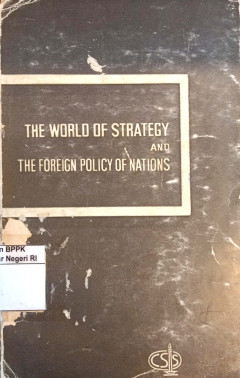
The world of strategy and the foreign policy of nations
This conference indicates none other than the emerging structure of inter dependency in our world. There are schools of thought which believe that it is exactly this structure that could condition peace. But we should not ignore the fact that together with the rapid flow and transfer of ideas.
- Edisi
- First edition
- ISBN/ISSN
- -
- Deskripsi Fisik
- x, 135 pages ; map ; 21 cm
- Judul Seri
- -
- No. Panggil
- 327 Ind w

The Malaysian currency crisis: How and why it happened
This book containing hope that in detailing the country's experience in handling the economic and financial turmoil, Malaysians will understand the very serious difficulty the country was in and appreciate the measures taken by the government to overcome the turmoil. It is also hoped that Malaysia's experience will provide invaluable lessons to other countries which might face similar situations.
- Edisi
- cet. 4
- ISBN/ISSN
- 967-978-756-7
- Deskripsi Fisik
- 61 pages ; 22 cm.
- Judul Seri
- -
- No. Panggil
- 332.4509595 Moh m
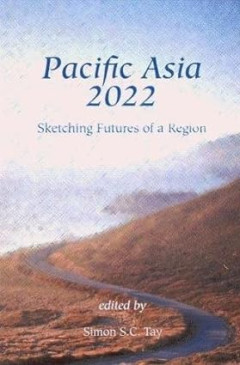
Pacific Asia 2022: Sketching futures of a region
The profound effects of the 1997-98 Asian financial crisis encompass more than economic concerns. Throughout Asia Pacific the crisis prompted a reassessment of governance, values, social safety structures, the commitment of the United States to the region, and the value of such institutions as the Asia Pacific Economic Cooperation forum. In this book, six authors from the region present a polic…
- Edisi
- -
- ISBN/ISSN
- 4-88907-064-8
- Deskripsi Fisik
- vii, 241 pages : bibliography ; 23 cm
- Judul Seri
- -
- No. Panggil
- 320.959 Tay p

Japan's failed revolution: Koizumi and the politics of economic reform
Japan's failed revolution: Koizumi and the politics of economic reform asks why, despite all the high expectation's, the Japanese public's desire for economic reform, and leadership of a majority coalition in a parliamentary democracy, the reformer prime minister Koizumi has not achieved the economic reforms expected of him since he surprisingly attained power over a year ago. this book expl…
- Edisi
- -
- ISBN/ISSN
- 0-7315-3693-2
- Deskripsi Fisik
- ix, 260 pages : index ; 23 cm
- Judul Seri
- -
- No. Panggil
- 330.95 Mul j
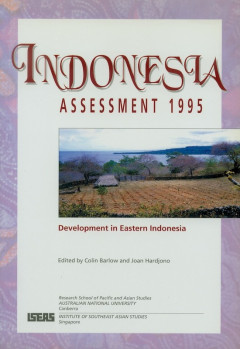
Indonesia assessment 1995: Development in Eastern Indonesia
Indonesia Assessment 1995 contains two main sections: one overviewing current Indonesian economic and political conditions, and one examining economic and social developments in Eastern Indonesia. This is the vast region of 25 million people, lying between Java, Malaysia, the Philippines and Australia. The book provides not only an up-do-date overview of Indonesia in 1995, but also one of the f…
- Edisi
- -
- ISBN/ISSN
- 981-3055-18-9
- Deskripsi Fisik
- xxviii, 287 pages : illustrations (black and white) : index ; 22 cm
- Judul Seri
- -
- No. Panggil
- 330.9598 Bar i

The Indonesian economy in crisis: Causes, consequences, and lessons
This book describes and analyses Indonesia's most serious economic crisis, against the general backdrop of economic decline in Southeast Asia. It also looks forward, considering Indonesia's immediate policy challenges to overcome the crisis, and dwelling on some of the longer-term policy challenges raised by the crisis.
- Edisi
- -
- ISBN/ISSN
- 981-230-058-9
- Deskripsi Fisik
- x, 152 pages : illustrations : index ; 22 cm
- Judul Seri
- -
- No. Panggil
- 330.9598 Hil i
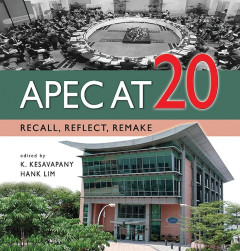
Apec at 20: Recall, reflect, remake
Spanning 20 years of history, the achievements of APEC may seem uneventful in the eyes of some observers. Yet careful deliberation will point to APEC's many remarkable high points as well as some of the challenges. The foundations of APEC were set in place about 40 years ago based on the achievements of the Association of Southeast Asian Nations (ASEAN) and the Pacific Economic Cooperation Coun…
- Edisi
- First Published
- ISBN/ISSN
- 978-981-4279-26-0
- Deskripsi Fisik
- xviii, 120 pages : illustrations : index ; 22 cm
- Judul Seri
- -
- No. Panggil
- 330.9 Kes a
 Karya Umum
  Filsafat
  Agama
Agama  Ilmu-ilmu Sosial
  Bahasa
  Ilmu-ilmu Murni
  Ilmu-ilmu Terapan
  Kesenian, Hiburan, dan Olahraga
  Kesusastraan
  Geografi dan Sejarah