Ditapis dengan

Typhoon in Tokyo : The Occupation and its aftermath
This book provides an analytical account of the Allied occupation of Tokyo following World War II. Harry Emerson Wildes examines political, social, and cultural changes that emerged during the occupation period, describing its impact on Japanese society and the transformation of Tokyo in the postwar era. Through firsthand observations and detailed reporting, the author offers insight into the c…
- Edisi
- 1
- ISBN/ISSN
- -
- Deskripsi Fisik
- 356 pages ; 21,5 cm
- Judul Seri
- -
- No. Panggil
- 952.044 WIL t

Japan and its world : Two centuries of change
Japan and Its World: Two Centuries of Change by Marius B. Jansen synthesizes decades of scholarship to explore how Japanese self-perception and its view of the Western world have evolved since the 18th century. Based on the Brown and Haley lectures delivered in 1975, the book traces key transformations in Japanese society, including challenges to the Confucian order, the quest for global wisdom…
- Edisi
- -
- ISBN/ISSN
- 0-691-05310-3
- Deskripsi Fisik
- 128 pages : illustrations ; 22 cm
- Judul Seri
- -
- No. Panggil
- 952.047 JAN j

The Enigma of Japanese power: People and politics in a stateless nation
The Enigma of Japanese Power explores the underlying mechanisms of Japan’s political, economic, and social system from a critical outsider’s perspective. Karel van Wolferen argues that despite its outward cohesion and stability, Japan’s power structure lacks a truly independent state in the Western sense: its institutions act as intermediaries rather than sovereign rulers. The book delves…
- Edisi
- -
- ISBN/ISSN
- 0-333-44321-7
- Deskripsi Fisik
- 496 pages ; 21,5 cm
- Judul Seri
- -
- No. Panggil
- 952.048 WOL e

The Enigma of Japanese power : People and politics in a stateless nation
The Enigma of Japanese Power explores the underlying mechanisms of Japan’s political, economic, and social system from a critical outsider’s perspective. Karel van Wolferen argues that despite its outward cohesion and stability, Japan’s power structure lacks a truly independent state in the Western sense: its institutions act as intermediaries rather than sovereign rulers. The book delves…
- Edisi
- -
- ISBN/ISSN
- 0-333-44321-7
- Deskripsi Fisik
- 496 pages ; 21,5 cm
- Judul Seri
- -
- No. Panggil
- 952.048 WOL e
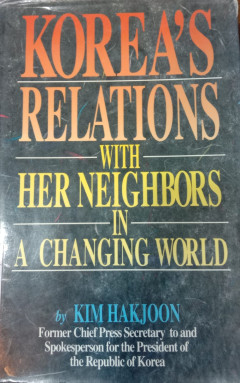
Korea's relations with her neighbors in a changing world
This book will help understand the dosmetic politics and foreign politics of the two Korean and serve as a reference for scholars concerned
- Edisi
- -
- ISBN/ISSN
- 1-56591-014-1
- Deskripsi Fisik
- viii, 775 pages : index ; 23 cm
- Judul Seri
- -
- No. Panggil
- 327.519 5 Hak k
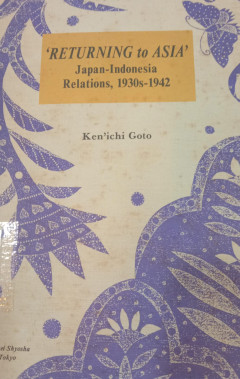
"Returning to Asia": Japan-Indonesia relations, 1930s-1942
In addition to tracing the development of Japan's southward-advance policies from the early 1930s to the outbreak of the "Greater East Asia War" in both government and private sectors, an outstanding feature of this book is that the author has looked into the trends within the na tionalist movement in Indonesia connected to the Japanese moves. Especially noteworthy is the analysis of the differ…
- Edisi
- First Published
- ISBN/ISSN
- 4-8447-8471-4
- Deskripsi Fisik
- xxvi, 496 pages : index ; 23 cm
- Judul Seri
- -
- No. Panggil
- 327.520 598 Got r

Diplomatic bluebook 2004: Japanese diplomacy and global affairs in 2003
Contents: 1. Overview: The international situation and Japanese diplomacy in 2003 2. Regional diplomacy 3. Japan's foreign policy in major diplomatic fields 4. Widening diplomacy 5. Assistance for Japanese nationals and companies overseas 6. Structure supporting Japan's diplomacy
- Edisi
- -
- ISBN/ISSN
- -
- Deskripsi Fisik
- 316 pages : illustrations (black and white) ; 30 cm
- Judul Seri
- -
- No. Panggil
- 952 Jap d

Japan's failed revolution: Koizumi and the politics of economic reform
Japan's failed revolution: Koizumi and the politics of economic reform asks why, despite all the high expectation's, the Japanese public's desire for economic reform, and leadership of a majority coalition in a parliamentary democracy, the reformer prime minister Koizumi has not achieved the economic reforms expected of him since he surprisingly attained power over a year ago. this book expl…
- Edisi
- -
- ISBN/ISSN
- 0-7315-3693-2
- Deskripsi Fisik
- ix, 260 pages : index ; 23 cm
- Judul Seri
- -
- No. Panggil
- 330.95 Mul j

U.S.-Japan relations in a changing world
This text evaluates the changing relationship between the US and Japan, providing analysis on a variety of topics. It scrutinizes the historical context, providing the reader with predictive tools for understanding events as they unfold.
- Edisi
- -
- ISBN/ISSN
- 0-8157-0629-4
- Deskripsi Fisik
- x, 286 pages : illustrations : index ; 24 cm
- Judul Seri
- -
- No. Panggil
- 327.7305209045 Vog u

The Japanese and sukarno's Indonesia: Tokyo-Jakarta Relations 1951-1966
This book treats the relationship between Japan and Indonesia, between an industrialized nation with sparse natural resources and a developing nation with rich natural resources, over the period from 1951 to 1966.
- Edisi
- -
- ISBN/ISSN
- 0-8248-0379-5
- Deskripsi Fisik
- xvii, 244 pages : bibl: hlm 219-230 : index ; 22 cm
- Judul Seri
- -
- No. Panggil
- 327.520598 Nis t
 Karya Umum
  Filsafat
  Agama
Agama  Ilmu-ilmu Sosial
  Bahasa
  Ilmu-ilmu Murni
  Ilmu-ilmu Terapan
  Kesenian, Hiburan, dan Olahraga
  Kesusastraan
  Geografi dan Sejarah