Ditapis dengan
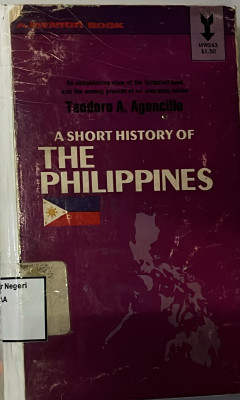
A short history of the Philippines
The Philippines—a vast archipelago consisting of over 7,000 islands and islets, with a land area of more than *114,000 square miles-occupies a uniquely sensitive geopolitical position. For thousands of years, the islands have had intimate contact with the Asian mainland; for over four centuries, they were under Western domina-tion, first by Spain, then by the United States. This book traces…
- Edisi
- -
- ISBN/ISSN
- -
- Deskripsi Fisik
- 319 pages ; 18 cm
- Judul Seri
- -
- No. Panggil
- 959.904 AGO s
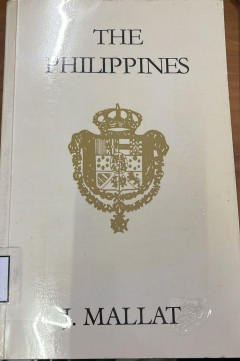
The Philippines
This book is a comprehensive historical and descriptive study of the Philippines during the Spanish colonial period, originally written by Jean Mallat and later translated into English. It examines the history, geography, social customs, agriculture, industry, and commerce of the Philippines as part of the Spanish colonies in Oceania. The work provides valuable firsthand observations and system…
- Edisi
- -
- ISBN/ISSN
- -
- Deskripsi Fisik
- 528 pages ; 20 cm
- Judul Seri
- -
- No. Panggil
- 959.9 MAL p

Quick access to the People’s Republic of China : The First sixty years (194…
Quick Access to the People’s Republic of China: The First Sixty Years (1949–2009) provides a comprehensive overview of the political, economic, social, and cultural development of the People’s Republic of China since its founding in 1949. The book presents key historical milestones, major reforms, and significant achievements over six decades, offering readers a concise reference to moder…
- Edisi
- -
- ISBN/ISSN
- 978-7-119-05990-7
- Deskripsi Fisik
- 183 pages; illustrations: 24 cm
- Judul Seri
- -
- No. Panggil
- 951.05 FOR q

Jose Rizal on his centenary: Being an attempt at a revaluation of his signifi…
This book is a collection of scholarly essays published in commemoration of the centenary of José Rizal, the national hero of the Philippines. Edited by Leopoldo Y. Yabes, the volume presents critical re-evaluations of Rizal’s historical, intellectual, and cultural significance, written by professors of the University of the Philippines. The essays examine Rizal’s role as a reformist, writ…
- Edisi
- -
- ISBN/ISSN
- -
- Deskripsi Fisik
- xi, 269 pages ; 21 cm
- Judul Seri
- -
- No. Panggil
- 959.903 YAB j
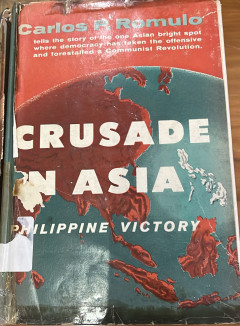
Crusade in Asia: Philippine victory
This book presents a firsthand political and historical account of the Philippines’ struggle and role in Asia during and after the Second World War. Written by Carlos P. Romulo, a prominent Filipino diplomat, soldier, and statesman, the work reflects on the broader Asian conflict against imperialism and totalitarianism, highlighting the Philippine experience as a symbol of democratic resistan…
- Edisi
- -
- ISBN/ISSN
- -
- Deskripsi Fisik
- 309 pages ; 21 cm
- Judul Seri
- -
- No. Panggil
- 959.904 ROM c
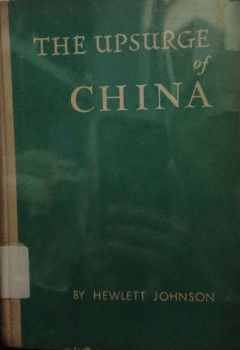
The Upsurge of China
The Upsurge of China is a firsthand account written by Hewlett Johnson—known as the “Red Dean of Canterbury”—documenting his travels and observations in the People’s Republic of China during the early years of the Communist era. Supported by the diaries and drawings of his wife Nowell Johnson and his daughters Kezia and Keren, the book offers a sympathetic portrayal of China’s polit…
- Edisi
- -
- ISBN/ISSN
- -
- Deskripsi Fisik
- 372 pages : Ilustration ; 21 cm
- Judul Seri
- -
- No. Panggil
- 951 JOH t

The First Filipino: A Biography of José Rizal
This book is a comprehensive biography of José Rizal, the foremost national hero of the Philippines, portraying his life, intellectual development, and political thought within the context of Spanish colonial rule. Written by León Ma. Guerrero, the work traces Rizal’s education, travels in Europe, literary contributions, and reformist ideas that inspired the Philippine nationalist movement.…
- Edisi
- -
- ISBN/ISSN
- 971-136-026-8
- Deskripsi Fisik
- xxv, 549 pages ; 23 cm
- Judul Seri
- -
- No. Panggil
- 959.90092 GUE f
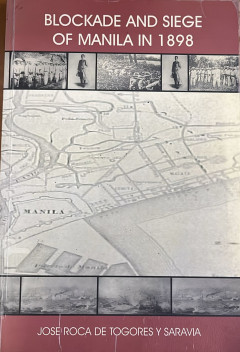
Blockade and siege of Manila
This book examines the historical events surrounding the blockade and siege of Manila during the late nineteenth century, a critical episode in Philippine history connected to the Spanish-American War of 1898. Written by Jose Roca S. de Tógóres, the work provides a detailed narrative of military operations, political circumstances, and the roles played by colonial powers in the capture of Man…
- Edisi
- -
- ISBN/ISSN
- 978-971-538-167-7
- Deskripsi Fisik
- x, 155 pages ; 23 cm
- Judul Seri
- -
- No. Panggil
- 959.9027 TOG b

The Brothers’ war: Biafra and Nigeria
This book provides a detailed narrative of the Nigerian Civil War, commonly known as the Biafra War, which took place between 1967 and 1970. John de St. Jorre examines the political, ethnic, and economic factors that led to the conflict, as well as its military and humanitarian consequences. Drawing on firsthand reporting and historical analysis, the work offers insight into the struggle betwee…
- Edisi
- -
- ISBN/ISSN
- 0-395-13934-1
- Deskripsi Fisik
- 437 pages : illustration ; 24 cm
- Judul Seri
- -
- No. Panggil
- 966.905 JOR b
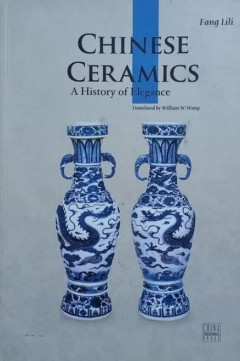
Chinese ceramics: A History of elegance
This book presents a comprehensive overview of the development of ceramics in China, from the prehistoric period (primitive pottery) to classical porcelain, complete with color illustrations. The book not only discusses manufacturing techniques, types of ceramics, and the development of styles and decorations (such as celadon, blue-and-white ware, wucai, fencai, and others), but also examines t…
- Edisi
- 2
- ISBN/ISSN
- 978-7-5085-1673-8
- Deskripsi Fisik
- 156 pages : illustrations ; 23 cm
- Judul Seri
- -
- No. Panggil
- 738.0951 FAN c
 Karya Umum
  Filsafat
  Agama
Agama  Ilmu-ilmu Sosial
  Bahasa
  Ilmu-ilmu Murni
  Ilmu-ilmu Terapan
  Kesenian, Hiburan, dan Olahraga
  Kesusastraan
  Geografi dan Sejarah