Ditapis dengan

Hostage in Peking
This book is a firsthand account of Anthony Grey, a Reuters correspondent who was held as a political hostage by the People's Republic of China government for two years (1967–1969) during the Cultural Revolution. Through personal narrative, Grey describes his experiences of detention, the psychological pressures, his interactions with local authorities, and the political and social situation …
- Edisi
- -
- ISBN/ISSN
- 0–297–79503–1
- Deskripsi Fisik
- 343 pages : illustration ; 21,5 cm
- Judul Seri
- -
- No. Panggil
- 365.450924 GRE h

Sino-Soviet crisis politics: A Study of political change and communication
Richard Wich's Sino-Soviet Crisis Politics is an in-depth study of the political dynamics and communication between the People's Republic of China and the Soviet Union during a period of heightened ideological and strategic tensions during the Cold War. Through analysis of archives, political statements, and communication patterns between the two countries, Wich outlines how the crisis and conf…
- Edisi
- -
- ISBN/ISSN
- 0-674-80935-1
- Deskripsi Fisik
- 313 pages ; 23,5 cm
- Judul Seri
- -
- No. Panggil
- 327.51047 WIC s

Soviet and Chinese Influence in the Third World
This book discusses the influence of the Soviet Union and the People's Republic of China in Third World countries during the Cold War period. Alvin Z. Rubinstein analyzes the foreign policy strategies of these two communist countries and how they competed and cooperated in expanding their ideology, military influence, and diplomatic relations in Asia, Africa, and Latin America. This work also e…
- Edisi
- -
- ISBN/ISSN
- 0-275-09640-8
- Deskripsi Fisik
- ix, 231 pages ; 23,5 cm
- Judul Seri
- -
- No. Panggil
- 327.09172 RUB s

The French presence in Cochinchina and Cambodia: Rule and response (1859–1905)
Milton E. Osborne's The French Presence in Cochinchina and Cambodia examines French colonial policy in Southeast Asia, particularly in Cochinchina (South Vietnam) and Cambodia, from 1859 to 1905. It examines the occupation process, colonial administration, the political relationship between France and local elites, and the forms of resistance and responses of local communities. Drawing on prima…
- Edisi
- -
- ISBN/ISSN
- 0-8014-0512-2
- Deskripsi Fisik
- xvi, 379 pages : illustration ; 21,5 cm
- Judul Seri
- -
- No. Panggil
- 959.6 OSB f

The People’s Republic of China Foreign Affairs archives compilation (Volume…
This volume presents a curated selection of diplomatic archives from the Ministry of Foreign Affairs of the People’s Republic of China, focusing on the Chinese delegation’s participation in the 1955 Asian-African Conference in Bandung. The documents provide insights into China’s foreign policy strategies, diplomatic interactions, preparatory communications, and the geopolitical context su…
- Edisi
- -
- ISBN/ISSN
- -
- Deskripsi Fisik
- 260 pages : illustrations ; 24,5 cm
- Judul Seri
- -
- No. Panggil
- 327.51 MIN p

After the cataclysm: Postwar Indochina and the reconstruction of imperial ide…
After the Cataclysm examines the political, social, and ideological aftermath of the Indochina wars, focusing on Vietnam, Cambodia, and Laos following the withdrawal of the United States. Chomsky and Herman analyze how Western media and political institutions constructed narratives about postwar Indochina to justify American foreign policy and sustain Cold War ideological frameworks. The book c…
- Edisi
- -
- ISBN/ISSN
- 0-89608-100-1
- Deskripsi Fisik
- 392 pages ; 21 cm
- Judul Seri
- -
- No. Panggil
- 959.704 CHO a
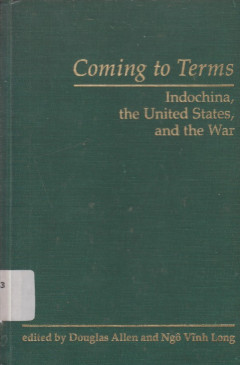
Coming to terms: Indochina, the United States, and the war
Coming to Terms is a scholarly examination of the political, social, and historical dimensions of the Indochina conflict and the role of the United States. Edited by Douglas Allen and Ngô Vĩnh Long, the book brings together contributions from leading researchers who analyze the roots of the war, the consequences for Vietnam, Laos, and Cambodia, and the broader geopolitical implications for So…
- Edisi
- -
- ISBN/ISSN
- 0-8133-1249-3
- Deskripsi Fisik
- ix, 350 pages : illustrations ; 23,5 cm
- Judul Seri
- -
- No. Panggil
- 959.7043 ALL c
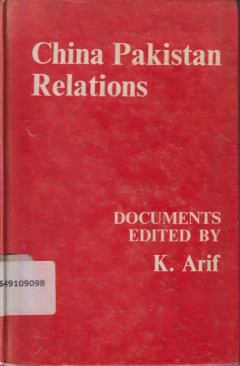
China Pakistan relations 1947–1980
This volume compiles key official documents, statements, agreements, and historical records that trace the evolution of China–Pakistan relations from 1947 to 1980. Edited by K. Arif, the book provides insight into diplomatic exchanges, political developments, security cooperation, and regional dynamics shaping the partnership between the two countries. It serves as an essential reference for …
- Edisi
- -
- ISBN/ISSN
- -
- Deskripsi Fisik
- xvii, 300 pages ; 22 cm
- Judul Seri
- -
- No. Panggil
- 327.549105 ARI c
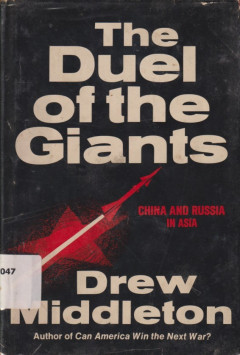
The Duel of the giants: China and Russia in Asia
This book provides an in-depth analysis of the geopolitical rivalry between China and Russia in Asia during the Cold War. Drew Middleton explores the historical roots of tensions, diplomatic conflicts, military strategies, and political motivations that shaped bilateral relations between the two major powers. The work examines how their competition influenced regional stability, foreign policy …
- Edisi
- -
- ISBN/ISSN
- 0-684-15785-3
- Deskripsi Fisik
- viii, 241 pages ; 21,5 cm
- Judul Seri
- -
- No. Panggil
- 327.51047 MID d
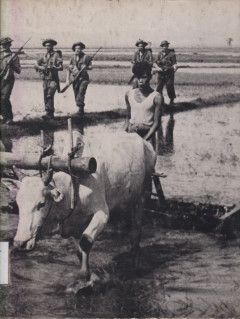
China–Burma–India
China–Burma–India recounts the complex and often overlooked campaigns fought in the Asian theater during World War II. Written by Don Moser with the editors of Time-Life Books, this volume explores the Allied struggle to keep China supplied, the grueling combat in the jungles of Burma, and the challenges of multinational cooperation. The narrative includes the efforts of General Joseph Stil…
- Edisi
- -
- ISBN/ISSN
- 0-8094-2407-0
- Deskripsi Fisik
- 208 pages : illustration ; 29 cm
- Judul Seri
- -
- No. Panggil
- 940.542 MOS c
 Karya Umum
  Filsafat
  Agama
Agama  Ilmu-ilmu Sosial
  Bahasa
  Ilmu-ilmu Murni
  Ilmu-ilmu Terapan
  Kesenian, Hiburan, dan Olahraga
  Kesusastraan
  Geografi dan Sejarah