Ditapis dengan
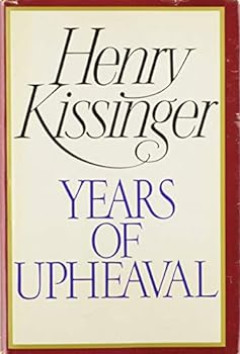
Years of upheaval
Henry Kissinger is a comprehensive biography exploring the life, career, and influence of one of the most significant American diplomats of the twentieth century. The book examines Kissinger’s early years, his rise as an academic and foreign policy strategist, and his role as National Security Advisor and Secretary of State under Presidents Nixon and Ford. It analyzes his contributions to maj…
- Edisi
- cet 1
- ISBN/ISSN
- 0-31-628-5919
- Deskripsi Fisik
- xxi, 1281 pages : illustrations ; 24 cm
- Judul Seri
- -
- No. Panggil
- 973.924 KIS y

Revolutionizing state hospitality for state and official guests in Indonesia:…
This paper examines the reform of Indonesia’s state hospitality policy for state and official guests, using airport VIP room facilities in Jakarta as a case study of government courtesy. It highlights institutional coordination challenges, particularly the dominant role of the Ministry of State Secretariat in organizing state and official engagements, while the position of Chief of State Prot…
- Edisi
- -
- ISBN/ISSN
- -
- Deskripsi Fisik
- Digital File
- Judul Seri
- -
- No. Panggil
- Sesparlu 74-2024

Subversion as foreign policy: The secret Eisenhower and Dulles debacle in Ind…
This account of US foreign policy reveals the story of the covert activity in Indonesia undertaken by President Eisenhower and Secretary of State John Foster Dulles in the late 1950s
- Edisi
- Cetakan pertama
- ISBN/ISSN
- 1-56584-244-8
- Deskripsi Fisik
- 318 pages : maps : index ; 25 cm
- Judul Seri
- -
- No. Panggil
- 327.598073 Kah s

A Strategy of interdependence: A Program for the control of conflict between …
This book presents a comprehensive program for controlling conflict between the United States and the Soviet Union during the Cold War era. Vincent P. Rock outlines a strategic framework based on political interdependence, diplomatic negotiation, and cooperative security measures. The work analyzes sources of tension between the two superpowers and proposes practical mechanisms to prevent escal…
- Edisi
- -
- ISBN/ISSN
- -
- Deskripsi Fisik
- xv, 399 pages ; 23 cm
- Judul Seri
- -
- No. Panggil
- 327.17 ROC s
Encyclopedia of American history
The Encyclopedia of American History: Bicentennial Edition provides a comprehensive chronological overview of the major events, developments, and figures that have shaped the United States from its origins to the modern era. Edited by renowned historian Richard B. Morris, with contributions from Jeffrey B. Morris, this reference work offers accessible entries, updated historical interpretations…
- Edisi
- Bicentennial
- ISBN/ISSN
- 0-06-013081-4
- Deskripsi Fisik
- Deskripsi fisik : xiv, 1245 pages : illustration ; 24 cm
- Judul Seri
- -
- No. Panggil
- 973.03 MOR e

The American Republic: Politics, institutions, and policies
This book offers a comprehensive overview of the political system of the United States, examining its institutions, public policies, and the dynamics of governance. It provides an analytical foundation for understanding how American political structures operate, the roles of key actors, and the processes that shape national decision-making. Designed for political science students, the volume bl…
- Edisi
- -
- ISBN/ISSN
- 0-314-28509-1
- Deskripsi Fisik
- ix, 353 pages : illustrations ; 25,5 cm
- Judul Seri
- -
- No. Panggil
- 320.973 RED a
Secret societies of America’s elite: From the knights templar to skull and …
This book explores the hidden influence of secret societies on America's political and cultural elite, tracing their origins from the medieval Knights Templar to modern groups such as Skull and Bones. Steven Sora examines the rituals, symbolism, and historical evolution of these organizations, revealing how clandestine networks have shaped leadership, decision-making, and power structures in th…
- Edisi
- -
- ISBN/ISSN
- 0-89281-959-6
- Deskripsi Fisik
- ix, 324 pages ; 23 cm
- Judul Seri
- -
- No. Panggil
- 366.00973 SOR s
American realities historical episodes
American Realities presents a series of historical episodes that illuminate the development of the United States from Reconstruction through the modern era. J. William T. Youngs introduces readers to key events and personalities that shaped American political, social, and cultural life. Through narrative chapters supported by illustrations and quotations, the book explores industrialization, im…
- Edisi
- -
- ISBN/ISSN
- 0-316-977292
- Deskripsi Fisik
- xii, 286 pages : illustrations ; 23 cm
- Judul Seri
- -
- No. Panggil
- 973.9 YOU a

The United States and China in the twentieth century
This book provides a comprehensive examination of the political, diplomatic, and economic relations between the United States and China throughout the twentieth century. Michael Schaller analyzes major historical events, ideological confrontations, and policy shifts that shaped the complex bilateral relationship, from early interactions to the Cold War era. The work highlights how both nationsâ…
- Edisi
- -
- ISBN/ISSN
- 0-19-502599-7
- Deskripsi Fisik
- vii, 199 pages : illustrations ; 21,5 cm
- Judul Seri
- -
- No. Panggil
- 327.73 SCH u
Are government organizations immortal?
Are Government Organizations Immortal? analyzes the longevity of governmental agencies in the United States. Herbert Kaufman examines why some public organizations persist for decades while others disappear, identifying political, structural, and environmental factors that shape their survival. Through empirical research, he explores patterns of organizational continuity, governmental resilienc…
- Edisi
- -
- ISBN/ISSN
- 0-8157-4839-6
- Deskripsi Fisik
- viii, 79 pages : illustrations ; 22 cm
- Judul Seri
- -
- No. Panggil
- 353.04 KAU a
 Karya Umum
 Filsafat
 Agama
 Ilmu-ilmu Sosial
 Bahasa
 Ilmu-ilmu Murni
 Ilmu-ilmu Terapan
 Kesenian, Hiburan, dan Olahraga
 Kesusastraan
 Geografi dan Sejarah