Ditapis dengan
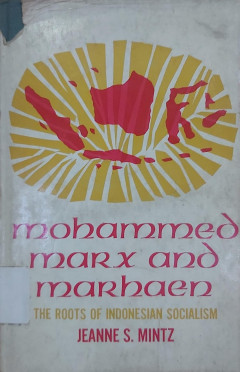
Mohammed Marx and Marhaen: The Roots of Indonesian socialism
The book "Mohammed Marx and Marhaen: The Roots of Indonesian Socialism" examines the development of socialism in Indonesia, especially by connecting Marxist ideas with local experience, which was popularized by the figure "Marhaen". In her book, Jeanne S. Mintz examines how Marx's thoughts are translated in the Indonesian context, where the struggles of ordinary people—as represented by Marha…
- Edisi
- -
- ISBN/ISSN
- -
- Deskripsi Fisik
- vi, 246 pages ; 21,5 cm
- Judul Seri
- -
- No. Panggil
- 320.352598 MIN m
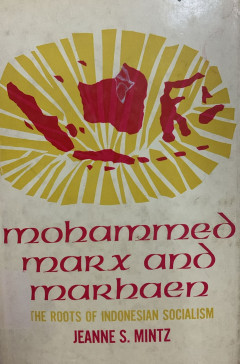
Mohammed, Marx and Marhaen: The Roots of Indonesian socialism
Mohammed, Marx and Marhaen: The Roots of Indonesian Socialism analyzes the ideological foundations of Indonesian socialism by examining the interaction between Islamic thought, Marxist theory, and indigenous concepts such as Marhaenism. Jeanne S. Mintz traces the development of socialist ideas in Indonesia within the context of colonialism, nationalism, and political movements, providing an in-…
- Edisi
- First edition
- ISBN/ISSN
- -
- Deskripsi Fisik
- 246 pages ; 22 cm
- Judul Seri
- -
- No. Panggil
- 320.53109598 MIN m
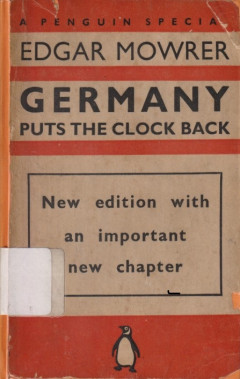
Germany puts the clock back
This book contains Edgar Ansel Mowrer's sharp analysis of German political developments after the Nazi Party rose to power. Written by a renowned international journalist, this book describes how the policies of Adolf Hitler and Nazi leaders changed the course of German history in the early 1930s. Using an investigative style, Mowrer highlights political oppression, propaganda, social change, a…
- Edisi
- -
- ISBN/ISSN
- -
- Deskripsi Fisik
- v, 284 pages ; 18 cm
- Judul Seri
- -
- No. Panggil
- 943.086 MOW g

A German generation: An Experiential history of the twentieth century
This book is an experiential history study of the German generation that lived throughout the 20th century, particularly during World War I, the Weimar Republic, the Nazi era, World War II, and the postwar period. Through narrative analysis and oral history interviews, Thomas A. Kohut reveals how identity, experience, and collective memory shaped how this generation understood themselves and th…
- Edisi
- -
- ISBN/ISSN
- 978-0-300-17003-0
- Deskripsi Fisik
- xi, 335 pages ; 24 cm
- Judul Seri
- -
- No. Panggil
- 943.087 KOH g
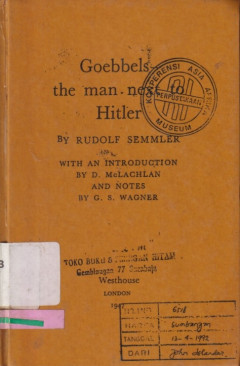
Goebbels: The Man next to Hitler
This book is the personal account of Rudolf Semmler, one of Joseph Goebbels' closest associates, the Nazi German Minister of Propaganda. Through the author's personal experiences, this book describes Goebbels' personality, leadership style, propaganda strategies, and his relationship with Adolf Hitler and the inner circle of the Nazi Party. With an introduction by D. McLachlan and additional no…
- Edisi
- -
- ISBN/ISSN
- -
- Deskripsi Fisik
- 234 pages : illustration ; 18,5 cm
- Judul Seri
- -
- No. Panggil
- 943.086092 SEM g

The Third reich: Its Beginnings, its development, its end
This book outlines the complete history of the establishment of the Third Reich in Germany, from its inception and rise to power to its collapse in 1945. Hans Buchheim explains the political, social, and ideological factors that enabled the growth of the Nazi regime, including the internal dynamics of the government, propaganda, and the impact of Hitler's policies on the German people. Written …
- Edisi
- -
- ISBN/ISSN
- -
- Deskripsi Fisik
- 98 pages ; 19 cm
- Judul Seri
- -
- No. Panggil
- 943.086 BUC t

Eurocommunisme en staat
Eurocommunisme en staat is a Dutch translation of Santiago Carrillo's work discussing the development of eurocommunism as a new form of communist movement in Western Europe in the 1970s. This book describes how communist parties in various European countries tried to adapt the principles of communism to the reality of democratic politics, as well as how they viewed the role of the state, power …
- Edisi
- -
- ISBN/ISSN
- 90 6012 363 8
- Deskripsi Fisik
- 197 pages ; 20 cm
- Judul Seri
- -
- No. Panggil
- 335.43 CAR e

Roots of totalitarianism: The Ideological sources of fascism, national social…
J. Lucien Radel's Roots of Totalitarianism examines the ideological roots of three major 20th-century political movements: fascism, national socialism, and communism. The book traces the development of thought, socio-political conditions, and the figures that influenced the birth of these totalitarian systems. Using historical and philosophical analysis, Radel explains how these ideologies form…
- Edisi
- -
- ISBN/ISSN
- 0-8448-0374-X
- Deskripsi Fisik
- ix, 218 pages ; 23 cm
- Judul Seri
- -
- No. Panggil
- 335.5 RAD r

The rise and fall of the American left
The American Left was born in America, not, as some would have it in Europe or the Third World, and the American Left was nurtured by intellectuals and activists who read Jefferson and Whitman before the read Marx or Mao. One lesson this brilliant history teaches us in that the fury of radical innocence and wounded idealism so peculiar to American intellectual history springs from native soil
- Edisi
- -
- ISBN/ISSN
- 0-393-03075-X
- Deskripsi Fisik
- 432 pages : illustrations ; 22 cm
- Judul Seri
- -
- No. Panggil
- 303.484 DIG r

Revolution in the third world
Revolution in the Third World provides a comprehensive analysis of revolutionary movements across Asia, Africa, and Latin America during the post–World War II era. Gérard Chaliand examines the historical conditions, political dynamics, and strategies that shaped guerrilla struggles and socialist-oriented revolutions in developing regions. Drawing on comparative cases, the book explores the i…
- Edisi
- -
- ISBN/ISSN
- 0-14-04796-4
- Deskripsi Fisik
- xxii, 202 pages ; 20 cm
- Judul Seri
- -
- No. Panggil
- 320.5 CHA r
 Karya Umum
  Filsafat
  Agama
Agama  Ilmu-ilmu Sosial
  Bahasa
  Ilmu-ilmu Murni
  Ilmu-ilmu Terapan
  Kesenian, Hiburan, dan Olahraga
  Kesusastraan
  Geografi dan Sejarah