Ditapis dengan
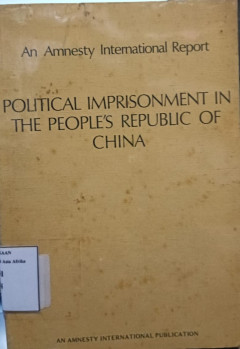
Political Imprisonment In The People's Republic Of China
This report examines the practice of political imprisonment in the People’s Republic of China, documenting patterns of arrest, detention, and punishment of individuals targeted for their political views or perceived dissent. It analyzes the legal and administrative mechanisms used to justify political detentions, including “re-education,” labor camps, and forms of extrajudicial punishment.
- Edisi
- -
- ISBN/ISSN
- 0-900058-83-3
- Deskripsi Fisik
- xv, 176 pages : 20 cm
- Judul Seri
- -
- No. Panggil
- 365.45 AMN p

Inclusive diplomacy: Advancing Papuan participation in Indonesia’s approach…
This paper examines Indonesia’s inclusive diplomacy in the Pacific by emphasizing Papuan participation in engagement with Melanesia. The Papua issue and questions of cultural legitimacy continue to constrain Indonesia’s diplomacy in the Melanesian Spearhead Group (MSG) and the Pacific Islands Forum (PIF). Through a literature review, the paper assesses the alignment of the Ministry of Forei…
- Edisi
- -
- ISBN/ISSN
- -
- Deskripsi Fisik
- -
- Judul Seri
- -
- No. Panggil
- Sesdilu 79-2025

Comparative Regional Systems: West and East Europe, North America, The Middle…
This book explores the comparative political systems across various global regions, including Western and Eastern Europe, North America, the Middle East, and developing countries. The primary focus is to analyze how political systems function in each region, highlighting both the differences and similarities in governance structures, political processes, and policies implemented. The book provi…
- Edisi
- -
- ISBN/ISSN
- 0-08-023358-9
- Deskripsi Fisik
- 516 pages ; 24 cm
- Judul Seri
- -
- No. Panggil
- 341.24 FEL c

The Bandung connection: The Asia-Africa conference in Bandung in 1955
This book presents a detailed account of the 1955 Asia-Africa Conference held in Bandung, Indonesia, written by Dr. Roeslan Abdulgani, one of the key figures behind the historic event. It explores the political background, preparation, major participants, and the global significance of the conference, which later became the foundation of the Non-Aligned Movement. Translated into English by Moll…
- Edisi
- 2
- ISBN/ISSN
- 9971-927-01-2
- Deskripsi Fisik
- viii, 195 pages : illustrations ; 21 cm
- Judul Seri
- -
- No. Panggil
- 327.172 ABD b

Roosevelt : Studie über glück und macht
This book is a biographical and psychological study of Franklin D. Roosevelt, written by Emil Ludwig. The author explores Roosevelt’s character, leadership style, and exercise of power, focusing on the relationship between personal happiness and political authority. Published in 1938, the work reflects contemporary perspectives on Roosevelt’s presidency and offers insight into political lea…
- Edisi
- -
- ISBN/ISSN
- -
- Deskripsi Fisik
- 309 pages : illustration ; 20,5 cm
- Judul Seri
- -
- No. Panggil
- 973.917 LUD r
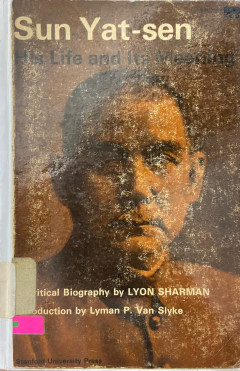
Sun Yat-sen : His life and its meaning
Sun Yat-sen: His Life and Its Meaning is a political biography written by Lyon Sharman that examines the life, ideas, and historical significance of Sun Yat-sen, the founding father of modern China. The book explores Sun Yat-sen’s revolutionary activities, political thought, and leadership in the movement that led to the overthrow of the Qing dynasty and the establishment of the Republic of C…
- Edisi
- -
- ISBN/ISSN
- -
- Deskripsi Fisik
- 420 pages; 24 cm
- Judul Seri
- -
- No. Panggil
- 951.092 SHA s

Long walk to freedom: The autobiography of Nelson Mandela
This book is the autobiography of Nelson Mandela, the first black former President of South Africa and also the first president elected through a general election. Written by the character himself, this book contains memories and experiences full of drama that shaped Nelson Mandela's personality.
- Edisi
- -
- ISBN/ISSN
- 0-316-87496-5
- Deskripsi Fisik
- ix, 630 pages : index ; 24 cm
- Judul Seri
- -
- No. Panggil
- 920 MAN l

Deng Xiao Ping and the making of modern China
This comprehensive biography of Deng Xiaoping, written by Richard Evans, a longtime Western diplomat and researcher in China, traces Deng Xiaoping's life from his youth, involvement in the revolution, his role in the Chinese Communist Party, and his role as a key architect of China's economic modernization. With a thorough and historically researched writing style, this book depicts how Deng sh…
- Edisi
- -
- ISBN/ISSN
- 978-7-5125-0483-7
- Deskripsi Fisik
- 388 pages : illustrations ; 24 cm
- Judul Seri
- -
- No. Panggil
- 951.056092 EVA d
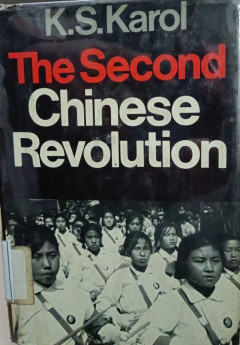
The Second Chinese revolution
The Second Chinese Revolution examines China’s political, social, and economic transformation in the years after 1949. The book describes how the country attempted to reshape its agricultural and industrial sectors, reorganize society under socialist principles, and navigate internal debates over ideology and policy. It also discusses the shifting dynamics within the Chinese Communist Party, …
- Edisi
- -
- ISBN/ISSN
- 0-8090-8516-X
- Deskripsi Fisik
- 472 pages : 20 cm
- Judul Seri
- -
- No. Panggil
- 320.95105 KAR s

Le Sahel au XXIe siècle : un essai de réflexion prospective sur les sociét…
This book provides a prospective and analytical reflection on the social, economic, and political transformations of Sahelian societies in the twenty-first century. Jacques Giri examines the historical background, structural challenges, and future trajectories of the Sahel region, focusing on issues such as environmental vulnerability, demographic growth, governance, and development policies. B…
- Edisi
- -
- ISBN/ISSN
- -
- Deskripsi Fisik
- 342 pages ; 21 cm
- Judul Seri
- -
- No. Panggil
- 963.5 GIR l
 Karya Umum
  Filsafat
  Agama
Agama  Ilmu-ilmu Sosial
  Bahasa
  Ilmu-ilmu Murni
  Ilmu-ilmu Terapan
  Kesenian, Hiburan, dan Olahraga
  Kesusastraan
  Geografi dan Sejarah