Ditapis dengan

Weltgeschichte der neuzeit
This volume offers a comprehensive overview of modern world history, presenting key political, social, cultural, and economic developments from the early modern period to the present. Compiled by the editorial team of F. A. Brockhaus in collaboration with leading scholars, the book provides clear, concise explanations of major historical events, influential figures, and global transformations. …
- Edisi
- -
- ISBN/ISSN
- 3-89331-606-X
- Deskripsi Fisik
- 511 pages : illustration ; 22 cm
- Judul Seri
- -
- No. Panggil
- 909.08 DAL w

Zero-Sum future: American power in an age of anxiety
Zero-Sum Future examines the shifting landscape of global power in the post–Cold War era, arguing that rising economic insecurity and geopolitical competition are pushing major nations toward zero-sum thinking. Gideon Rachman analyzes how globalization, financial instability, and the emergence of new world powers shape American influence in the 21st century. Through historical context and con…
- Edisi
- -
- ISBN/ISSN
- 978-1-4391-7661-0
- Deskripsi Fisik
- viii, 340 pages ; 24 cm
- Judul Seri
- -
- No. Panggil
- 973.93 RAC z

Global paradox: The Bigger the world economy, the more powerful its smallest …
Global Paradox explores one of John Naisbitt’s central ideas: as the global economy becomes increasingly interconnected and expansive, power paradoxically shifts toward smaller, more agile players—small nations, small companies, and even individuals. Naisbitt analyzes global economic trends, technological change, and the rise of the information society, arguing that decentralization and reg…
- Edisi
- -
- ISBN/ISSN
- 0-688-12791-6
- Deskripsi Fisik
- 304 pages ; 24 cm
- Judul Seri
- -
- No. Panggil
- 330.900112 NAI g

The Globalization gap: How the rich get richer and the poor get left further …
This book examines the widening gap created by globalization, where the wealthy continue to accumulate greater advantages while the poor fall further behind. Robert A. Isaak analyzes how global economic structures, trade policies, and multinational corporate strategies reinforce inequalities across nations. Through critical insights and case studies, the author argues that without significant p…
- Edisi
- -
- ISBN/ISSN
- 0-13-142896-9
- Deskripsi Fisik
- xxiii, 275 pages : illustration ; 23,5 cm
- Judul Seri
- -
- No. Panggil
- 303.482 ISA g

The Chinese dream: What it means for China and the rest of the world
This book explores the idea of the “Chinese Dream” and its significance for China and the wider world. The author (editor) examines how the Chinese Dream is understood as an ideal of national renaissance, prosperity, socio-political development, and China's global position. It also analyzes questions such as: is the Chinese Dream a vision of national renaissance or global domination? …
- Edisi
- -
- ISBN/ISSN
- 978-7-5104-4480-7
- Deskripsi Fisik
- 205 pages : illustrations ; 22,5 cm
- Judul Seri
- -
- No. Panggil
- 305.8 XIA c

The world is flat: A brief history of the globalized world in The 21st Century
Friedman brilliantly demystifies the exciting, often bewildering, global scene unfolding before our eyes, one which we sense but barely yet understand. With his inimitable ability to simplify complex political and economic issues, he explains how this flattening of the world happened; what it will mean for countries, communities and individuals; and how governments and societies can - and must …
- Edisi
- First Published
- ISBN/ISSN
- 0713998784
- Deskripsi Fisik
- 488 pages : 24 cm.
- Judul Seri
- -
- No. Panggil
- 330. 9051122 Fri w

Globalisation and the new realities: Selected speeches of DR Mahathir Mohamad…
In this book, Dr. Mahathir Mohamad provides an incisive critique of the main aspects of globalization and an explanation for this changing tide of opinion against the concept of globalization. Globalization, deregulation and liberalization in a borderless world must be handled with care as they are means to an end - not ends in themselves. Globalization must result in a better life for all. Tho…
- Edisi
- -
- ISBN/ISSN
- 967-978-818-0
- Deskripsi Fisik
- 236 pages : index ; 22 cm
- Judul Seri
- -
- No. Panggil
- 303.482 Moh g

The choice: Global domination or global leadership
The foreign policy expert offers an assessment of recent American foreign policy, arguing for a more sophisticated posture in the world that positions America as a supporter of reform and justice in the world.
- Edisi
- -
- ISBN/ISSN
- 0-465-00800-3
- Deskripsi Fisik
- xi, 242 pages : index ; 22 cm
- Judul Seri
- -
- No. Panggil
- 327.73 Brz c

Recreating Asia: Visions for a new century
The World Economic Forum is an independent, international organization committed to improving the state of the world. The Forum provides a collaborative framework for the world's leaders to address global issues, engaging particularly its corporate members in global citizenship. Drawing on its unparalleled Asian network, this book offers a fascinating insight into how the region is managing …
- Edisi
- -
- ISBN/ISSN
- 0-470-82085-3
- Deskripsi Fisik
- xxxi, 313 pages : illustration : index ; 24 cm
- Judul Seri
- -
- No. Panggil
- 330.959 Ric r
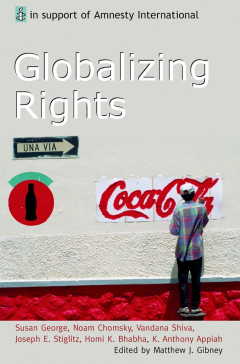
Globalizing Rights
This book, based on the prestigious Oxford Amnesty Lecture series, investigates the relationship between globalization and human rights. Provocative essays challenge the view that the development of global markets and global investment, together with the widespread circulation of information on which this depends, make human rights abuses less likely.
- Edisi
- First Published
- ISBN/ISSN
- 0-19-280305-0
- Deskripsi Fisik
- ix, 271 pages : index ; 20 cm
- Judul Seri
- -
- No. Panggil
- 330.9 Gib g
 Karya Umum
  Filsafat
  Agama
Agama  Ilmu-ilmu Sosial
  Bahasa
  Ilmu-ilmu Murni
  Ilmu-ilmu Terapan
  Kesenian, Hiburan, dan Olahraga
  Kesusastraan
  Geografi dan Sejarah