Ditapis dengan
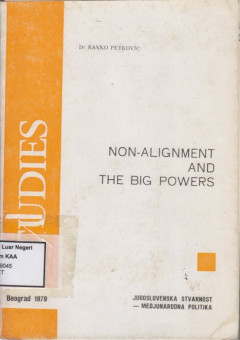
Non-Alignment and the big powers
Non-Alignment and the Big Powers analyzes the development, principles, and political significance of the Non-Aligned Movement in the context of global power rivalry. Dr. Ranko Petkovic examines how non-aligned countries attempted to assert independence from the dominant blocs during the Cold War while promoting peace, sovereign equality, and collective cooperation. The book also explores the re…
- Edisi
- -
- ISBN/ISSN
- -
- Deskripsi Fisik
- 46 pages ; 20 cm
- Judul Seri
- -
- No. Panggil
- 327.17 PET n
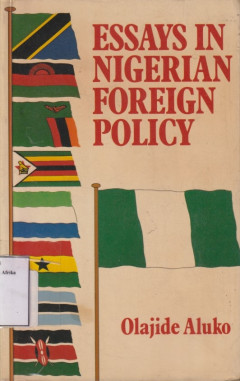
Essays on Nigerian foreign policy
Essays on Nigerian Foreign Policy by Olajide Aluko is a collection of scholarly analyses examining the development, direction, and challenges of Nigeria’s foreign policy. Written by one of Nigeria’s leading experts in international relations, the essays explore Nigeria’s diplomatic posture within Africa and the global arena, its relations with major powers, and the impact of domestic poli…
- Edisi
- -
- ISBN/ISSN
- -
- Deskripsi Fisik
- 288 pages ; 21,5 cm
- Judul Seri
- -
- No. Panggil
- 327.669 ALU e

Non-Aligned Movement under India’s chairmanship
Published by the Indian Institute for Non-Aligned Studies, the book Non-Aligned Movement Under India’s Chairmanship examines India’s role during its leadership of the Non-Aligned Movement (NAM). First published in November 1986, the book provides an overview of India’s diplomatic activities, work programs, and political positions in guiding the movement’s direction in the mid-1980s. It …
- Edisi
- -
- ISBN/ISSN
- -
- Deskripsi Fisik
- 47 pages; 22 cm
- Judul Seri
- -
- No. Panggil
- 327.172 IND n

Brazilian foreign policy in changing times; The Quest for autonomy from sarne…
This book examines the dynamics of Brazilian foreign policy from the administrations of José Sarney to Luiz Inácio Lula da Silva. Vigevani and Cepaluni emphasize how Brazil sought to increase its autonomy within the international system, particularly in its relations with the United States and other countries. Through political and international relations analysis, the book highlights the shi…
- Edisi
- -
- ISBN/ISSN
- 978-0-7391-2881-7
- Deskripsi Fisik
- xx, 169 pages ; 23,5 cm
- Judul Seri
- -
- No. Panggil
- 327.81 VIG b

Konfrontasi Revisited: Indonesia's foreign policy under Soekarno
This book re-examines Indonesia’s foreign policy during the presidency of Soekarno, with particular emphasis on the period of political confrontation and its international context. It analyzes the ideological, political, and strategic factors that shaped Indonesia’s foreign policy orientation, including its relations with Western countries, the Eastern Bloc, and the emerging nations of the …
- Edisi
- -
- ISBN/ISSN
- 979-8026-52-7
- Deskripsi Fisik
- xiv, 226 pages ; 25 cm
- Judul Seri
- -
- No. Panggil
- 327.598 DJI k
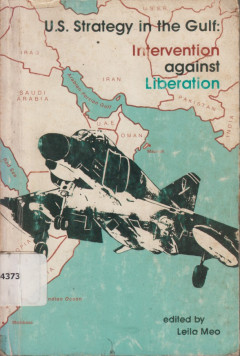
U.S. Strategy in the gulf: Intervention against liberation
bstract: This monograph analyzes United States strategic policies and military involvement in the Persian Gulf region during the period of regional upheaval. Edited by Leila Meo, the book examines the political motivations, geopolitical interests, and interventionist actions taken by the United States, particularly in relation to liberation movements and regional conflicts. It provides critic…
- Edisi
- -
- ISBN/ISSN
- 0-937694-50-9
- Deskripsi Fisik
- ii, 130 pages : illustrations ; 22,5 cm
- Judul Seri
- -
- No. Panggil
- 355.0335 MEO u
A Strategy of peace in a changing world
In this influential work, Arthur N. Holcombe examines the challenges of creating and sustaining peace in a rapidly changing international environment. He discusses the political, economic, and strategic forces shaping world affairs during the mid-twentieth century and explores the role of the United States in promoting global stability. Holcombe analyzes the requirements of an effective peace s…
- Edisi
- -
- ISBN/ISSN
- -
- Deskripsi Fisik
- 332 pages ; 21,5 cm
- Judul Seri
- -
- No. Panggil
- 327.172 HOL s

Soviet foreign policy since world war II
This second edition of Soviet Foreign Policy Since World War II provides a comprehensive analysis of the Soviet Union's foreign policy from the end of World War II to the early 1980s. Joseph L. Nogee and Robert H. Donaldson discuss the dynamics of ideology, strategic interests, international relations, and changes in Soviet leadership that influenced foreign policy. This book combines a framewo…
- Edisi
- Second edition
- ISBN/ISSN
- 0-08-030151-7
- Deskripsi Fisik
- vii, 351 pages ; 23 cm
- Judul Seri
- -
- No. Panggil
- 327.47 NOG s
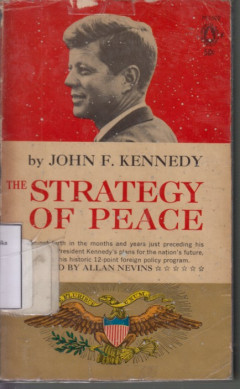
The Strategy of peace
“The Strategy of Peace” is a collection of speeches, statements, and policy essays by John F. Kennedy prior to his presidency, outlining his vision for American foreign policy in the Cold War era. The book emphasizes diplomatic leadership, nuclear responsibility, and the pursuit of global peace through international cooperation. Edited by historian Allan Nevins, the volume provides insight …
- Edisi
- -
- ISBN/ISSN
- -
- Deskripsi Fisik
- xxvi, 272 pages ; 17,5 cm
- Judul Seri
- -
- No. Panggil
- 327.73 KEN s
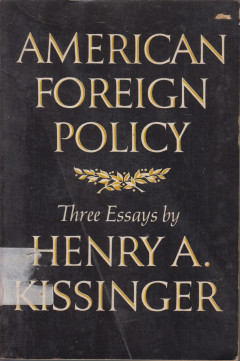
American foreign policy: Three essays
American Foreign Policy: Three Essays presents Henry A. Kissinger’s influential analyses of the strategic challenges confronting the United States during the Cold War era. In these essays, Kissinger examines the central issues of American foreign policy, the ideological and geopolitical forces shaping global power, and the need for a coherent national strategy. His reflections provide insight…
- Edisi
- -
- ISBN/ISSN
- 393-09853-2
- Deskripsi Fisik
- 143 pages ; 20,5 cm
- Judul Seri
- -
- No. Panggil
- 327.73 KIS a
 Karya Umum
  Filsafat
  Agama
Agama  Ilmu-ilmu Sosial
  Bahasa
  Ilmu-ilmu Murni
  Ilmu-ilmu Terapan
  Kesenian, Hiburan, dan Olahraga
  Kesusastraan
  Geografi dan Sejarah