Ditapis dengan

Fast-tracking Indonesia readiness for green jobs: Optimizing climate diplomacy
This study examines Indonesia’s efforts to promote a green economy and reduce emissions in line with its Enhanced Nationally Determined Contributions (NDC) and Indonesia Emas 2045 vision. It highlights the potential of green jobs to support sustainable development and ensure a just transition for workers. The study recommends integrating climate priorities into the Ministry of Foreign Affairs…
- Edisi
- -
- ISBN/ISSN
- -
- Deskripsi Fisik
- -
- Judul Seri
- -
- No. Panggil
- Sesparlu 74-2024

A new footing: formulating Indonesia's digital diplomacy strategy
This paper examines the formulation of Indonesia’s digital economic diplomacy strategy in response to the growing importance of the digital economy and the global transition towards an innovation-based economy. While Indonesia’s economic diplomacy concentrates on trade, tourism, investment, free trade negotiations, and business advocacy, considerable scope remains for a diplomatic approach …
- Edisi
- -
- ISBN/ISSN
- -
- Deskripsi Fisik
- -
- Judul Seri
- -
- No. Panggil
- Sesparlu 67-2021

Revamping Indonesia’s strategy in gaining Russian outbound tourists during …
This paper examines how Indonesia’s economic diplomacy can strengthen the competitiveness and global market share of its halal food industry. Despite being the world’s largest halal food consumer, Indonesia has yet to maximise its potential as a global producer and exporter. Using scenario planning, the paper analyses key market dynamics, major stakeholders, and challenges, focusing on two …
- Edisi
- -
- ISBN/ISSN
- -
- Deskripsi Fisik
- -
- Judul Seri
- -
- No. Panggil
- Sesparlu 68-2021

The strategic role of the Ministry of Foreign Affairs in strengthening Indone…
Indonesia’s digital games industry offers significant potential for economic growth and international influence, yet domestic revenue remains largely captured by foreign publishers despite the country’s substantial gaming market. This policy brief recommends strengthening the Ministry of Foreign Affairs’ role in creative economy diplomacy through a dedicated working group on international…
- Edisi
- -
- ISBN/ISSN
- -
- Deskripsi Fisik
- -
- Judul Seri
- -
- No. Panggil
- Sesparlu 79-2026

Scale up the role of the Ministry of Foreign Affairs of the Republic of Indon…
This paper examines scaling up the role of the Ministry of Foreign Affairs of the Republic of Indonesia in promoting the creative economy as a catalyst for national economic growth. The creative economy sector contributed IDR 1.105 trillion to Indonesia's GDP in 2018, with USD 20.5 billion in export value, employed 17 million workers, and supported SDGs implementation. Creative economy is one o…
- Edisi
- -
- ISBN/ISSN
- -
- Deskripsi Fisik
- -
- Judul Seri
- -
- No. Panggil
- Sesdilu 69-2021

Strengthening the strategic role of Mofa in advancing creative economy cooper…
Indonesia can strengthen ASEAN creative economy cooperation by improving cross-pillar coordination between the ASEAN Socio-Cultural and Economic Communities. Despite the growing importance of the creative economy, regional cooperation remains fragmented due to differing approaches and mandates among relevant institutions. The Ministry of Foreign Affairs can strengthen its strategic role by faci…
- Edisi
- -
- ISBN/ISSN
- -
- Deskripsi Fisik
- -
- Judul Seri
- -
- No. Panggil
- Sesdilu 77-2024

Southeast Asia and New Zealand: A History of regional and bilateral relations
This volume provides a comprehensive examination of the historical development of both regional and bilateral relations between Southeast Asia and New Zealand. Edited by Anthony L. Smith, the book explores political, strategic, and economic interactions that have shaped engagement between the two regions from early contact to the contemporary era. Through contributions from multiple scholars, i…
- Edisi
- -
- ISBN/ISSN
- 0-86473-519-7
- Deskripsi Fisik
- xiv, 392 pages ; 23 cm
- Judul Seri
- -
- No. Panggil
- 327.59 SMI s

Our Zimbabwe: An element of political economy
Our Zimbabwe: An Element of Political Economy offers an analytical overview of Zimbabwe’s economic and political structures in the years following independence. Arthur Jim Patsanza examines the nation’s development challenges, economic policies, and the relationship between political decision-making and economic outcomes. The book discusses issues such as state planning, resource distributi…
- Edisi
- -
- ISBN/ISSN
- 0-7974-0832-0
- Deskripsi Fisik
- 246 pages ; 21,5 cm
- Judul Seri
- -
- No. Panggil
- 338.9689 PAT o
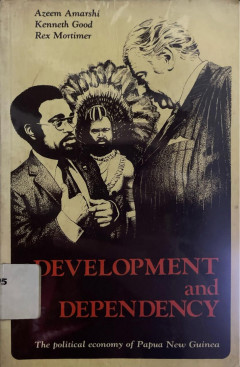
Development and Dependency
Development and Dependency examines the contrasting theories of economic development and dependency that have shaped global development discourse. The book analyzes how historical, political, and economic structures contribute to persistent inequalities between industrialized and developing nations. It explores concepts such as modernization, exploitation, peripheral economies, and the influenc…
- Edisi
- 1
- ISBN/ISSN
- 0 19 550582 4
- Deskripsi Fisik
- xviii, 261 pages : illustrations ; 21,5 cm
- Judul Seri
- -
- No. Panggil
- 330.9 AMA z

Iraq: The Eternal fire 1972 Iraqi oil nationalizaation in perspective
Iraq: The Eternal Fire – 1972 Iraqi Oil Nationalization in Perspective examines one of the most significant turning points in Iraq’s modern economic and political history: the nationalization of its oil industry in 1972. The book analyzes the circumstances that led to the decision, including international pressures, domestic political shifts, and Iraq’s growing assertion of sovereignty ov…
- Edisi
- 11
- ISBN/ISSN
- 0 86199 004 8
- Deskripsi Fisik
- 255 pages; 22,5 cm
- Judul Seri
- -
- No. Panggil
- 338.2 HUS i
 Karya Umum
 Filsafat
 Agama
 Ilmu-ilmu Sosial
 Bahasa
 Ilmu-ilmu Murni
 Ilmu-ilmu Terapan
 Kesenian, Hiburan, dan Olahraga
 Kesusastraan
 Geografi dan Sejarah