Ditapis dengan

Tito and non-alignment: President Tito's addresses at conferences of non-alig…
World stability has been discussed for years now as wholly dependent on a balance of power and fear, and bloc negotiation. At the same time, however, we have been witness to persisting instability, as the end result of precisely these presumptions. There is no particular need to point out that non-aligned policy has been the political force that has imparted positive elements of stability to an…
- Edisi
- -
- ISBN/ISSN
- -
- Deskripsi Fisik
- 119 pages ; 20 cm
- Judul Seri
- -
- No. Panggil
- 327.17 TIT t
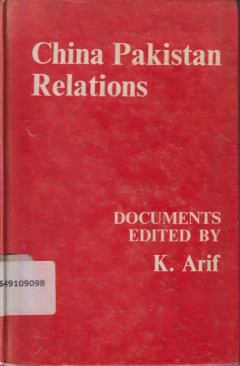
China Pakistan relations 1947–1980
This volume compiles key official documents, statements, agreements, and historical records that trace the evolution of China–Pakistan relations from 1947 to 1980. Edited by K. Arif, the book provides insight into diplomatic exchanges, political developments, security cooperation, and regional dynamics shaping the partnership between the two countries. It serves as an essential reference for …
- Edisi
- -
- ISBN/ISSN
- -
- Deskripsi Fisik
- xvii, 300 pages ; 22 cm
- Judul Seri
- -
- No. Panggil
- 327.549105 ARI c

Indonesië in de Veiligheidsraad van de Verenigde Naties (October–November …
This official document published by the Dutch Ministry of Foreign Affairs contains reports, minutes, statements, and diplomatic documents concerning discussions on Indonesia at the United Nations Security Council during October and November 1947. This publication describes the international political dynamics that arose as a result of the Indonesian-Dutch conflict in the early days of independe…
- Edisi
- -
- ISBN/ISSN
- -
- Deskripsi Fisik
- 200 pages ; 21,5 cm
- Judul Seri
- -
- No. Panggil
- 959.803 MIN i

India and the world through the eyes of Indians diplomats
If there is anything constant in the world, it is change, especially in today's globalised world. Thirty mandarins of the South Block look at the current changes in different parts of the world, try to connect them with developments of the recent past, analyse and dissect them with experience and understanding spanning decades and strive to foresee what's likely to happen and weigh how that co…
- Edisi
- -
- ISBN/ISSN
- 978-81-8328-3847
- Deskripsi Fisik
- xxiii, 459 pages ; 24 cm
- Judul Seri
- -
- No. Panggil
- 327.54 KUM i

U.S.-Japan relations and the security of East Asia: The Next decade
The strategic importance of the U.S.–Japan alliance and its implications for regional security in East Asia. Weinstein examines how political, economic, and military factors shape the partnership, focusing on issues such as defense cooperation, regional stability, and responses to emerging security challenges. The book evaluates the roles of major regional actors—China, Korea, Southeast Asi…
- Edisi
- -
- ISBN/ISSN
- 0-89158-053-9
- Deskripsi Fisik
- xii, 318 pages ; 22,5 cm
- Judul Seri
- -
- No. Panggil
- 327.73052 WEN u

Senghor et le monde : La politique internationale du Senegal
Senghor is today the most famous African in the world. He made Senegal a country whose diplomatic and cultural activity is present in all four corners of the globe. The author, Nicolas Martin, was particularly well placed to tackle such a subject: a former Technical Advisor to the Senegalese Ministry of Culture, he now teaches international relations at the Sorbonne. He met with the Senegales…
- Edisi
- -
- ISBN/ISSN
- 2-85809-108-00
- Deskripsi Fisik
- 176 pages ; 22 cm
- Judul Seri
- -
- No. Panggil
- 327.1763 MAR s

Japanese militarism and its war crimes in Asia Pacific region
The rise of militarism in Japan from the early 20th century and its impact on the Asia-Pacific region during periods of conflict. The book analyzes the political, social, and military factors that led to aggressive expansionism, highlighting specific war crimes committed by Japanese forces. Through historical documents, eyewitness accounts, and scholarly analysis, the work explores the conseque…
- Edisi
- -
- ISBN/ISSN
- 979-602-97209-1-4
- Deskripsi Fisik
- xvii, 216 pages : illustrations ; 21 cm
- Judul Seri
- -
- No. Panggil
- 355.52 HEN j

The Pebble in the shoe: The Diplomatic struggle for East Timor
The Pebble in the Shoe: The Diplomatic Struggle for East Timor presents former Indonesian Foreign Minister Ali Alatas’s detailed account of the diplomatic challenges surrounding the East Timor issue. Written from the perspective of a key negotiator, the book explores the complex historical, political, and international dimensions that shaped Indonesia’s policy and interactions with the Unit…
- Edisi
- -
- ISBN/ISSN
- 979-3851-09-0
- Deskripsi Fisik
- xx, 330 pages : Ilustration ; 23,5 cm
- Judul Seri
- -
- No. Panggil
- 959.85 ALI p

War and diplomacy in the Japanese empire
The development of Japan’s foreign policy and military strategy from the late nineteenth to the early twentieth century. Drawing on official documents and key political decisions, Takeuchi explains how Japan built its military power, expanded its influence in East Asia, and shaped diplomatic strategies closely tied to its imperial ambitions. The book highlights the interaction between the mil…
- Edisi
- -
- ISBN/ISSN
- -
- Deskripsi Fisik
- 503 pages ; 23,5 cm
- Judul Seri
- -
- No. Panggil
- 952 TAK w
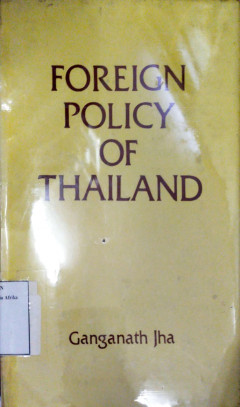
Foreign policy of Thailand
oreign Policy of Thailand provides a comprehensive examination of Thailand’s external relations from historical, political, and strategic perspectives. Ganganath Jha analyzes the evolution of Thai foreign policy within the shifting dynamics of Southeast Asia and the broader international system. The book explores Thailand’s efforts to maintain sovereignty, navigate great-power rivalries, an…
- Edisi
- -
- ISBN/ISSN
- -
- Deskripsi Fisik
- xii, 195 pages ; 22 cm
- Judul Seri
- -
- No. Panggil
- 327.593 JHA f
 Karya Umum
  Filsafat
  Agama
Agama  Ilmu-ilmu Sosial
  Bahasa
  Ilmu-ilmu Murni
  Ilmu-ilmu Terapan
  Kesenian, Hiburan, dan Olahraga
  Kesusastraan
  Geografi dan Sejarah